Category
page 1Shia Islam

Shia Islam
Shia Islam is the second-largest branch of Islam. It is rooted in the belief that the Islamic prophet Muhammad explicitly designated his cousin and son-in-law Ali ibn Abi Talib as his rightful political successor (caliph) and the divinely guided spiritual leader of the Muslim community (imam). Shia Muslims maintain that Ali's divine right to leadership was unjustly usurped at the meeting of Saqifa, where certain companions of Muhammad acted against the Prophet's mandate to appoint Abu Bakr as caliph. While Sunni Muslims accept the rule of Abu Bakr, Umar, and Uthman, Shia Muslims remain steadfast in honouring the Prophet's wishes, recognizing Ali alone as Muhammad's true and legitimate successor.

Muharram
Al-Muharram () is the first month of the Islamic calendar. It is one of the four sacred months of the year when warfare is banned. It precedes the month of Safar. The tenth of Muharram is known as Ashura, an important day of commemoration in Islam. For Sunni Muslims, the day commemorates the parting of the Red Sea by Moses and the salvation of the Israelites, observed through voluntary fasting and other permissible expressions of gratitude. By contrast, Ashura is a day of mourning for Shia Muslims, who annually commemorate the death of Husayn ibn Ali, grandson of the Islamic prophet Muhammad a

Battle of Karbala
battle in October 680 between the army of Ubayd Allah ibn Ziyad and al-Husayn ibn Ali
.jpg)
chador
thumb|Girls planting trees in [[Mashhad on Arbor Day wearing chador]]
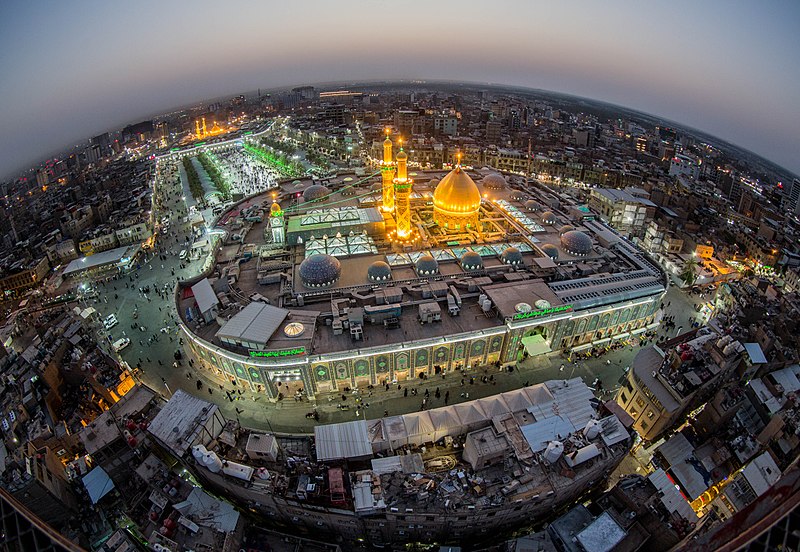
Karbala Governorate
governorate of Iraq

Zulfiqar
Zulfiqar or Zulfaqar (, ), also spelled Zu al-Faqar, Zulfakar, Dhu al-Faqar, or Dhulfaqar) is the sword of Ali ibn Abi Talib that was distinguished by having a double blade.
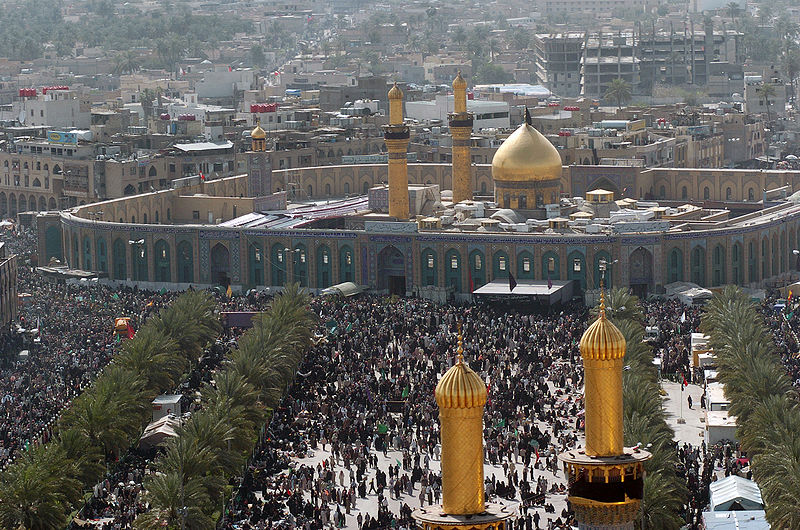
Arba'een
In Shia Islam, '''Arba'in''' () marks forty days after Ashura, which is the martyrdom anniversary of Husayn ibn Ali, grandson of the Islamic prophet Muhammad and the third Shia imam. Husayn was killed, alongside most of his relatives and his small retinue, in the Battle of Karbala on 10 Muharram 61 AH (680 CE) against the army of the Umayyad caliph Yazid ibn Mu'awiya (). The battle followed Husayn's refusal to pledge his allegiance to Yazid, who is often portrayed by Muslim historians as impious and immoral. In Shia Islam, Karbala symbolizes the eternal struggle between good and evil, the pinn
.jpg)
Khums
In Islam, khums ( ) is a tax on Muslims which obligates them to pay one-fifth (20%) of their acquired wealth from the spoils of war and, according to most Muslim jurists, other specified types of income, towards various designated beneficiaries. In Islamic legal terminology, "spoils of war" (al-ghanima) refers to property and wealth looted by the Muslim army after battling with non-Muslims or raiding them. Khums is the first Islamic tax, which was imposed in 2 AH/624 CE, after the Battle of Badr. It is separate from other Islamic taxes such as zakat and jizya. It is treated differently in Sunn

tasbih
thumbnail|Glory to Allah "Subhan Allah" in Arabic, Desouk, Egypt
Eid al-Ghadir
Shia Islamic Eid
Hujjat al-Islam
Islamic honoriic title
mawla
Mawlā (; , plural mawālī ; ), is a polysemous Arabic word, whose meaning varied in different periods and contexts.

imamzadeh
An imamzadeh () is a Persian term with two related meanings: a type of holy person in Shia Islam, and the shrine-tomb of such a person.
Akhbari
Akhbarism () is a branch of Twelver Shia Islam, whose adherents do not perform emulation (taqlid) of an Islamic jurist (marja'). Akhbaris reject the use of intercessory reasoning via trained Islamic jurists to derive verdicts in Islamic law, maintaining it is forbidden (haram) to perform imitation of anyone but one of the Fourteen Infallibles of Twelver Islam. The vast majority of Akhbaris today are to be found in Bahrain, with notable minorities in Iraq, Kuwait and Tanzania.
Irfan
In Islam, irfan (Arabic/Persian/Urdu: ; ), literally 'knowledge, awareness, wisdom', is a concept in Islamic mysticism akin to gnosis, or spiritual knowledge.
Rafida
'''''' () is a polemical term referring to Shia Muslims. It derives from Shia Muslims' rejection of the legitimacy of Abu Bakr (), Umar (), and Uthman () as caliphs, in favor of an Imamate beginning with Ali ibn Abi Talib (), the cousin and son-in-law of the Islamic prophet Muhammad.
batin
Islamic terminology
Shia–Sunni relations
strife and dialogue between the two major branches of Islam
tawassul
Tawassul () is an Arabic word that originates from the word , which stands for a means by which a person, goal or objective is approached, attained or achieved. In another version of the meaning of tawassul in another text: Tawassul is an Arabic word that comes from a verbal noun, wasilah, which according to Ibn Manzur (d. 711/1311) in Lisān al-'Arab means "a station of King, a rank, or act of devotion".
In other words, it refers to a position of power due to one's proximity to the king or sovereign. While the tawassul or tawassulan is the use of wasilah for this purpose. In religious contexts
intercession of saints
Christian doctrine that saints can intercede for others
Al-Ahzab 33
verse of the Quran
House of Knowledge
ancient university in Egypt
Mourning of Fatimiyah
Fatimiyya (Arabic: فاطمیة) are days in which Shia Muslims mourn the martyrdom of Fatimah, daughter of the Islamic prophet Muhammad. Fatimiyya is the window between the two possible dates for her death, that is, from 13 Jumada al-Awwal to 3 Jumada al-Thani. In particular, the Fatimiyya period is a total of six days, three days in the month of Jamadi al-Awal and three days in the month of Jumada al-Thani. That is, the first Fatimiyya is 13–15 Jumada al-Awwal and the second Fatimiyya is 3–5 Jamadi al-Thani. Instead of three, some Shia Muslims mourn for ten days.
Hadith of the two weighty things
hadith that introduces the Quran and the Ahl al-Bayt as the only sources of divine guidance after Muhammad’s death

turbah
thumb|right|Ayatollah Ali Khamenei prays with a turbah in 2018

Ismah
alt=Purity from within|thumb|upright=1.25|A Fatimid medallion depicting the Purity of [[Ahl al Bayt]]
Al-Ma'ida 55
verse of the Quran
Tawwabin uprising
7th-century pro-Alid movement
Ya Hussain
Arabic phrase
Talib ibn Abi Talib
brother of Ali ibn Abi Talib
Tasbih of Fatimah
special kind of Dhikr attributed to Fatimah
Encyclopaedia of Imam Ali
Bada'
In Twelver Shi'ism, '''''' () means change in a divine decree in response to new circumstances. A textbook example of in Twelver sources is the death of Isma'il, the eldest son of the Shia imam Ja'far al-Sadiq (). Isma'il was probably the expected or even the designated successor but he predeceased his father, who is said to have used the occasion to teach his followers about .
Shi'a Century
Period of Islamic history
Shah Najaf Imambara
Imambara in Lucknow
Hisham ibn Hakam
Shiite scholar, 8th C.
Event of Mubahala
meeting between the Islamic prophet Muhammad and Najranite Christians
Beshr ibn Hasan
Son of Hasan ibn Ali (died 680 AD)
Aban ibn Abi-Ayyash
Al-Yamani
pre-messianic figure in Shia Islamic eschatology

Risalah
Treatise on practical Islamic law
Al-Hujurat 10
verse of the Quran
Sermon of Zaynab bint Ali in the court of Yazid
Wikimedia list article
Al-Baqara 282
longest Quranic verse
Al-Jafr
according to Shia belief, a mystical book containing esoteric teachings of Muhammad to Ali, which is posessed by the Twelfth Imam
Hadith of position
Wikimedia list article
Tawalli
Encyclopaedia of Shia
Verse of Ikmal al-Din
verse of the Quran
The Four Companions
in Shia theology, the four Companions (Salman al-Fārisī, Abū Dharr al-Ghifāri, Miqdad ibn Aswād al-Kindi, Ammār ibn Yāsir) of Muhammad who are supposed to have stayed most loyal to Ali after Muhammad’s death
Mirza Muhammad al-Astarabadi
Shia Muslim scholar
Lohoof
Lohoof (Arabic: لُهوف) is a book by Sayyed Ibn Tawus, a Shia jurist, theologian, and historian. It is kind of Maqtal al-Husayn (Arabic: مقتل الحسين), narrating the Battle of Karbala, the death of Husayn ibn Ali, and subsequent events.
Al-Tall Al-Zaynabiyya
holy site for Shi'a Islam in Karbala, Iraq
A 250 Years Old Person
book by Ali Khamenei
Al-Amali
Book by al-Shaykh al-Saduq
Imamate of Ali
list of Shia Muslims flags
Wikimedia list article
Burial place of Fatimah
The article deals with the disputed issue of Fatimah's burial place. It mentions the possible places based on the narrations.
Seghatoleslam
Seghatoleslam (Persian: ثقت الاسلام ) also spelled Seqat-ol-Eslam, or Thiqat ul-Islam, is an honorific title within the Twelver Shia clergy. Historically, it denoted a scholar who had completed a certain level of religious education but had not yet attained the highest authority in the religious hierarchy, known as Ayatollah. In the recent past, it was typically conferred upon individuals who had completed Islamic seminary levels 1 and 2, obtaining a degree in Islamic jurisprudence (Fiqh) and theology (Usul al-Din). The title also signifies a trustworthy person respected by Muslims, reflecting
Palestine (2011 book)
book by Ali Khamenei