Category
page 1Sixth-generation video game consoles

PlayStation 2
Sony's second home video game console, part of the sixth generation of consoles

Xbox
video game console by Microsoft

Nintendo GameCube
The is a home video game console developed and marketed by Nintendo. It was released in Japan on September 14, 2001, in North America on November 18, 2001, and in Europe on May 3, 2002. It is Nintendo's fourth major home console, succeeding the Nintendo 64, and competed with Sony's PlayStation 2, Sega’s Dreamcast, and Microsoft's Xbox in the sixth generation of game consoles.

Dreamcast
thumb|130px|Alternative Dreamcast logo used in PAL territories

Game Boy Advance
handheld game console by Nintendo
Game Boy Advance SP
handheld video game console

N-Gage
The N-Gage is a mobile device combining features of a cellular phone and a handheld game system developed by Nokia, released on 7 October 2003. Officially nicknamed the game deck, the N-Gage's phone works on the GSM cellular network, and software-wise runs on the Series 60 platform on top of Symbian OS v6.1.
Game Boy Micro
handheld game console by Nintendo

WonderSwan
The is a handheld game console released in Japan by Bandai. Developed in collaboration with Gunpei Yokoi's company Koto Laboratory, it was the final piece of hardware Yokoi worked on before his death in 1997. Launched in Japan in March 1999 during the sixth generation of video game consoles, the WonderSwan was followed by two upgraded models, the WonderSwan Color and SwanCrystal, before Bandai discontinued the line in 2003. Throughout its lifespan, no version of the WonderSwan was officially released outside Japan.
Pokémon Mini
handheld game console
sixth generation of video game consoles
video game console generation
Neo Geo Pocket Color
handheld console
Sega Pico
video game console
PSX
Sony digital video recorder with a fully integrated PlayStation 2 video game console

GP32
The GP32 (GamePark 32) is a ARM-based handheld game console developed by the South Korean company Game Park. It was released on November 23, 2001, in South Korea and distributed in some parts of Europe.
Tapwave Zodiac
mobile entertainment console released in 2003

VMU
The Visual Memory Unit (VMU), also referred to as the (VMS) in Japan, is the primary memory card produced by Sega for the Dreamcast home video game console. The device features a monochrome liquid crystal display (LCD), multiplayer gaming capability (via connectors at the top), second screen functionality, a real-time clock, file manager, built-in flash memory, and sound capability. Prior to the launch of the Dreamcast, a special Godzilla edition VMU, preloaded with a virtual pet game, was released on July 30, 1998, in Japan.

V.Smile
The V.Smile (stylized as V.SMILE TV Learning System) is a sixth-generation educational home video game console manufactured and released by VTech. The system was first released on August 4, 2004. Its titles are available on ROM cartridges called "Smartridges", a pun on the system's educational nature. Several variants of the V.Smile console are sold, including handheld versions and models with added functionality such as touch tablet integrated controllers or microphones. The V.Motion is a variant that includes motion-sensitive controllers and has titles designed to take advantage of motion-re
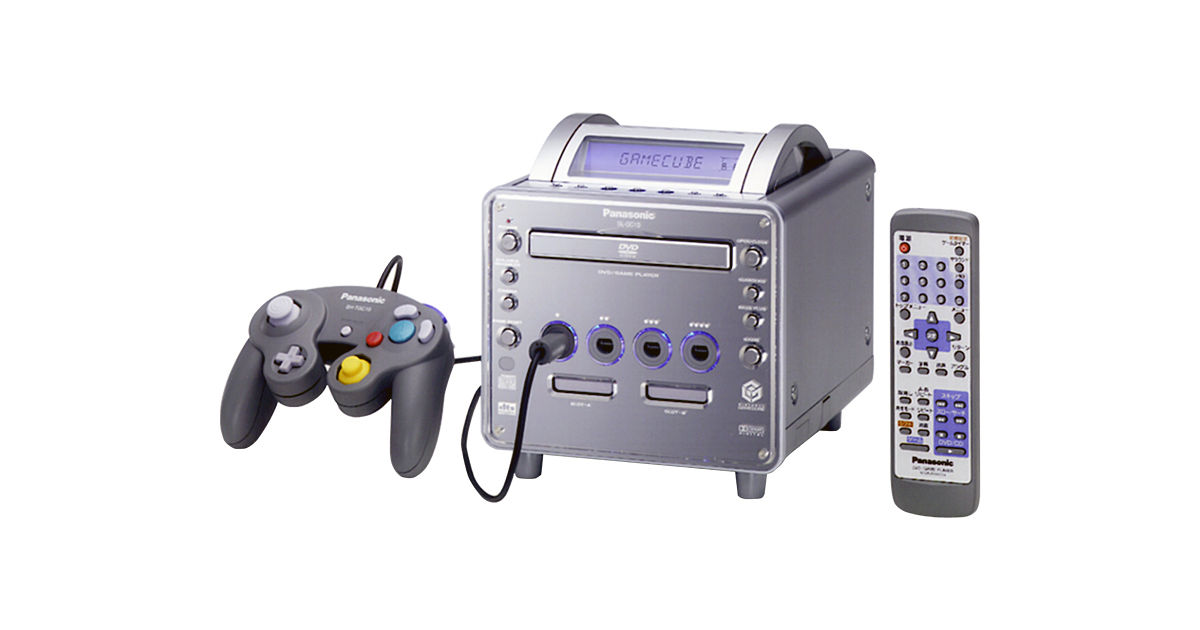
Panasonic Q
hybrid video game console between a GameCube and a DVD player, manufactured by Nintendo and Panasonic
Nuon
video game console

XaviXPort consoles
The XaviXPORT, sold as the Domyos Interactive System in Europe in Decathlon stores, is a fitness-based home video game console developed by Japanese company SSD Company Limited and released in the United States in 2004 during the sixth generation of video game consoles. The console uses cartridges and wireless controllers. The controllers are shaped like sports equipment (such as baseball bats or tennis rackets), with users' actions represented on the television screen through the use of sensors in the controllers.
GameKing
GameKing is a brand of handheld game consoles, designed and developed by Timetop and manufactured by Guangzhou Panyu Gaoming Electronics Co., Ltd., (also known as GZ Daidaixing Electronics Tech Co., Ltd.) in 2003, for the Hong Kong consumer market. The brand has three consoles, the GameKing I, the GameKing II and the GameKing III. A fourth console, the Handy Game, was produced by Timetop and shares some branding, but otherwise has little to do with the GameKing franchise.
Panasonic M2
video game console model
Cybiko
The Cybiko is a line of personal digital assistants and handheld game consoles first released by Cybiko Inc. in 2000. Cybiko Inc. was a startup company founded by David Yang; the eponymous PDA was first test marketed in New York in April 2000 and rolled out nationwide in May 2000. It was designed for teens, featuring its own two-way radio text messaging system. It has over 430 "official" freeware games and applications. It features a rubber QWERTY keyboard. An MP3 player add-on with a SmartMedia card slot was made for the unit as well. Cybikos can communicate with each other up to a maximum ra
Phantom Entertainment
company
Leapster
The Leapster Learning Game System, formerly known as the Leapster Multimedia Learning System, is an educational handheld game console manufactured and sold by LeapFrog Enterprises, aimed at children ages 4 to 10 (preschool to fifth grade). Its games teach the alphabet, phonics, basic math (addition, subtraction, multiplication, division), and art and animal facts to players. Along with a directional pad, the system features a touchscreen with a stylus pen that enables young users to interact directly with the screen.
ApeXtreme
ApeXtreme is a cancelled video game console that was developed by Apex Digital. While the console made a promising first appearance at the Consumer Electronics Show in January 2004, it had been cancelled by December of that year. The console was initially based on VIA's Glory Personal Gaming Console Platform (although Apex Digital later switched to an AMD CPU and NVIDIA GPU platform), and would have included a keyboard, mouse, game controller, 3.5 inch floppy disk reader, and a remote control.