Category
page 1Sol Invictus

Helios
In ancient Greek religion and mythology, Helios (; ; Homeric Greek: ) is the god who personifies the Sun. His name is also Latinized as Helius, and he is often given the epithets Hyperion ("the one above") and Phaethon ("the shining"). Helios is often depicted in art with a radiant crown and driving a horse-drawn chariot through the sky. He was a guardian of oaths and also the god of sight. Though Helios was a relatively minor deity in Classical Greece, his worship grew more prominent in late antiquity thanks to his identification with several major solar divinities of the Roman period, partic

Sol Invictus
Solar deity of the later Roman Empire
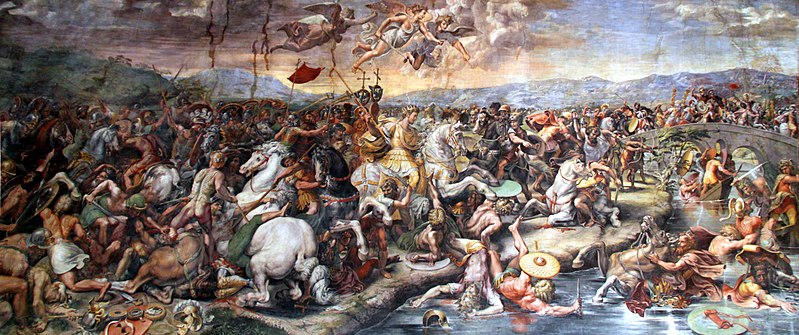
Battle of the Milvian Bridge
4th-century battle for control of Rome

labarum
thumb|The Labarum of Constantine I, reconstructed from the depiction on a follis minted . The three dots represent "medallions" which are said to have shown portraits of Constantine and his sons.
The labarum ( or λάβουρον) was a vexillum (military standard) that displayed the "Chi-Rho" symbol ☧, a christogram formed from the first two Greek letters of the word "Christ" (, or Χριστός) – Chi (χ) and Rho (ρ). It was first used by the Roman emperor Constantine the Great.
Colossus of Nero
Bronze sculpture
Sol
Roman god of the Sun
Elagabalus
Syro-Roman sun god

Malakbel
thumb|right|1st century AD relief from Palmyra depicting, from left to right, Aglibol, [[Baalshamin, and Malakbel]]
Malakbel (Palmyrene Aramaic 𐡬𐡫𐡪𐡡𐡫 ) was a sun god worshipped in the ancient Syrian city of Palmyra, frequently associated and worshipped with the moon god Aglibol as a party of a trinity involving the sky god Baalshamin.
radiant crown
radiate crown

Lucius Caesonius Ovinius Manilius Rufinianus Bassus
consul of the Roman Empire
sun
heraldic figure
Temple of the Sun
Roman temple in the Campus Agrippae dedicated in C.E.274
radiate
Roman coin type