Category
page 1Solar System dynamic theories

formation and evolution of the Solar System
overview of formation and evolution of the Solar System

planetesimal
thumb|300px|right|Debris disks detected in HST archival images of young stars, HD 141943 and HD 191089, using improved imaging processes (24 April 2014).
thumb|486958 Arrokoth, the first pristine planetesimal visited by a spacecraft.

accretion
astrophysical process in which matter gravitationally collects into a massive object

Nemesis
hypothetical star orbiting the Sun, responsible of extinction events
Vulcan
hypothetical planet between the Sun and Mercury

Late Heavy Bombardment
hypothesized event, occurring ca. 4.1–3.8 billion years ago, during which a large number of asteroids collided with the Moon, Mercury, Venus, Earth, and Mars
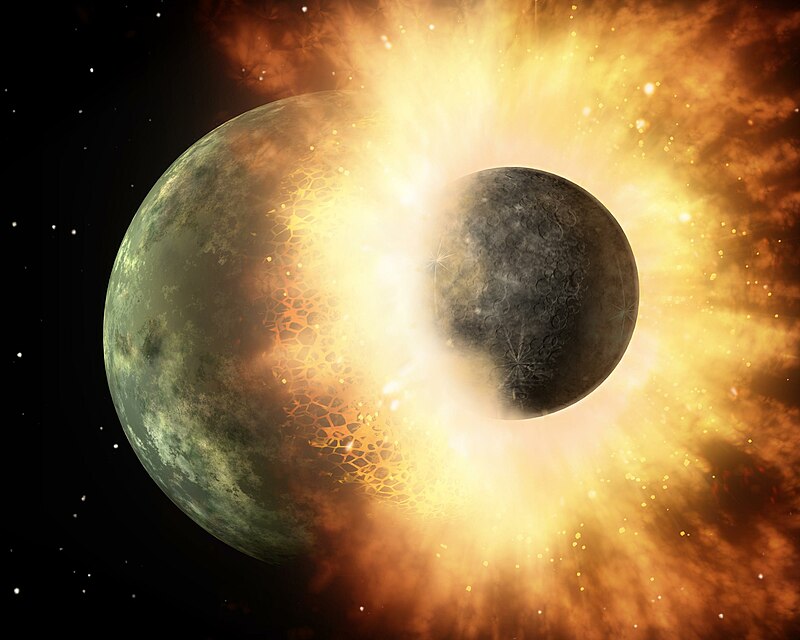
giant impact hypothesis
theory that the Moon formed out of the debris left over from a collision between Earth and an astronomical body the size of Mars, approximately 4.5 billion years ago
Tyche
Öpik–Oort Comet Cloud hypothetical planet
planet beyond Neptune
any Solar System planet that might orbit the Sun beyond Neptune
planetary migration
astronomical phenomenon when a planet or other stellar satellite interacts with a disk of gas or planetesimals, resulting in the alteration of the satellite's orbital parameters, especially its semi-major axis
Nice model
astrophysical model of planetary migration in the Solar System
grand tack hypothesis
in the early days of the Solar System, Jupiter moved inward then reversed course ("tacked") to its current orbit
Planet V
scientific proposal in 2002 for a destroyed fifth planet
Ca-Al-rich inclusion
history of Solar System formation and evolution hypotheses
aspect of history
five-planet Nice model
numerical model of the early Solar System
jumping-Jupiter scenario
a scenario of the giant planet migration