Category
page 1Solomon

Solomon
Solomon (), also called Jedidiah, was a king of the Kingdom of Israel and Judah, according to the Hebrew Bible. The successor of his father David, he is described as the penultimate ruler of all Twelve Tribes of Israel under a united Israel and Judah. His reign is hypothesized to have lasted from . According to the biblical narrative, his reign brought commercial prosperity through alliances and trade, but his accumulation of wealth, horses, and foreign wives, many of whom introduced idolatry, led to divine punishment. After Solomon's death, his son Rehoboam’s harsh policies led the northern I

Al-Anbiya
thumb|Folio from Samarkand Kufic Quran with surah Al-Anbiya. Late 8th–early 9th century. [[Metropolitan Museum of Art]]

Kingdom of Israel
possible Israelite kingdom of Israel and Judah (c. 1047–930 BCE)

Takht-e Soleyman
archaeological site in West Azarbaijan, Iranian national heritage site
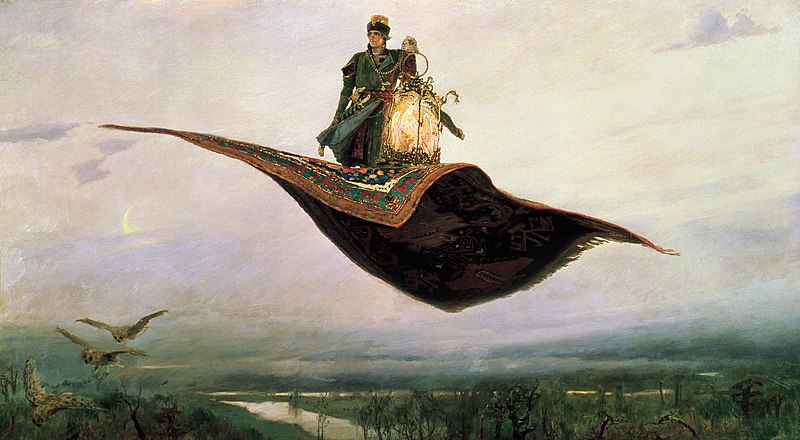
magic carpet
legendary carpet used for transportation

Jeroboam I
Jeroboam I (; Hebrew: Yārŏḇʿām; ), frequently cited Jeroboam son of Nebat, was, according to the Hebrew Bible, the first king of the northern Kingdom of Israel following a revolt of the ten tribes against Rehoboam that put an end to the United Monarchy. According to the book of 1 Kings, he reigned for 22 years and "there was war continually between Rehoboam and Jeroboam". Jeroboam also fought Abijam son of Rehoboam king of Judah. Jeroboam is often described as "doing evil in the sight of the Lord"
Captain Marvel
fictional character in DC Comics
Adonijah
According to 2 Samuel, Adonijah (, ’Ǎḏōnīyyā; "my lord is Yah") was the fourth son of King David. His mother was Haggith as recorded in the book of . Adonijah was born at Hebron during the long conflict between David and the House of Saul. In 1 Kings, he briefly proclaimed himself king of Israel during the terminal illness of his father David, before peacefully ceding the throne to his brother Solomon.
Solomon in Islam
prophet, king and son of David in Islam
Ahijah the Shilonite
biblical prophet in the Old Testament (First Book of Kings)

Tarshish
Tarshish (; ; ) occurs in the Hebrew Bible with several uncertain meanings, most frequently as a place (probably a large city or region) far across the sea from Phoenicia and the Land of Israel. Tarshish was said to have exported vast quantities of important metals to Phoenicia and Israel. The same place name occurs in the Akkadian inscriptions of the Neo-Assyrian emperor Esarhaddon (died 669 BC) and also on the Phoenician inscription of the Nora Stone (around 800 BCE) in Sardinia; its precise location was never commonly known, and was eventually lost in antiquity. Legends grew up around

Joab
thumb|right|Death of Absalom, 1860 woodcut by Julius Schnorr von Carolsfeld. Joab is depicted directly to the left of Absalom.
Joab (; ), the son of Zeruiah, was the nephew of King David and the commander of his army according to the Hebrew Bible.

Key of Solomon
pseudepigraphical grimoire (book of spells)

Ophir
Ophir (; ) is a port or region mentioned in the Bible, famous for its wealth. Its existence is attested to by an inscribed pottery shard found at Tell Qasile (in modern-day Tel Aviv) in 1946, dating to the eighth century BC, which reads "gold of Ophir to/for Beth-Horon [...] 30 shekels". The location of Ophir is unknown, though the find confirms it as a real place which exported gold.
Judgment of Solomon
bible story and art theme
Los goetia
anonymous spellbook (grimoire) of the 17th century
Template:Solomon
Wikimedia template

Ezion-Geber
thumb|right|300px|Pharaoh's Island in the Gulf of Eilat/Aqaba
Psalm 45
Biblical psalm

Lajat
thumb|right|Trachonitis on map from Encyclopaedia Biblica (1903)
Solomon's knot
ornament with two doubly-interlinked loops
Marwani Mosque
underground vaulted space within the Temple Mount of Jerusalem, currently as a Muslim prayer hall
Solomon's Pools
ancient reservoirs near Bethlehem, Palestine
The Fisherman and the Jinni
story from the One Thousand and One Nights
Lemuel
Biblical king mentioned in Proverbs 31
Shazam
comic book character created by Bill Parker and C. C. Beck for Fawcett Comics
Rezon the Syrian
enemy of King Solomon mentioned in 1 Kings

Mary Marvel
DC Comics character

Captain Marvel Jr.
fictional character
Solomon and Marcolf
literary work
Eilat stone
type of gemstone
Tel Afek
Archaeological site in Israel
Acts of Solomon
lost text referred to in 1 Kings 11:41: “And the rest of the acts of Solomon […], are they not written in the book of the acts of Solomon?”
Hadad the Edomite
human biblical figure
2 Chronicles 1
Second Book of Chronicles, chapter 1
Proverbs 31
Book of Proverbs, chapter 31
Solomon and Saturn
Old English poem about a dialogue of riddles between Solomon, the king of Israel, and Saturn, a prince of the Chaldeans
Schelomo
Schelomo: Rhapsodie Hébraïque for Violoncello and Orchestra was the final work of composer Ernest Bloch's Jewish Cycle. Schelomo (the Hebrew form of "Solomon"), which was written in 1915 to 1916, premiered on May 3, 1917, played by cellist Hans Kindler. Artur Bodanzky conducted the concert, which took place in Carnegie Hall. This concert included other works from Bloch's Jewish Cycle, including the premier of Bloch's work the Israel Symphony, which Bloch himself conducted. Three Jewish Tone Poems was also on the concert, but it had premiered two months earlier in Boston.
1 Kings 11
1 Kings, chapter 11
Matthew 1:6
verse of the Bible
1 Kings 9
1 Kings, chapter 9
1 Kings 4
1 Kings, chapter 4
1 Kings 5
1 Kings, chapter 5
Shamshir-e Zomorrodnegar
Legendary Persian sword