Category
page 1Solved games

tic-tac-toe
Tic-tac-toe (American English), noughts and crosses (Commonwealth English), or Xs and Os (Canadian or Irish English) is a paper-and-pencil game for two players who take turns marking the spaces in a three-by-three grid, one with Xs and the other with Os. A player wins when they mark all three spaces of a row, column, or diagonal of the grid, whereupon they traditionally draw a line through those three marks to indicate the win. It is a solved game, with a forced draw assuming best play from both players.
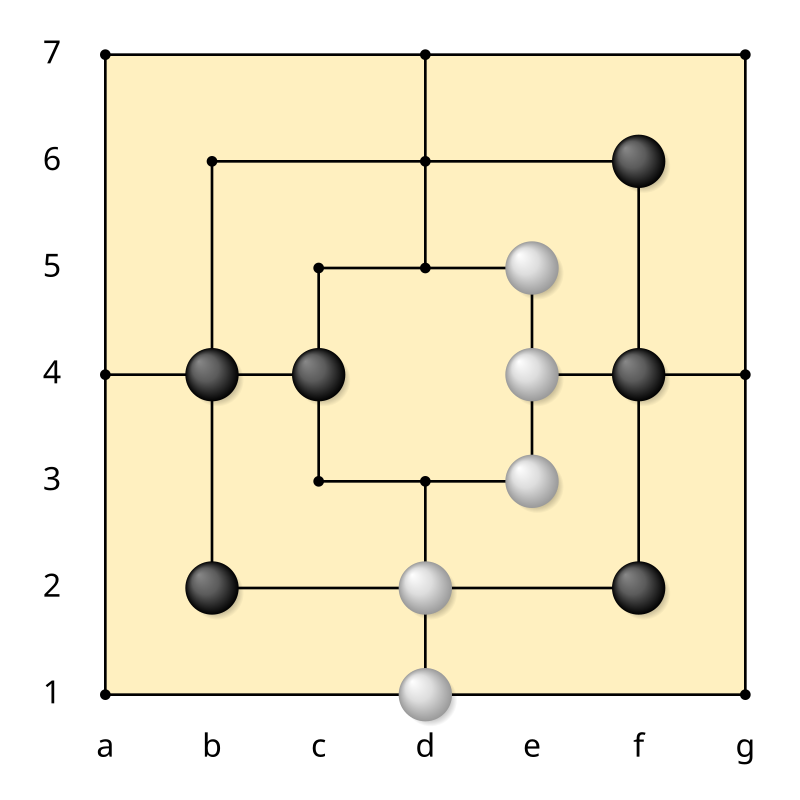
nine men's morris
strategy board game for two players
Nim
Nim is a mathematical combinatorial game in which two players take turns removing (or "nimming") objects from distinct heaps or piles. On each turn, a player must remove at least one object, and may remove any number of objects provided they all come from the same heap or pile. Depending on the version being played, the goal of the game is either to avoid taking the last object or to take the last object.
Hex
board game

pentomino
thumb|right|upright=1.7|The 12 pentominoes can form 18 different shapes, with 6 of them (the chiral pentominoes) being mirrored.
Connect Four
children's board game

Gomoku
Gomoku, also called five in a row, is an abstract strategy board game. It is traditionally played with Go pieces (black and white stones) on a 15×15 Go board while in the past a 19×19 board was standard. Because pieces are typically not moved or removed from the board, gomoku may also be played as a paper-and-pencil game. The game is known in several countries under different names.

Oware
thumb|A game of awale
Oware is an abstract strategy game among the mancala family of board games (pit and pebble games) played worldwide with slight variations as to the layout of the game, number of players and strategy of play. Its origin is uncertain, but it is widely believed to be of Ashanti origin.
Renju
Renju () is a professional variant of the abstract strategy board game gomoku. It was named renju by Japanese journalist Ruikou Kuroiwa (黒岩涙香) on December 6, 1899, in a Japanese newspaper Yorozu chouhou (萬朝報). The name "renju" means "connected pearls" in Japanese. The game is played with black and white stones on a 15×15 gridded go board.
Quarto
1991 board game
antichess
chess variant whose goal is to lose pieces
L game
abstract two-player strategy game

Fanorona
Fanorona () is a strategy board game for two players. The game is indigenous to Madagascar.

Kalah
Kalah is a modern variation in the ancient Mancala family of games. The Kalah board was first patented and sold in the United States by William Julius Champion, Jr. in the 1950s. This game is sometimes also called "Kalahari", possibly by false etymology from the Kalahari Desert in Namibia.

Pentago
thumb|Pentago Winning Position for White

bagh-chal
250px|thumb|Brass playing board and tokens
thumb|Bagh Chal table
Bagh-chal ( bāgh cāl, dhun kasa meaning "tiger game") is a strategic, two-player board game that originated in Nepal. The game is asymmetric in that one player controls four tigers and the other player controls up to twenty goats. The tigers 'hunt' the goats while the goats attempt to block the tigers' movements. This game is also seen in southern India with a different board, but the rules are the same. This game is popular in rural areas of the country.
English draughts
Board game draughts
Congkak
mancala game
solved game
game whose outcome can be correctly predicted
Maharajah and the Sepoys
variant of chess
hexapawn
Hexapawn is a deterministic two-player game invented by Martin Gardner. It is played on a rectangular board of variable size, for example on a 3×3 board or on a regular chessboard. On a board of size n×m, each player begins with m pawns, one for each square in the row closest to them. The goal of each player is to either advance a pawn to the opposite end of the board or leave the other player with no legal moves (akin to stalemate), including by capturing all of their pawns.
Qubic
abstract strategy board game, generally for two players
Teeko
thumb|right|upright=1.5|Teeko game board
Teeko is an abstract strategy game invented by John Scarne in 1937 and rereleased in refined form in 1952 and again in the 1960s. Teeko was marketed by Scarne's company, John Scarne Games Inc.; its quirky name, he said, borrowed letters from the games Tic-tac-toe, Chess, Checkers, and Bingo.
Sim
pencil game
three musketeers
abstract strategy game
Chopsticks
hand game for two players, in which players extend a number of fingers from each hand and transfer those scores by taking turns to tap one hand against another