Category
page 1Southern constellations

Sagittarius
zodiac constellation in the southern celestial hemisphere

Scorpius
Scorpius is a zodiac constellation located in the Southern celestial hemisphere, where it sits near the center of the Milky Way, between Libra to the west and Sagittarius to the east. Scorpius is an ancient constellation whose recognition predates Greek culture; it is one of the 48 constellations identified by the Greek astronomer Ptolemy in the second century.
.svg)
Capricornus
Capricornus is one of the constellations of the zodiac. Its name is Latin for "horned goat" or "goat horn" or "having horns like a goat's", and it is commonly represented in the form of a sea goat: a mythical creature that is half goat, half fish.

Libra
zodiac constellation in the southern celestial hemisphere

Canis Major
constellation in the southern celestial hemisphere

Crux
Crux ( ) is a constellation of the southern sky that is centred on four bright stars in a cross-shaped asterism commonly known as the Southern Cross. It lies on the southern end of the Milky Way's visible band. The name Crux is Latin for cross. Though it is the smallest of all 88 modern constellations, Crux is among the most easily distinguished, as each of its four main stars has an apparent visual magnitude brighter than +2.8. It has attained a high level of cultural significance in many Southern Hemisphere states and nations.
.jpg)
Centaurus
Centaurus ( ) is a bright constellation in the southern sky. One of the largest constellations, Centaurus was included among the 48 constellations listed by the 2nd-century astronomer Ptolemy, and it remains one of the 88 modern constellations. In Greek mythology, Centaurus represents a centaur; a creature that is half human, half horse (another constellation named after a centaur is one from the zodiac: Sagittarius). Notable stars include Alpha Centauri, the nearest star system to the Solar System, its neighbour in the sky Beta Centauri, and HR 5171, one of the largest stars yet discovered. T

Antlia
Antlia (; from Ancient Greek ἀντλία) is a constellation in the Southern Celestial Hemisphere. Its name means "pump" in Latin and Greek; it represents an air pump. Originally Antlia Pneumatica, the constellation was established by Nicolas-Louis de Lacaille in the 18th century. Its non-specific (single-word) name, already in limited use, was preferred by John Herschel then welcomed by the astronomic community which officially accepted this. North of stars forming some of the sails of the ship Argo Navis (the constellation Vela), Antlia is completely visible from latitudes south of 49 degrees nor

Lepus
constellation in the southern celestial hemisphere

Lupus
constellation in the southern celestial hemisphere

Carina
constellation in the southern celestial hemisphere

Caelum
Caelum is a faint constellation in the southern sky, introduced in the 1750s by Nicolas Louis de Lacaille and counted among the 88 modern constellations. Its name means "chisel" in Latin, and it was formerly known as Caelum Sculptorium ("Engraver's Chisel"); it is a rare word, unrelated to the far more common Latin caelum, meaning "sky", "heaven", or "atmosphere". It is the eighth-smallest constellation, and subtends a solid angle of around 0.038 steradians, just less than that of Corona Australis.

Hydrus
Hydrus is a small constellation in the deep southern sky. It was one of twelve constellations created by Petrus Plancius from the observations of Pieter Dirkszoon Keyser and Frederick de Houtman and it first appeared on a 35-cm (14 in) diameter celestial globe published in late 1597 (or early 1598) in Amsterdam by Plancius and Jodocus Hondius. The first depiction of this constellation in a celestial atlas was in Johann Bayer's Uranometria of 1603. The French explorer and astronomer Nicolas Louis de Lacaille charted the brighter stars and gave their Bayer designations in 1756. Its name mea

Vela
constellation in the southern celestial hemisphere

Piscis Austrinus
constellation in the southern celestial hemisphere

Fornax
Fornax () is a constellation in the southern celestial hemisphere, partly ringed by the celestial river Eridanus. Its name is Latin for furnace. It was named by French astronomer Nicolas Louis de Lacaille in 1756. Fornax is one of the 88 modern constellations.

Apus
Apus is a small constellation in the southern sky. It represents a bird-of-paradise, and its name means "without feet" in Greek because the bird-of-paradise was once wrongly believed to lack feet. First depicted on a celestial globe by Petrus Plancius in 1598, it was charted on a star atlas by Johann Bayer in his 1603 Uranometria. The French explorer and astronomer Nicolas Louis de Lacaille charted and gave the brighter stars their Bayer designations in 1756.

Puppis
Puppis ("stern") is a constellation in the southern sky. It was originally part of the traditional constellation of Argo Navis (Argo is the ship of Jason and the Argonauts), which was divided into three parts, the other two being Carina (the keel and hull), and Vela (the sails). Puppis is the largest of the three constellations in square degrees. It is one of the 88 modern constellations recognized by the International Astronomical Union.

Chamaeleon
Chamaeleon ( ) is a small constellation in the deep southern sky. It is named after the chameleon, a kind of lizard. It was first defined in the end of the 16th century.

Ara
constellation in the southern celestial hemisphere

Phoenix
constellation in the southern celestial hemisphere

Columba
constellation in the southern celestial hemisphere

Corvus
constellation in the Southern Celestial Hemisphere

Horologium
constellation in the southern celestial hemisphere

Scutum
constellation in the southern celestial hemisphere

Crater
constellation in the southern celestial hemisphere

Octans
Octans is a faint constellation located in the deep Southern Sky. Its name is Latin for the eighth part of a circle, but it is named after the octant, a navigational instrument. Devised by French astronomer Nicolas Louis de Lacaille in 1752, Octans remains one of the 88 modern constellations. The southern celestial pole is located within the boundaries of Octans.

Grus
constellation in the southern celestial hemisphere

Corona Australis
constellation in the southern celestial hemisphere

Sculptor
constellation in the southern celestial hemisphere
Tucana
Tucana (The Toucan) is a constellation in the southern sky, named after the toucan, a South American bird. It is one of twelve constellations conceived in the late sixteenth century by Petrus Plancius from the observations of Pieter Dirkszoon Keyser and Frederick de Houtman. Tucana first appeared on a celestial globe published in 1598 in Amsterdam by Plancius and Jodocus Hondius and was depicted in Johann Bayer's star atlas Uranometria of 1603. French explorer and astronomer Nicolas Louis de Lacaille gave its stars Bayer designations in 1756. The constellations Tucana, Grus, Phoenix and Pavo a

Pavo
constellation in the southern celestial hemisphere
.jpg)
Volans
Volans is a constellation in the southern sky. It represents a flying fish; its name is a shortened form of its original name, Piscis Volans. Volans was one of twelve constellations created by Petrus Plancius from the observations of Pieter Dirkszoon Keyser and Frederick de Houtman and it first appeared on a 35-cm (14") diameter celestial globe published in 1597 (or 1598) in Amsterdam by Plancius with Jodocus Hondius. The first depiction of this constellation in a celestial atlas was in Johann Bayer's Uranometria of 1603.

Microscopium
Microscopium ("the Microscope") is a minor constellation in the southern celestial hemisphere, one of twelve created in the 18th century by French astronomer Nicolas-Louis de Lacaille and one of several depicting scientific instruments. The name is a Latinised form of the Greek word for microscope. Its stars are faint and hardly visible from most of the non-tropical Northern Hemisphere.

Indus
constellation in the southern celestial hemisphere

Musca
is a small constellation in the deep southern sky. It was one of 12 constellations created by Petrus Plancius from the observations of Pieter Dirkszoon Keyser and Frederick de Houtman, and it first appeared on a celestial globe in diameter published in 1597 (or 1598) in Amsterdam by Plancius and Jodocus Hondius. The first depiction of this constellation in a celestial atlas was in Johann Bayer's Uranometria of 1603. It was also known as for 200 years. Musca remains below the horizon for most Northern Hemisphere observers.
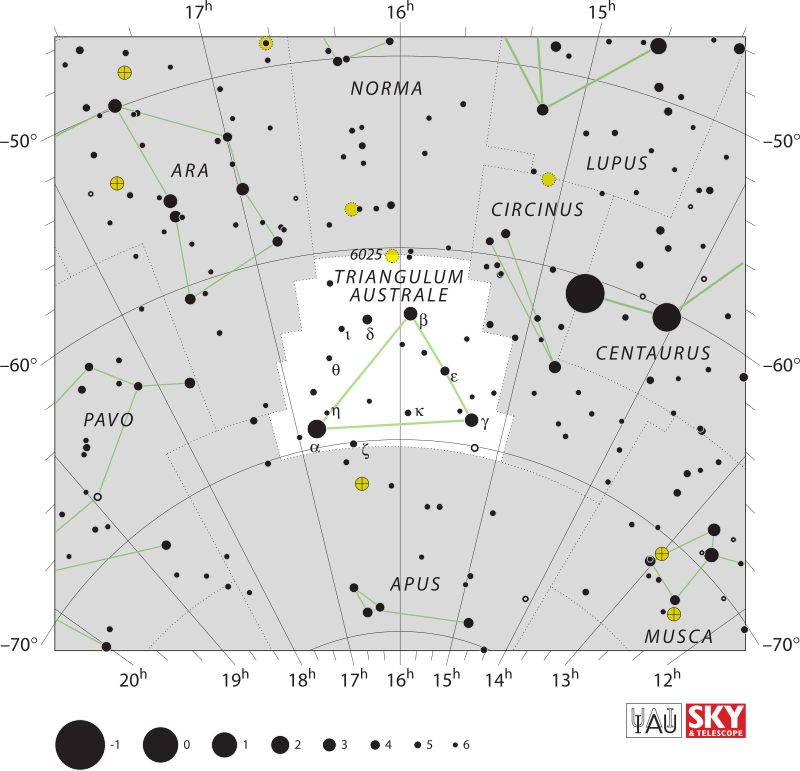
Triangulum Australe
constellation in the southern celestial hemisphere

Dorado
Dorado (, ) is a constellation in the Southern Sky. It was named in the late 16th century and is now one of the 88 modern constellations. Its name refers to the mahi-mahi (Coryphaena hippurus), which is known as dorado ("golden") in Spanish, although it has also been depicted as a swordfish. Dorado contains most of the Large Magellanic Cloud, the remainder being in the constellation Mensa. The South Ecliptic pole also lies within this constellation.

Pictor
Pictor is a constellation in the Southern Celestial Hemisphere, located between the star Canopus and the Large Magellanic Cloud. Its name is Latin for painter, and is an abbreviation of the older name Equuleus Pictoris (the "painter's easel"). Normally represented as an easel, Pictor was named by Abbé Nicolas-Louis de Lacaille in the 18th century. The constellation's brightest star is Alpha Pictoris, a white main-sequence star around 97 light-years away from Earth. Pictor also hosts RR Pictoris, a cataclysmic variable star system that flared up as a nova, reaching apparent (visual) magnit

Mensa
constellation in the southern celestial hemisphere

Circinus
Circinus is a small, faint constellation in the southern sky, first defined in 1756 by the French astronomer Nicolas-Louis de Lacaille. Its name is Latin for compass, referring to the drafting tool used for drawing circles (it should not be confused with Pyxis, a constellation that represents a mariner's compass which points north). Its brightest star is Alpha Circini, with an apparent magnitude of 3.19. Slightly variable, it is the brightest rapidly oscillating Ap star in the night sky. AX Circini is a Cepheid variable visible with the unaided eye, and BX Circini is a faint star thought to ha

Telescopium
Telescopium is a minor constellation in the southern celestial hemisphere, one of twelve named in the 18th century by French astronomer Nicolas-Louis de Lacaille and one of several depicting scientific instruments. Its name is a Latinized form of the Greek word for telescope. Telescopium was later much reduced in size by Francis Baily and Benjamin Gould.

Pyxis
Pyxis is a small and faint constellation in the southern sky. Abbreviated from Pyxis Nautica, its name is Latin for a mariner's compass (contrasting with Circinus, which represents a draftsman's compasses). Pyxis was introduced by Nicolas-Louis de Lacaille in the 18th century, and is counted among the 88 modern constellations.

Norma
constellation in the southern celestial hemisphere

Reticulum
Reticulum is a small, faint constellation in the southern sky. Its name is Latin for a small net, or reticle—a net of crosshairs at the focus of a telescope eyepiece that is used to measure star positions. The constellation is best viewed between October and December, and save for one main star visible in ideal conditions, cannot be seen from north of the 30th parallel north.