Category
page 1Soviet phraseology

Gulag
thumb|A punishment cell block in one of the subcamps of Vorkutlag, 1945
The Gulag was a system of forced labor camps in the Soviet Union. The word Gulag originally referred only to the division of the Soviet secret police that was in charge of running the forced labor camps from the 1930s to the early 1950s during Joseph Stalin's rule, but in English literature the term is popularly used for the system of forced labor throughout the Soviet era. The abbreviation GULAG (ГУЛАГ) stands for "Glávnoye upravléniye ispravítel'no-trudovýkh lageréy " (Гла́вное управле́ние исправи́тельно-трудовы́х лагере

perestroika
Perestroika ( ; ) was a political reform movement within the Communist Party of the Soviet Union (CPSU) during the late 1980s, widely associated with CPSU general secretary Mikhail Gorbachev and his ("transparency") policy reform. literally means "restructuring", referring to the restructuring of the political economy of the Soviet Union in an attempt to end the Era of Stagnation.

Great Purge
Soviet campaign of political repression, imprisonment, and execution (August 1936 - March 1938)

Glasnost
Glasnost ( ; , ) is a concept relating to openness and transparency. It has several general and specific meanings, including a policy of maximum openness in the activities of state institutions and freedom of information and the inadmissibility of hushing up problems. In Russian, the word glasnost has long been used to mean 'openness' and 'transparency'. In the mid-1980s, it was popularised by Mikhail Gorbachev as a political slogan for increased government transparency in the Soviet Union within the framework of perestroika, and the word came to be used in English in the latter meaning.

New Economic Policy
economic policy of Soviet Russia proposed by Vladimir Lenin, who described it as a progression towards "state capitalism" within the workers' state of the USSR

Soviet
political organizations and governmental bodies, primarily associated with the Russian Revolutions and the history of the Soviet Union, and which gave the name to the latter state

kulaks
thumb|265x265px|The requisition of grain from "wealthy peasants" (kulaks) during state Collectivization in the Soviet Union|collectivization in [[Timashyovsky District, Kuban, Soviet Union, 1933]]
A kulak ( ; ; plural: кулаки́, kulakí, 'fist' or 'tight-fisted'), also kurkul () or golchomag (, plural: ), was a peasant who owned over of land in the times near the end of the Russian Empire. In the early Soviet Union, particularly in Soviet Russia and Azerbaijan, kulak referred to property ownership among peasants who were considered hesitant allies of the Bolshevik Revolution. In Ukraine during 1

urban-type settlement
type of urban populated place

samizdat
Samizdat (, , ), also Samvydav () was a form of dissident activity across the Eastern Bloc in which individuals reproduced censored and underground makeshift publications, often by hand, and passed the documents from reader to reader. The practice of manual reproduction was widespread, because printed texts could be traced back to the source. This was a grassroots practice used to evade official Soviet censorship.
war communism
public policy in Soviet Russia during the Russian Civil War
.jpg)
sovkhoz
thumb|1932 Socialist Realism painting, "In a pig-breeding sovkhoz" (Petr Stroev)
thumb|Headquarters of the "Leninugol" sovkhoz, Kemerovo Oblast.
thumb|Students from the Kazakh Agricultural Institute at the [[Novopokrovsky sovkhoz, 1991.]]
A sovkhoz was a form of state-owned farm or agricultural enterprise in the Soviet Union.
closed city
settlement with restrictions on ingress and egress
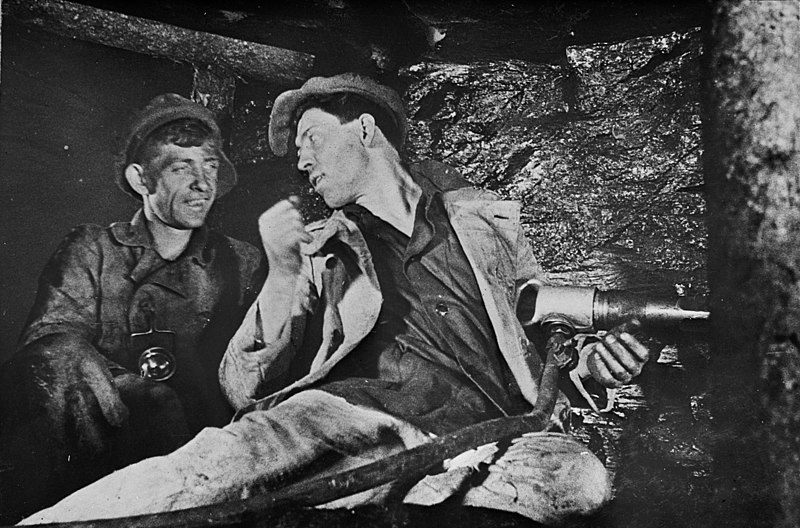
Stakhanovite movement
Soviet work ethos equating labor with heroism
Khrushchev thaw
period from the early 1950s to the early 1960s when repression and censorship in the Soviet Union were relaxed
enemy of the people
designation for political or class opponents of a state; term used in Antique Rome, Revolutionary France, Nazi Germany, Stalin-era Soviet Union, Communist China and The United States

Exhibition of achievements of national economy
trade show in Moscow, Russia

Khrushchyovka
thumb|Panel khrushchevka in Tomsk

nomenklatura
thumb|Moscow Kremlin, where the highest of the elite Soviet nomenklatura lived
The nomenklatura (; from , system of names) were a category of people within the Soviet Union and other Eastern Bloc countries who held various key administrative positions in the bureaucracy, running all spheres of those countries' activity: government, industry, agriculture, education, etc., whose positions were granted only with approval by the communist party of each country or region. While in the Russian language the term номенклатура has the same generic meaning as "nomenclature", in the context of the politi
whataboutism
"Whataboutism" or "whataboutery" (as in, "but what about X?") refers to the propaganda strategy of responding to an accusation with a counter-accusation instead of offering an explanation or defense against the original accusation. It is an informal fallacy that the accused party uses to avoid accountability—whether attempting to distract by shifting the conversation's focus away from their behaviour or attempting to justify themselves by pointing to the similar behaviour (which may be true or false, but irrelevant) of their opponent or another party who is not the current subject of discussio

dekulakization
Dekulakization (; ) was a campaign of repression in the Soviet Union directed against so-called kulaks, a loosely defined category of supposedly wealthy or exploitative peasants. The campaign involved mass arrests, executions, expropriation of property, and deportations of entire households to remote and inhospitable regions.
peaceful coexistence
theory that the Socialist Bloc could peacefully coexist with the capitalist bloc
Green armies
Peasant Army in Russian Civil War of 1918-1919

Lysenkoism
thumb|upright=1.35 |Trofim Lysenko speaking at the Kremlin in 1935; behind him are (left to right) [[Stanislav Kosior, Anastas Mikoyan, Andrei Andreev and Joseph Stalin]]
Lysenkoism was a pseudoscientific political campaign led by the Soviet biologist Trofim Lysenko against genetics and science-based agriculture in the mid-20th century, rejecting natural selection in favour of a form of Lamarckism, as well as expanding upon the techniques of vernalization and grafting.
Socialism in One Country
political theory by Joseph Stalin
Era of Stagnation
a late period in the history of the U.S.S.R.
five-year plans of the Soviet Union
Communist economic plans in the former Soviet Union
people's democracy (theoretical concept within Marxism–Leninism)
multi-party, popular front-influenced rule by the people for the transition to socialism

Korenizatsiya
thumb|The 1921 Soviet recruitment to the Military Education poster with the Ukrainization theme. The text reads: "Son! Enroll in the , and the defence of Soviet Ukraine will be ensured." The poster uses traditional Ukrainian imagery with Ukrainian-language text to reach a wider appeal. The School of Red Commanders in [[Kharkiv was organized to promote the careers of the Ukrainian national cadre in the army.]]
Doctors' plot
1950s antisemitic campaign by Stalin in the Soviet Union

economism
Economism is a direct reduction of any political or cultural phenomena or activities to economics.
apparatchik
__NOTOC__
social parasitism
pejorative that is leveled against a group or class which is considered to be detrimental to society
real socialism
Soviet-type economic planning enforced by the ruling communist parties
naukograd
Naukograd (, also technopole), meaning "science city", is a formal term for towns with high concentrations of research and development facilities in Russia and the Soviet Union, some specifically built by the Soviet Union for these purposes. Some of the towns were secret and were part of a larger system of closed cities in the USSR, many built by forced labour from the Soviet Gulag. In the Russian Federation in post-Soviet times, the term is used generally for about seventy towns that have concentrations of scientific research and production, and specifically, refers to a small number of towns
101st kilometre
colloquial phrase
Anti-Party Group
Anti-Khrushchev political party
Old Bolshevik
follower of Lenin before the Russian Revolution

Sovietization
thumb|300px|Latvian National Theatre decorated with Soviet symbols ([[hammer and sickle, red star, red flags and a double portrait of Vladimir Lenin and Joseph Stalin) after the Soviet occupation in 1940. The text on top reads "Long live the USSR!"]]
Sovietization ( ) is the adoption of a political system based on the model of soviets (workers' councils) or the adoption of a way of life, mentality, and culture modeled after the Soviet Union.
thief in law
type of professional criminal
NKVD troika
commission of three for express judgment in the Soviet Union during the time of Joseph Stalin
social fascism
communist term for social democracy
We will bury you
quote by Soviet First Secretary Nikita Khrushchev
active measures
term for the actions of political warfare conducted by the Soviet and Russian security services

Likbez
thumb|"- Woman, learn to read and write! - Oh, mother! If you were literate, you could help me!" A poster by Elizaveta Kruglikova advocating female literacy, 1923.

refusenik
thumb|January 10, 1973. Soviet Jewish refusenik demonstration in front of the Ministry of Internal Affairs for the right to emigrate to Israel, before being broken up by Soviet authorities.
thumb|A rare type 2 USSR exit visa. This type of visa was issued to those who received permission to leave the USSR permanently and lost their Soviet citizenship. Many people who wanted to emigrate were unable to receive this kind of exit visa.
thumb|Letter from the Soviet Ministry of Internal Affairs|MVD to a 76-year-old man from Sverdlovsk refusing him permission to move to Israel due to "knowledge of sta
national delimitation in the Soviet Union
process of allocating national administrative-territorial units
There is no sex in the USSR
Russian catchphrase
Stalin's ten blows
phrase in Soviet historiography
rehabilitation
exoneration of victims of repression, term used in the context of the former Soviet Union, and the Post-Soviet states

udarnik
thumb|right|Agitprop poster by [[Vladimir Mayakovsky: "Hurry to join shock brigades!"
– Do you want it? Then join.
1. Want to defeat cold?
2. Want to defeat hunger?
3. Want to eat?
4. Want to drink?
Hurry, join the advanced exemplary labour group. ]]
In the terminology of the Soviet Union, the Eastern Bloc, and other communist countries, an udarnik (, plural udarniks or udarniki; ), also known in English as a shock worker or strike worker (collectively known as shock brigades or a shock labor team) is a high productivity worker. It derived from the expression "udarny trud" for "superproducti
ribs
x-ray films turned into gramophone recordings
rootless cosmopolitan
antisemitic slur for Jews in the Soviet Union
administrative procedure
Soviet euphemism for extrajudicial punishment
sluggish schizophrenia
alleged mental disorder applied to Soviet political dissidents

Prodrazvyorstka
thumb|350px|"Grain requisitioning" by Ivan Vladimirov
', also transliterated ( , short for , ), alternatively referred to in English as grain requisitioning', was a policy and campaign of confiscation of grain and other agricultural products from peasants at nominal fixed prices according to specified quotas (the noun , , and the verb , refer to the partition of the requested total amount as obligations from the suppliers).

sharashka
thumb|Tupolev's sharashka TsKB-29 of NKVD in Omsk (1943)
Uskoreniye
Uskorenie (; literally meaning acceleration) was a slogan and a policy announced by Communist Party General Secretary Mikhail Gorbachev on 20 April 1985 at a Soviet Party Plenum, aimed at the acceleration of political, social and economic development of the Soviet Union. It was the first slogan of a set of reforms that also included (restructuring), (transparency), new political thinking, and (democratization).
Yevsektsiya
A Yevsektsiya (, a syllabic abbreviation for "Jewish Section" (). ; ) was the ethnically Jewish section of the Communist Party of the Soviet Union and its main institutions; it is also sometimes described as the Yiddish-language branch of the CPSU. The section was established in fall of 1918 with consent of Vladimir Lenin to carry Party ideology and Marxist-Leninist atheism to the Soviet Jewish masses. The Yevsektsiya published a Yiddish periodical, der Emes. According to Walter Kolarz, the Yevsektsiya inside the League of Militant Godless, "had a total of 40,000 Jewish members in 1929, the ye
Soviet democracy
political system; emphasizes directly elected soviets or councils
Japhetic theory
Postulation that the Kartvelian languages of the Caucasus area are related to the Semitic languages of the Middle East; proposed by Nikolay Yakovlevich Marr in 1920s and 1930s, now seen as outdated