Category
page 1Spacecraft launched in 1972
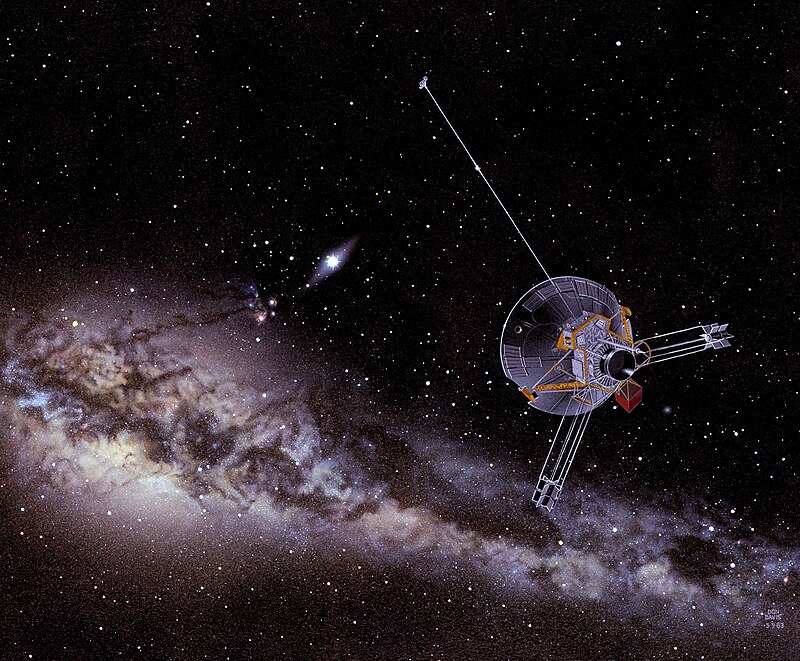
Pioneer 10
NASA space probe launched in March 1972

Apollo 17
Apollo 17 was the eleventh and final crewed mission of NASA's Apollo program, the sixth and most recent time humans have set foot on the Moon. Commander Gene Cernan and Lunar Module Pilot Harrison Schmitt walked on the Moon, while Command Module Pilot Ronald Evans orbited above. Schmitt was the only professional geologist to land on the Moon; he was selected in place of Joe Engle, as NASA had been under pressure to send a scientist to the Moon. The mission's heavy emphasis on science meant the inclusion of a number of new experiments, including a biological experiment containing five mice that was carried in the command and service module.

Apollo 16
fifth Moon landing and tenth crewed flight of the United States Apollo program
Venera 8
Soviet space probe which delivered a lander to Venus
Luna 20
space probe
Kosmos 482
Soviet Venera spacecraft which failed to escape Earth orbit
Kosmos 496
Soviet uncrewed Soyuz test
Landsat 1
first satellite of the United States' Landsat program, active 1972-1978
DOS-2
DOS-2 was a space station, launched as part of the Salyut programme, which was lost in a launch failure on 29 July 1972, when the failure of the second stage of its Proton-K launch vehicle prevented the station from achieving orbit. It instead fell into the Pacific Ocean. The station, which would have been given the designation Salyut 2 had it reached orbit, was structurally identical to Salyut 1, as it had been assembled as a backup unit for that station. Four teams of cosmonauts were formed to crew the station, of which two would have flown:
Alexei Leonov and Valeri Kubasov
Vasily Lazarev an
Kosmos 481
Soviet satellite
Kosmos 497
satellite
Denpa
Japanese scientific research satellite
TD-1A
TD-1A, or Thor-Delta 1A (or just TD-1), was a European astrophysical research satellite which was launched in 1972. Operated by the European Space Research Organisation, TD-1A made astronomical surveys primarily in the ultraviolet, but also using x-ray and gamma ray detectors.
Kosmos 485
Soviet satellite
Kosmos 521
soviet satellite
Meteoroid Technology Satellite
NASA satellite of the Explorer program
AEROS
AEROS satellites were to study the aeronomy i. e. the science of the upper atmosphere and ionosphere, in particular the F region under the strong influence of solar extreme ultraviolet radiation. To this end the spectrum of this radiation was recorded aboard by one instrument (of type Hinteregger) on the one hand and a set of 4 other instruments measuring the most important neutral uand iononized parameters at the satellite's position on the other.
Kosmos 523
Soviet satellite
Kosmos 501
Soviet satellite
Kosmos 487
Soviet satellite
Kosmos 498
Soviet satellite
Kosmos 472
Soviet satellite
Kosmos 524
Soviet satellite
Kosmos 526
Soviet satellite
Kosmos 520
Russian military early warning satellite