Category
page 1Spacecraft launched in 1988
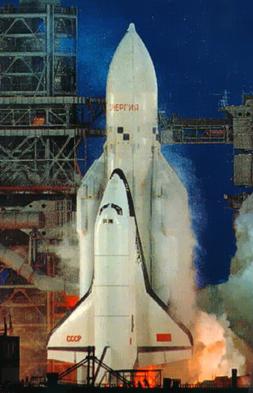
Buran
first and only operational spaceplane in the Soviet Buran programme

STS-26
STS-26 was the 26th NASA Space Shuttle mission and the seventh flight of the orbiter Discovery. The mission launched from Kennedy Space Center, Florida, on September 29, 1988, and landed four days later on October 3, 1988. STS-26 was declared the "Return to Flight" mission, being the first mission after the Space Shuttle Challenger disaster of January 28, 1986. It was the first mission since STS-9 to use the original Space Transportation System (STS) numbering system, the first to have all its crew members wear pressure suits for launch and landing since STS-4, and the first mission with bailo
STS-27
STS-27 was the 27th NASA Space Shuttle mission, and the third flight of Space Shuttle Atlantis. Launching on December 2, 1988, on a four-day mission, it was the second shuttle flight after the Space Shuttle Challenger disaster of January 1986. STS-27 carried a classified payload for the U.S. Department of Defense (DoD), ultimately determined to be a Lacrosse surveillance satellite. The vessel's heat shielding was substantially damaged during lift-off, and crew members thought that they would die during reentry. This was a situation that was similar to the one that would prove fatal 15 years la
Phobos 2
Soviet Mars probe
Soyuz TM-6
1988 Soviet crewed spaceflight to Mir
Soyuz TM-7
1988 Soviet crewed spaceflight to Mir
Soyuz TM-5
1988 Soviet crewed spaceflight to Mir
Phobos 1
Soviet mars mission
Astra 1A
communications satellite
Kosmos 1977
Russian military early warning satellite
TDRS-3
TDRS-3, known before launch as TDRS-C, is a first-generation American communications satellite, which is operated by NASA as part of the Tracking and Data Relay Satellite System. It was constructed by TRW and is based on a custom satellite bus, which was used for all seven first-generation TDRS satellites.
IRS-1A
IRS-1A, Indian Remote Sensing satellite-1A, the first of the series of indigenous state-of-art remote sensing satellites, was successfully launched into a polar Sun-synchronous orbit on 17 March 1988 from the Soviet Cosmodrome at Baikonur. IRS-1A carries two sensors, LISS-1 and LISS-2, with resolutions of and respectively with a swath width of about during each pass over the country. Undertaken by the Indian Space Research Organisation (ISRO). It was a part-operational, part-experimental mission to develop Indian expertise in satellite imagery.