Category
page 1Spaceflight

spaceflight
thumb|upright=1.5|Tracy Caldwell Dyson in the [[International Space Station's Cupola]]

spacecraft
thumb|List of Soyuz missions|More than 140 Soviet and Russian crewed Soyuz spacecraft (TMA version shown) have flown since 1967 and now support the [[International Space Station.]]

space exploration
discovery and exploration of outer space and celestial objects outside Earth

space debris
defunct artificial object or collection of such objects in space
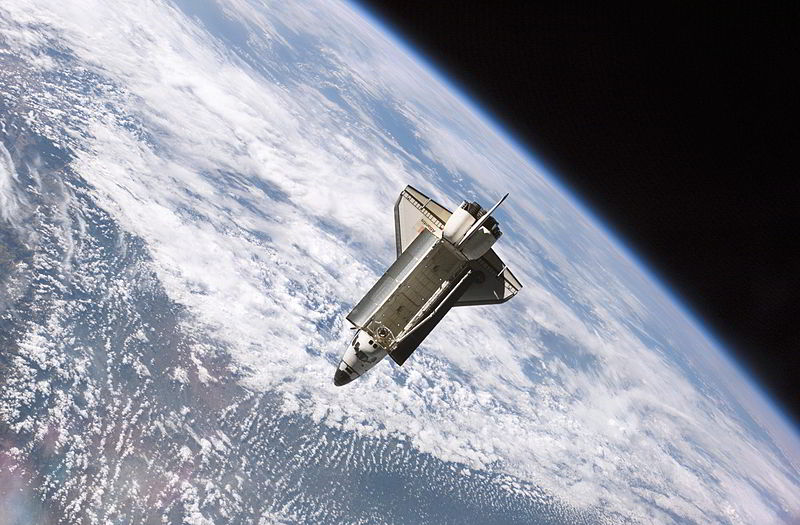
human spaceflight
space travel with humans aboard spacecraft

Pioneer plaque
plaque attached to the Pioneer 10 and Pioneer 11 spacecraft in case extraterrestrial life finds them
list of space agencies
overview of state-sponsored programs for flight beyond Earth
Space Age
historical period started in 1957
City of Space
French theme park

aerobraking
thumb|300px|right|An artist's conception of aerobraking with the Mars Reconnaissance Orbiter
300px|thumb |right |An example of Aerobraking
Aerobraking is a spaceflight maneuver that reduces the high point of an elliptical orbit (apoapsis) by flying the vehicle through the atmosphere at the low point of the orbit (periapsis). The resulting drag slows the spacecraft. Aerobraking is used when a spacecraft requires a low orbit after arriving at a body with an atmosphere, as it requires less fuel than using propulsion to slow down. A more extreme maneuver is aerocapture, where a spacecraft uses an

starship
thumb|upright=1.3|An updated version (NASA, 1999) of the Project Orion by the [[United States government (1958–1965). It was the earliest scaled project developing a concept for a spaceship with a propulsion, of fission pulses, that was to be capable to transport humans light years within hundreds of years instead of thousands.]]

Esrange
Esrange Space Center or Esrange is Sweden's space and research center located about 40 kilometers east of the town of Kiruna in northern Sweden, owned and operated by the Swedish Space Corporation (SSC). The base itself covers 20 square kilometers, while the impact area for rockets is 5,600 km2. Located 200 km north of the Arctic Circle, the geographic location of Esrange is advantageous thanks to the limited light pollution, allowing for studies of northern lights. The stable climate, limited commercial air traffic and sparsely populated area are further reasons why the location is well suite
mission control center
facility that manages aerospace vehicle flights
intergalactic travel
The hypothetical travel that is crewed or uncrewed between galaxies
electrically powered spacecraft propulsion
spacecraft propulsion system which uses electricity
sample-return mission
space mission to retrieve tangible samples from an extraterrestrial location and return with them to Earth for analysis
NASA Space Science Data Coordinated Archive
archive of space science data
Commercial Resupply Services
flights awarded by NASA for the delivery of cargo and supplies to the International Space Station on commercially operated spacecraft

Nammo
Nammo, short for Nordic Ammunition Company, is a Norwegian-Finnish aerospace and defence group specialized in production of ammunition, rocket engines and space applications. The company has subsidiaries in Finland, Germany, Norway, Sweden, Switzerland, Spain, the United Kingdom, the Republic of Ireland, and the United States. The company ownership is evenly split between the Norwegian government (represented by the Norwegian Ministry of Trade, Industry and Fisheries) and the Finnish defence company Patria. The company has its headquarters in Raufoss, Norway.
radiation hardening
act of making electronic components and systems resistant to damage or malfunctions caused by ionizing radiation (particle radiation and high-energy electromagnetic radiation)
space architecture
theory and practice of designing and building inhabited environments in outer space
planetary flyby
the act of sending a space probe past a planet or a dwarf planet close enough to record scientific data
space research
scientific studies carried out using scientific equipment in outer space
Aeroshell
Viking 1 aeroshell|thumb
An aeroshell is a rigid heat-shielded shell that helps decelerate and protects a spacecraft vehicle from pressure, heat, and possible debris created by drag during atmospheric entry. Its main components consist of a heat shield (the forebody) and a back shell. The heat shield absorbs heat caused by air compression in front of the spacecraft during its atmospheric entry. The back shell carries the load being delivered, along with important components such as a parachute, rocket engines, and monitoring electronics like an inertial measurement unit that monitors the orien

Launch and Early Orbit Phase
phase of a spacecraft mission
space art
visual art genre
interplanetary contamination
biological contamination of a planetary body by a space probe or spacecraft
Earth orbit rendezvous
method for conducting round trip human flights to the Moon

MELiSSA
right|300px|frameless
The Micro-Ecological Life Support System Alternative (MELiSSA) is a European Space Agency (ESA) initiative with the aim to develop the technology for a future regenerative life support system for long-term human space missions. Initiated in 1989, the design is inspired by a terrestrial ecosystem. As of 2023, MELiSSA is a consortium made up of 30 organisations across Europe.
Rockoon
thumb|A Deacon rockoon just after shipboard launch.
thumb|A rockoon at liftoff, August 2022.
space dock
concept in science fiction
space selfie
self-portrait photo taken in outer space
Comparison of orbital rocket engines
Wikimedia list article
Religion in space
religious context during spaceflights
Mission Elapsed Time
time scale used by NASA during their space missions
Atompunk
REDIRECT Cyberpunk derivatives#Atompunk
list of artificial objects on extraterrestrial surfaces
Wikimedia list article
ORFEO Programme
French/Italian Earth observation satellite programme
HiWish program
NASA program for public suggestions for MRO images
Patched Conic Approximation
method to calculate trajectory calculations for spacecraft
Erin Overcash
American aerospace engineer (born 1986)
cascade effect
inevitable and sometimes unforeseen chain of events due to an act affecting a system
satellite internet constellation
computer network architecture based on orbital satellites

Satellogic
Satellogic Inc. is an American company specializing in Earth-observation satellites, founded in 2010 by Emiliano Kargieman and Gerardo Richarte.