Category
page 1Spanish Florida

St. Augustine
city in St. Johns County, Florida, United States

Fountain of Youth
mythological theme in art and literature, a spring that supposedly restores the youth of anyone who drinks or bathes in its waters
Spanish Florida
former Spanish possession in North America (1513–1763, 1783–1821)
Adams–Onís Treaty
Treaty between the United States and Spain, ceding Florida to the U.S. (1819)
Queen Anne's War
North American theater of the War of the Spanish Succession
Seminole Wars
19th-century wars between the United States Army and the Seminole people of Florida
West Florida
region
Parris Island
census-designated place in Beaufort County, South Carolina, United States

Calusa
The Calusa ( , Calusa: *ka(ra)luś(i)) were a Native American people of Florida's southwest coast. Calusa society developed from that of archaic peoples of the Everglades region. Previous Indigenous cultures had lived in the area for thousands of years.
Peace of Paris (1783)
set of treaties which ended the American Revolutionary War
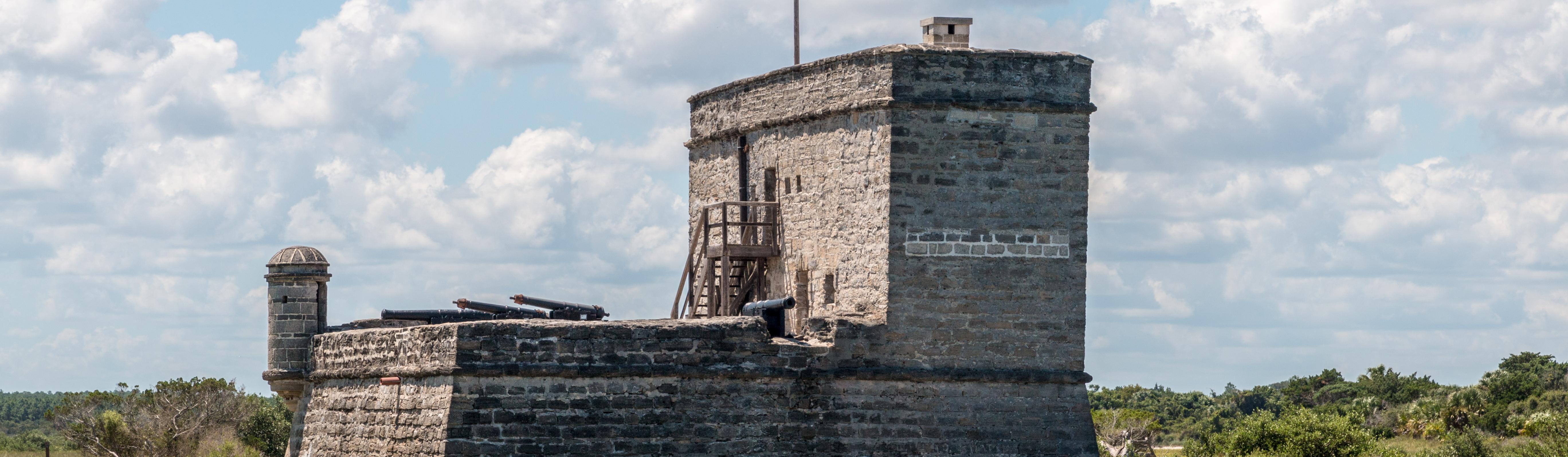
Fort Matanzas National Monument
fort in Florida managed by the National Park Service

Tequesta
thumb|A bronze statue of a Tequesta warrior and his family on the Brickell Avenue Bridge, Miami, created by [[Manuel Carbonell.]]
The Tequesta, also Tekesta, Tegesta, Chequesta, Vizcaynos, were a Native American tribe on the Southeastern Atlantic coast of Florida. They had infrequent contact with Europeans and had largely migrated by the middle of the 18th century.
Narváez expedition
16th-century Spanish journey of exploration in North America
West Florida
colony of Great Britain from 1763 to 1783
Florida Parishes
eight parishes in the southeastern part of the U.S. state of Louisiana
Castillo de San Marcos
historic fort in St. Augustine, Florida, USA
Mayaimi
right|thumb|Approximate territory of the Mayaimi tribe
The Mayaimi (also Maymi, Maimi) were Native American people who lived around Lake Mayaimi (now Lake Okeechobee) in the Belle Glade area of Florida from the beginning of the Common Era until the 17th or 18th century. In the languages of the Mayaimi, Calusa, and Tequesta tribes, Mayaimi meant "big water." The origin of the Calusa language has not been determined, as the meanings of only ten words were recorded before extinction. The current name, Okeechobee, is derived from the Hitchiti word meaning "big water". The Mayaimis have no linguist
Spanish Main
historical region
Tocobaga
Tocobaga (occasionally Tocopaca) was the name of a chiefdom of Native Americans, its chief, and its principal town during the 16th century. The chiefdom was centered around the northern end of Old Tampa Bay, the arm of Tampa Bay that extends between the present-day city of Tampa and northern Pinellas County. The exact location of the principal town is believed to be the archeological Safety Harbor site. This is the namesake for the Safety Harbor culture, of which the Tocobaga are the most well-known group.
De Soto National Memorial
National Memorial of the United States in Bradenton, United States of America
Fort Mose
Place in Florida listed on National Register of historic Places
State of Muskogee
Proclaimed nation in North America
Apalachee massacre
1704 raids by English colonists against Native Americans
Spanish West Florida
province of the Spanish Empire from 1783 to 1821
Potano
The Potano (also Potanou or Potavou, Timucua: Potano "That is happening now") tribe lived in north-central Florida at the time of first European contact. Their territory included what is now Alachua County, the northern half of Marion County and the western part of Putnam County. This territory corresponds to that of the Alachua culture, which lasted from about 700 until 1700. The Potano were among the many tribes of the Timucua people, and spoke a dialect of the Timucua language.
Saturiwa
The Saturiwa were a Timucua chiefdom centered on the mouth of the St. Johns River in what is now Jacksonville, Florida. They were the largest and best attested chiefdom of the Timucua subgroup known as the Mocama, who spoke the Mocama dialect of Timucuan and lived in the coastal areas of present-day northern Florida and southeastern Georgia. They were a prominent political force in the early days of European settlement in Florida, forging friendly relations with the French Huguenot settlers at Fort Caroline in 1564 and later becoming heavily involved in the Spanish mission system.
Battle of Flint River
1702 battle of Queen Anne's War
Siege of St. Augustine
1702 siege in North America
Fort Barrancas
fort
San Marcos de Apalache Historic State Park
place in Florida listed on National Register of Historic Places
Ibi
Timucua chiefdom in Spanish Florida
Republic of the Floridas
Amelia Island affair
Juan Ortiz
Spanish military personnel
Siege of Pensacola
1707 siege, part of Queen Anne's War
Raid on St. Augustine
1586 raid during the Anglo-Spanish War (1585–1604)
Siege of St. Augustine
1740 siege during the War of Jenkin's Ear
Santa Elena
human settlement in Spanish Florida (1566–1587)