Category
page 1Spider anatomy
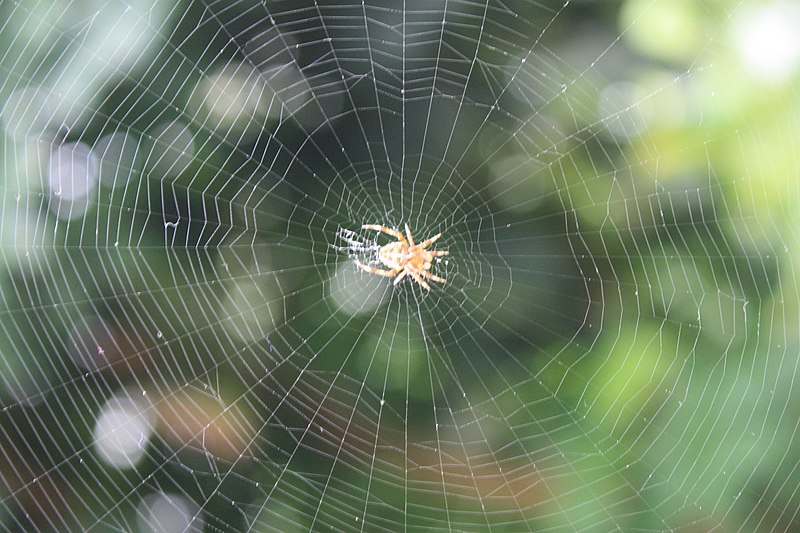
spider web
silk structure woven by a spider, designed to catch prey
spider silk
filament material produced by spiders

pedipalp
thumb|right|Green-shaded pedipalps in an illustrated dorsal view of a Uropygi|whip scorpion

spinneret
thumb|upright=1.35|The spinnerets of an Australian garden orb weaver spider.
exuviae
In biology, exuviae are the remains of an exoskeleton and related structures that are left after ecdysozoans (including insects, crustaceans and arachnids) have molted. The exuviae of an animal can be important to biologists as they can often be used to identify the species of the animal and even its sex.

clypeus
thumb|right|The clypeus of this jumping spider is covered with red scales.
The clypeus is one of the sclerites that make up the face of an arthropod. In insects, the clypeus delimits the lower margin of the face, with the labrum articulated along the ventral margin of the clypeus. The mandibles bracket the labrum, but do not touch the clypeus. The dorsal margin of the clypeus is below the antennal sockets. The clypeus is often well-defined by sulci ("grooves") along its lateral and dorsal margins, and is most commonly rectangular or trapezoidal in overall shape.
book lung
type of lung commonly found in arachnids

epigyne
thumb|upright=1.5|The external anatomy of a spider, with the epigyne labeled
thumb|upright=1.75|The internal anatomy of a spider, with the reproductive system (purple) reaching the exoskeleton at the epigyne
The epigyne or epigynum is the external genital structure of female spiders. As the epigyne varies greatly in form in different species, even in closely related ones, it often provides the most distinctive characteristic for recognizing species. It consists of a small, hardened portion of the exoskeleton located on the underside of the abdomen, in front of the epigastric furrow and between
urticating hair
defense mechanisms used by plants, tarantulas, and caterpillars
arthropod leg
locomotory appendage of arthropods

Cribellum
thumb|right|upright|Progradungula otwayensis ([[Gradungulidae) holding a snare made from silk spun from its cribellum]]
%20female%20on%20web%20Nyamebe%20Bepo.jpg)
web decoration
thumb|300px|Argiope (spider)|Argiope flavipalpis adult female
thumb|300px|An Argiope (spider)|Argiope juvenile femalespiders both same genuson the stabilimentum at the center of the web.
A stabilimentum (plural: stabilimenta), also known as a web decoration, is a conspicuous silk structure included in the webs of some species of orb-web spider. Its function is a subject of debate.
calamistrum
In spiders, the calamistrum is a row of specialized leg bristles used to comb out fine bands of silk. It is only found on cribellate spiders, that is, spiders that possess the spinning organ known as the cribellum. The calamistrum and cribellum are used to form the hackled bands of silk which are characteristic of the webs of these spiders. The calamistrum is found on the upper margin of the metatarsus of the hind legs. Each bristle of the calamistrum is serrated on one side and smooth on the other.
bulbus
part of a pedipalp of a male spider