Category
page 1Spider subfamilies
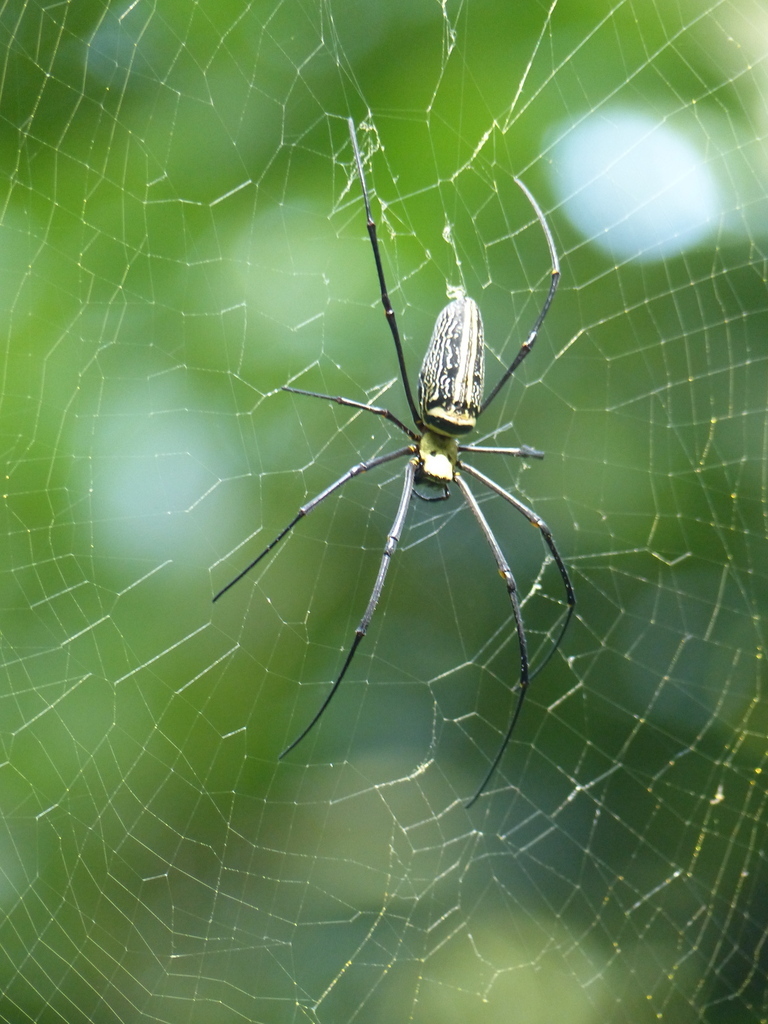
Nephilidae
Nephilinae is a spider subfamily in the family Araneidae, commonly referred to as golden orb-weavers. It has also been treated as the family Nephilidae. The various genera in the subfamily were formerly placed in Tetragnathidae. All nephiline genera partially renew their webs.
Micropholcommatidae
The Micropholcommatinae are a subfamily of araneomorph spiders in the family Anapidae. They were previously treated as the family Micropholcommatidae. Micropholcommatins are extremely small, with body lengths typically between 0.5 and 2 mm. They are usually found among leaf litter or moss.
Prodidomidae
Prodidomidae is a family of spider, sometimes called long-spinneret ground spiders. It was formerly regarded as a subfamily of Gnaphosidae, but was raised to a family in 2022.
Erigoninae
Erigoninae are the largest subfamily of sheet weavers (Linyphiidae), which is itself the second largest spider family. In the United States they are known as dwarf spiders, while they are called money spiders in England. The exact taxonomic limits of the subfamily are not yet known.
Theraphosinae
The Theraphosinae are a large subfamily of Mygalomorphae spiders in the family Theraphosidae found primarily in the Neotropical realm.
Salticinae
Salticinae is a subfamily of jumping spiders (family Salticidae). It includes over 90% of the known species of jumping spiders. The subfamily is divided into two unranked clades: Amycoida and Salticoida.
Harpactirinae
The Harpactirinae (commonly called baboon spiders) are a subfamily of tarantulas which are native to the continent of Africa. Like many Old World tarantulas, they have a relatively strong venom and can inflict a painful bite.
Spartaeinae
The Spartaeinae are a subfamily of the spider family Salticidae (jumping spiders). The subfamily was established by Fred R. Wanless in 1984 to include the groups Boetheae, Cocaleae, Lineae, Codeteae and Cyrbeae, which in turn were defined by Eugène Simon.
Ornithoctoninae
Ornithoctoninae is a subfamily of tarantulas found in Southeast Asia. It was first erected in 1895 by Reginald Innes Pocock based on the type specimen Ornithoctonus andersoni.
Stromatopelminae
The Stromatopelminae are a subfamily of tarantulas native to West Africa and part of Central Africa. The subfamily was first proposed by Günter Schmidt in 1993.
Aviculariinae
The Aviculariinae are a subfamily of spiders in the family Theraphosidae (tarantulas). They can be distinguished from other theraphosids by a number of characters. Their legs have no or few spines on the underside (ventral surface) of the tibial and metatarsal joints of the legs. The last two leg joints (the metatarsi and tarsi) have brushes of hairs (scopulae) that extend sideways, particularly on the front legs, giving them a spoon-like (spatulate) appearance. Females have two completely separated spermathecae.
Lyssomaninae
Lyssomaninae is a subfamily of jumping spiders. It includes four genera, three from the New World.
Selenocosmiinae
The Selenocosmiinae are a subfamily of tarantulas (Mygalomorphae: Theraphosidae) found throughout South-East Asia and Australia. This subfamily is defined by the presence of a lyra on the maxillae and strikers on the chelicerae, allowing these spiders to stridulate and produce a "hissing" sound. However some species within Phlogiellus may have secondary lost their lyra but retain their strikers. The monophyly of the subfamily has been only tested using genetic data with a handful of genera or species in a few studies. However, these studies found genera that had been previously placed in this
Selenogyrinae
The Selenogyrinae are a subfamily of tarantulas found in Africa and Asia.
Eumenophorinae
The Eumenophorinae are a subfamily of tarantula spiders (family Theraphosidae). They are known from genera distributed across Sub-Saharan Africa, the south of the Arabian peninsula, Madagascar and its associated islands, and parts of India.
Ischnocolinae
thumb|right
The Ischnocolinae are a problematic subfamily of tarantulas (family Theraphosidae). In 1892, Eugène Simon based the group, which he noted was only weakly homogeneous, on the presence of divided tarsal scopulae. This feature was later considered to be plesiomorphic (i.e. potentially inherited from an ancestor by multiple descendant groups), and both morphological and molecular phylogenetic studies have shown that, as traditionally circumscribed, the subfamily is not monophyletic. A much more narrowly defined Ischnocolinae sensu stricto was proposed in 2014. One of the authors of tha
Hisponinae
Hisponinae is a subfamily of jumping spiders (family Salticidae). The subfamily has six known extant genera and three extinct genera.