Category
page 1SQL

1753
year
SQL
Structured Query Language (SQL) (pronounced S-Q-L; or alternatively as "sequel") is a domain-specific language used to manage data, especially in a relational database management system (RDBMS). It is particularly useful in handling structured data, i.e., data incorporating relations among entities and variables.
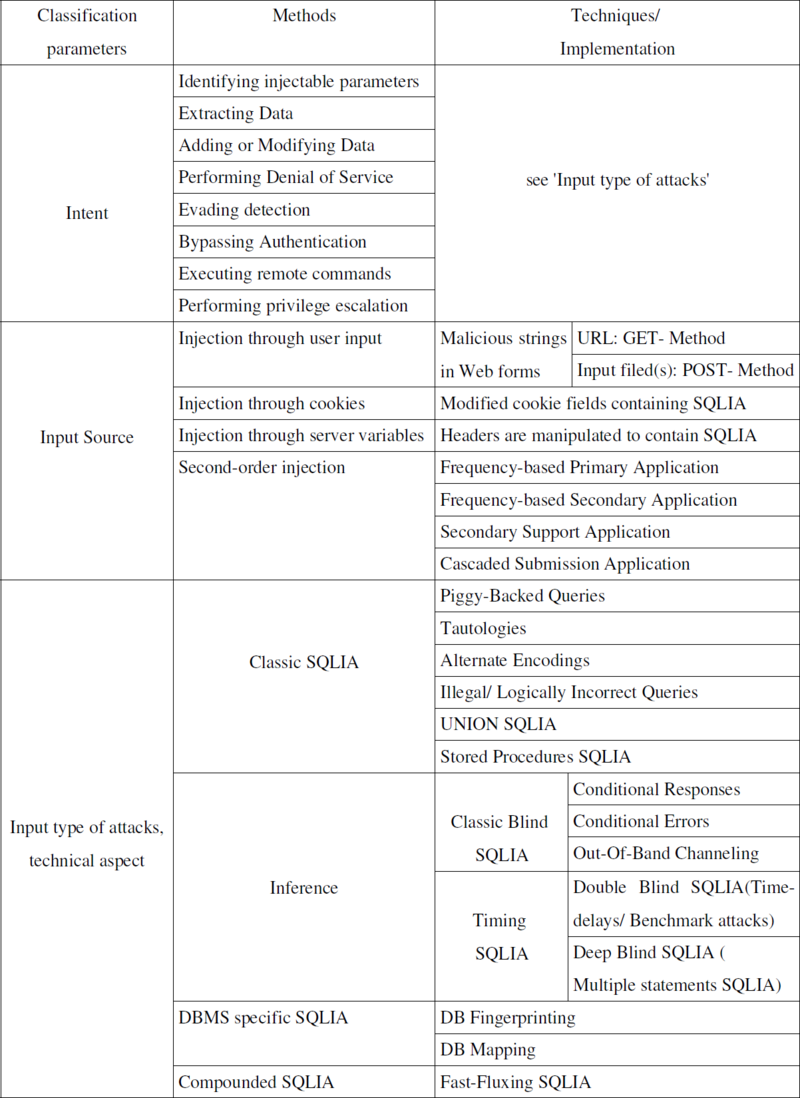
SQL injection
type of code injection, used to attack vulnerable data-driven software applications
PL/SQL
PL/SQL (Procedural Language for SQL) is Oracle Corporation's procedural extension for SQL and the Oracle relational database. PL/SQL is available in Oracle Database (since version 6 - stored PL/SQL procedures/functions/packages/triggers since version 7), TimesTen in-memory database (since version 11.2.1), and IBM Db2 (since version 9.7). Oracle Corporation usually extends PL/SQL functionality with each successive release of the Oracle Database.
database table
set of data elements arranged in rows and columns as part of a database
foreign key
field or collection of fields in one table that uniquely identifies a row of another table or the same table
data definition language
syntax for defining data structures in a database
data manipulation language
family of syntax elements used for selecting, inserting, deleting and updating data in a database
Transact-SQL
Transact-SQL (T-SQL) is Microsoft's and Sybase's proprietary extension to the SQL (Structured Query Language) used to interact with relational databases. T-SQL expands on the SQL standard to include procedural programming, local variables, various support functions for string processing, date processing, mathematics, etc. and changes to the DELETE and UPDATE statements.
view
result set of a stored query on a database
HSQLDB
HSQLDB (Hyper SQL Database) is a relational database management system written in Java. It has a JDBC driver and supports a large subset of SQL-92, SQL:2008, SQL:2011, and SQL:2016 standards. It offers a fast, small (around 1300 kilobytes in version 2.2) database engine which offers both in-memory and disk-based tables. Both embedded and server modes are available.
data control language
syntax used to control access to data stored in a database
MERGE
SQL statement

PL/pgSQL
PL/pgSQL (Procedural Language/PostgreSQL) is a procedural programming language supported by the PostgreSQL ORDBMS. It closely resembles Oracle's PL/SQL language. Implemented by Jan Wieck, PL/pgSQL first appeared with PostgreSQL 6.4, released on October 30, 1998. Version 9 also implements some ISO SQL/PSM features, like overloading of SQL-invoked functions and procedures.

database cursor
iterator over rows returned from a database query

Trino
Open-source distributed SQL query engine

query optimization
feature to execute queries efficiently in DBMS softwares
embedded SQL
SQL used as an embedded domain-specific language
user-defined function
function provided by the user of a program or environment
SQL:1999
SQL:1999 (also called SQL 3) was the fourth revision of the SQL database query language. It introduced many new features, many of which required clarifications in the subsequent SQL:2003. In the meanwhile SQL:1999 is deprecated.
SQL:2008
SQL:2008 is the sixth revision of the ISO and ANSI standard for the SQL database query language. It was formally adopted in July 2008. The standard consists of 9 parts which are described in detail in SQL. The next iteration is SQL:2011
Call Level Interface
APIT and software standard
query plan
sequence of steps used to access data in a SQL relational database management system
window function
kind of function in SQL; calculations across a set of table rows that are somehow related to the current row
SQL:2011
SQL:2011 or ISO/IEC 9075:2011 (under the general title "Information technology – Database languages – SQL") is the seventh revision of the ISO (1987) and ANSI (1986) standard for the SQL database query language. It was formally adopted in December 2011. The standard consists of 9 parts which are described in detail in SQL.
The next version is SQL:2016.
SQL-92
SQL-92 (also called SQL 2) was the third revision of the SQL database query language. Unlike SQL-89, it was a major revision of the standard. Aside from a few minor incompatibilities, the SQL-89 standard is forward-compatible with SQL-92.
varchar
A VARCHAR or variable character field is a set of character data of indeterminate length. The term varchar refers to a data type of a field (or column) in a database which can hold letters and numbers. Varchar fields can be of any size up to a limit, which varies by databases: an Oracle 11g database has a limit of 4000 bytes, a MySQL 5.7 database has a limit of 65,535 bytes (for the entire row) and Microsoft SQL Server 2008 has a limit of 8000 bytes (unless varchar(max) is used, which has a maximum storage capacity of 2 gigabytes).
Apache Drill
open-source software framework
hierarchical and recursive SQL queries
hierarchical and recursive queries in SQL
WQL
Windows Management Instrumentation Query Language (WQL) is Microsoft's implementation of the CIM Query Language (CQL), a query language for the Common Information Model (CIM) standard from the Distributed Management Task Force (DMTF). It is a subset of ANSI standard SQL with minor semantic changes.
Pro*C
Pro*C (also known as Pro*C/C++) is an embedded SQL programming language used by Oracle Database DBMSes. Pro*C uses either C or C++ as its host language. During compilation, the embedded SQL statements are interpreted by a precompiler and replaced by C or C++ function calls to their respective SQL library. The output from the Pro*C precompiler is standard C or C++ code that is then compiled by any one of several C or C++ compilers into an executable.
prepared statement
database feature
Presto
distributed SQL query engine
SQL:2003
SQL:2003 is the fifth revision of the SQL database query language. The standard consists of 9 parts which are described in detail in SQL. It was updated by SQL:2006.
SQL:2016
SQL:2016 or ISO/IEC 9075:2016 (under the general title "Information technology – Database languages – SQL") is the eighth revision of the ISO (1987) and ANSI (1986) standard for the SQL database query language. It was formally adopted in December 2016. The standard consists of 9 parts which are described in some detail in SQL. The next version is SQL:2023.
commit
computer operation that makes a set of tentative changes permanent
SQL/MED
The SQL/MED ("Management of External Data") extension to the SQL standard is defined by ISO/IEC 9075-9:2008 (originally defined for SQL:2003). SQL/MED provides extensions to SQL that define foreign-data wrappers and datalink types to allow SQL to manage external data. External data is data that is accessible to, but not managed by, an SQL-based DBMS. This standard can be used in the development of federated database systems.
check constraint
type of integrity constraint in SQL
SQL/XML
SQL/XML or XML-Related Specifications is part 14 of the Structured Query Language (SQL) specification. In addition to the traditional predefined SQL data types like NUMERIC, CHAR, TIMESTAMP, ... it introduces the predefined data type XML together with constructors, several routines, functions, and XML-to-SQL data type mappings to support manipulation and storage of XML in a SQL database.