Category
page 1Subatomic particles

atomic nucleus
core of the atom; composed of bound nucleons (protons and neutrons)

elementary particle
quantum particle having no known substructure; quark, electron, photon, etc.
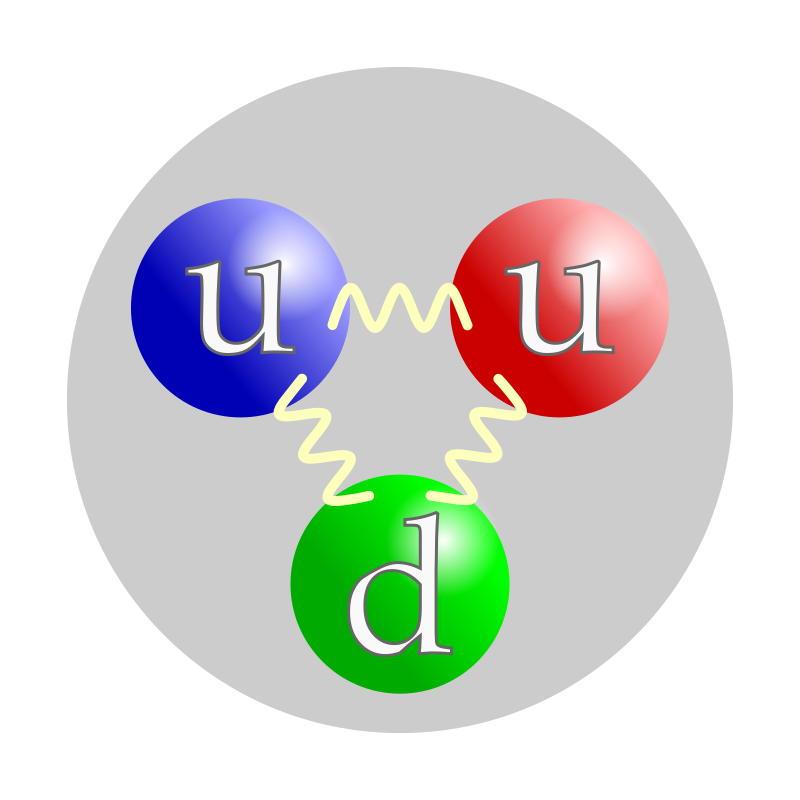
subatomic particle
particle smaller than an atom

antiparticle
thumb|alt=Diagram illustrating the particles and antiparticles of electron, neutron and proton, as well as their "size" (not to scale). It is easier to identify them by looking at the total mass of both the antiparticle and particle. On the left, from top to bottom, is shown an electron (small red dot), a proton (big blue dot), and a neutron (big dot, black in the middle, gradually fading to white near the edges). On the right, from top to bottom, are shown the anti electron (small blue dot), anti proton (big red dot) and anti neutron (big dot, white in the middle, fading to black near the edg
list of quantum particle types
Wikimedia list article
ultra-high-energy cosmic ray
cosmic-ray particle with a kinetic energy greater than 1 EeV (10¹⁸ eV)
Pomeron
In physics, the pomeron is a Regge trajectory — a family of particles with increasing spin — postulated in 1961 to explain the slowly rising cross section of hadronic collisions at high energies. It is named after Isaak Pomeranchuk.