Category
page 1Sukarno

Sukarno
Sukarno (born Koesno Sosrodihardjo; 6 June 1901 – 21 June 1970) was an Indonesian statesman, activist, and revolutionary who served as the first president of Indonesia from 1945 to 1967.

Megawati Soekarnoputri
5th President of Indonesia (2001—2004) and 8th Vice President of Indonesia (1999—2001)

Asian–African Conference
1955 meeting of Asian and African states in Bandung, West Java, Indonesia

Mohammad Hatta
1st vice president of Indonesia from 1945 to 1956 (1902–1980)
Blitar
Blitar is a landlocked city in East Java, Indonesia, about 73 km from Malang and 167 km from Surabaya. The area lies within longitude 111° 40' – 112° 09' East and its latitude is 8° 06' South. The city of Blitar lies at an altitude on average 167 metres above sea level, and is an enclave within Blitar Regency which surrounds the city on all sides. It covers an area of 32.57 km2, and had a population of 131,968 at the 2010 Census and 149,149 at the 2020 Census; the official estimate as at mid 2024 was 161,204 (comprising 80,376 males and 80,828 females).
Indonesia–Malaysia confrontation
military conflict (1963–1966)
Proclamation of Indonesian Independence
1945 document declaring Indonesian independence from the Netherlands
Constitution of Indonesia
constitution of the Republic of Indonesia

Marhaenism
Marhaenism ( ) is a socialistic political ideology originated and developed by the first President of Indonesia, Sukarno. It was developed from the ideas of Marxism applied according to the nature and culture of Indonesia, or simply described as "Marxism adapted to Indonesian conditions".
Chairul Saleh
Indonesian politician
1955 Indonesian legislative election
1st legislative election in Indonesia

Nasakom
Nasakom (), which stands for nationalism, religion and communism, was a political concept coined by President Sukarno. This concept prevailed in Indonesia from 1959 during the Guided Democracy Era until the New Order, in 1966. Sukarno's idea of Nasakom was an attempt to unify various political ideologies. Nasakom attempted to unite the nationalist, religious, and communist groups that at that time had the most power in Indonesian politics.
Operation Trikora
1961–1962 Indonesian military operation
communist insurgency in Sarawak
communist insurgency in Malaysia

Revolutionary Government of the Republic of Indonesia
oppostion governent in Sumatra (1958–1961)
Guided Democracy
Indonesian political system
Ruslan Abdulgani
Government official, diplomat (1914-2005)
Guruh Sukarnoputra
Indonesian musician, actor, politician
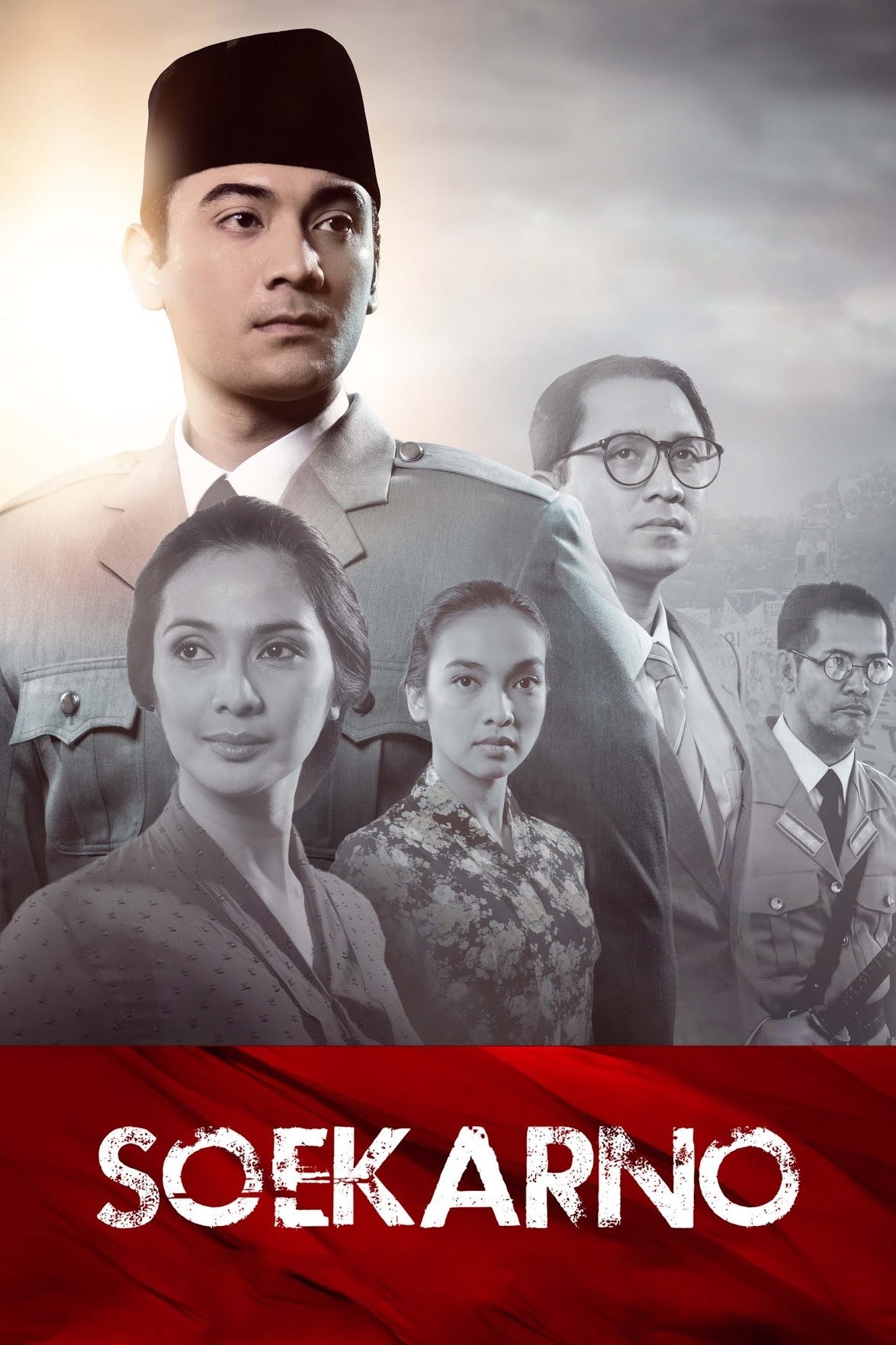
Soekarno: Indonesia Merdeka
2013 film by Hanung Bramantyo
Supersemar
The Order of Eleventh March (), commonly referred to by its syllabic abbreviation Supersemar, was a document signed by the Indonesian President Sukarno on 11 March 1966, giving army commander Lt. Gen. Suharto authority to take whatever measures he "deemed necessary" to restore order to the chaotic situation during the Indonesian mass killings of 1965–66. The abbreviation "Supersemar" is also a play on the name of Semar, the mystic and powerful figure who commonly appears in Javanese mythology including wayang puppet shows. The invocation of Semar was presumably intended to help draw on Javanes
Liberal democracy period in Indonesia
The era in which President Soekarno ruled using the 1950 Republic of Indonesia Constitution
Transition to the New Order
Period of Indonesian history
Prijono
thumb|Prijono
Prijono (20 July 1907 – 6 March 1969) was an Indonesian politician and academic. Prijono was a leading figure of the Murba Party and the Indonesian Peace Committee. Prijono served as Minister of Education and Culture between 1957 and 1966. He was one of the intellectual ideologues who surrounded President Sukarno.
1st Summit of the Non-Aligned Movement
1961 Non-Aligned Movement Summit in Belgrade, Yugoslavia
Constitutional Assembly of Indonesia
Grave of Sukarno
grave of Sukarno in East Java, Indonesia