Category
page 1Summer holidays (Northern Hemisphere)
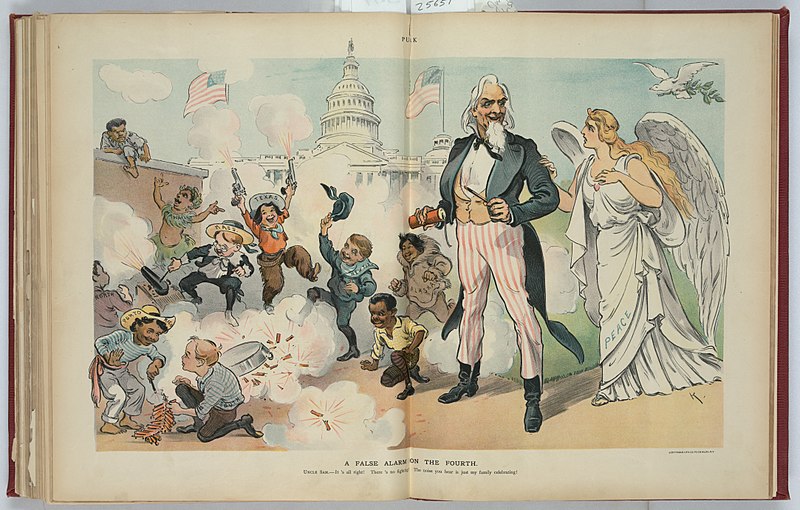
Independence Day
United States holiday held on July 4 to mark the Declaration of Independence

Sabantuy
Sabantuy is a Tatar, Idel-Uralian, Bashkir and Kazakh ('Sabantoy') summer festival, that dates back to the Volga Bulgarian epoch. At first Sabantuy was a festival of farmers in rural areas, but it later became a national holiday and now is widely celebrated in the cities. In 2012, Kazan Sabantuy was celebrated on June 23.

Neptunalia
The Neptunalia was an obscure archaic two-day festival in honor of Neptune as god of waters, celebrated at Rome in the heat and drought of summer, probably 23 July (Varro, De lingua Latina vi.19). It was one of the dies comitiales, when committees of citizens could vote on civil or criminal matters. In the ancient calendar this day is marked as Nept. ludi et feriae, or Nept. ludi, from which Leonhard Schmitz (in Smith, see link) concluded that the festival was celebrated with games (ludi). Respecting the ceremonies of this festival nothing is known, except that the people used to build huts of

Yhyakh
Yhyаkh (, ) is the festival that celebrates the rebirth of nature after a hard winter, the triumph of life, the beginning of a new year in the Sakha Republic. Historic celebration is observed on the 21st June, the day of the summer solstice.
Consualia
The Consualia or Consuales Ludi was the name of two ancient Roman festivals in honor of Consus, a tutelary deity of the harvest and stored grain. Consuales Ludi harvest festivals were held on August 21, and again on December 15, in connection with grain storage. The shrine of Consus was underground, it was covered with earth all year and was only uncovered for this one day. Mars, the god of war, as a protector of the harvest, was also honored on this day, as were the Lares, the household gods that individual families held sacred.

Jāņi
thumb|A man with an oak leaf wreath lighting up a pūdele (a container filled with tar, decorated with oak leaves and attached atop of a pole).
thumb|Jāņi cheese
Jāņi () is an annual Latvian festival celebrating the summer solstice. Although, astronomically the solstice falls on the 21st or 22nd of June, the public holidays—Līgo Day and Jāņi Day—are on the 23rd and 24th of June. The day before Jāņi is known as Līgosvētki, Līgovakars or simply known as Līgo.
Furrinalia
In ancient Roman religion, the Furrinalia (or Furinalia) was an annual festival held on 25 July to celebrate the rites (sacra) of the goddess Furrina. Varro notes that the festival was a public holiday (feriae publicae dies). Both the festival and the goddess had become obscure even to the Romans of the Late Republic; Varro (mid-1st century BC) notes that few people in his day even know her name. One of the fifteen flamines (high priests of official cult) was assigned to her, indicating her archaic stature, and she had a sacred grove (lucus) on the Janiculum, which may have been the location o

Adonia
thumb|300px|Celebrating the Adonia: fragment of an Attic red-figure wedding vase, ca. 430–420 BCE
Beñesmen
The Beñesmen or Beñesmer was the most important festival of the ancient aborigines of the Canary Islands, mainly between the Guanches of the island of Tenerife. It was the feast of the harvest, it ordered Aboriginal affairs materials, and celebrated, venerated cultural and spiritual traditions. It was considered the "New Year", which coincided with the collection of the harvest. They were held during the first moon of August. Beñesmen was also the name with which the Guanches knew the month of August.
Aadi Perukku
South Indian Hindu festival
Republic Day (Philippines)
public holiday in the Philippines
Medoviy Spas
Slavic folk Christianity
Liberation Day
public holiday in Rwanda commemorating the end of the 1994 genocide against the Tutsi