Category
page 1Summer solstice

Stonehenge
Stonehenge is a prehistoric megalithic structure on Salisbury Plain in Wiltshire, England, west of Amesbury. It consists of an outer ring of vertical sarsen standing stones, each around high, wide, and weighing around 25 tons, topped by connecting horizontal lintel stones which are held in place with mortise and tenon joints—a feature unique among contemporary monuments. Inside is a ring of smaller bluestones. Inside, these are free-standing trilithons, two bulkier vertical sarsens joined by a single lintel. The whole monument, now in ruins, is aligned towards the sunrise on the summer solstic

midnight sun
natural phenomenon when daylight lasts for more than 24 hours, occuring only inside or close to the polar circles
Music Day
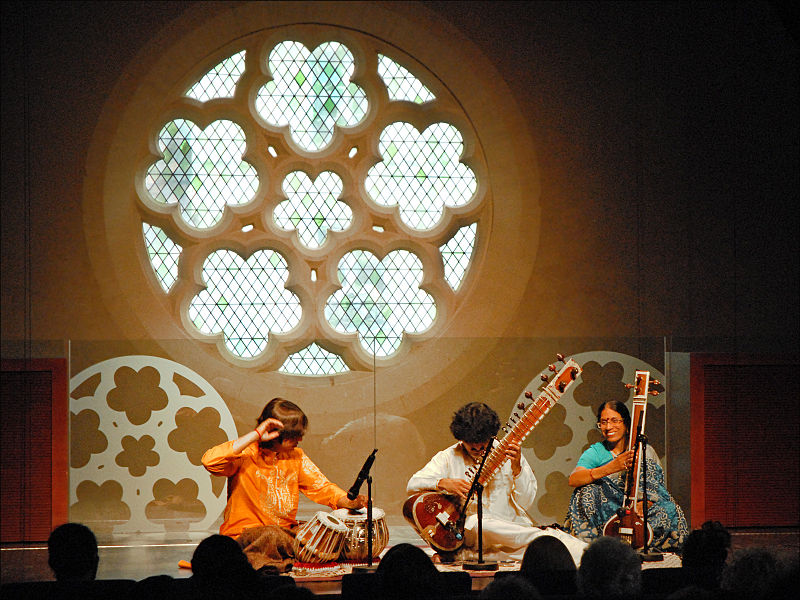
annual music celebration

summer solstice
astronomical phenomenon that occurs in June in Northern Hemisphere and in December in Southern Hemisphere

St John's Eve
evening of June 23, celebration

Midsummer
Midsummer or Midsommar ( ) is a celebration of the season of summer, taking place on or near the date of the summer solstice in the Northern Hemisphere, the longest day of the year. The name midsummer mainly refers to summer solstice festivals of European origin. These cultures traditionally regard it as the middle of summer, with the season beginning on May Day. Although the summer solstice falls on 20, 21 or 22 June in the Northern Hemisphere, it was traditionally reckoned to fall on 23–24 June in much of Europe. These dates were Christianized as Saint John's Eve and Saint John's Day. It is

Sabantuy
Sabantuy is a Tatar, Idel-Uralian, Bashkir and Kazakh ('Sabantoy') summer festival, that dates back to the Volga Bulgarian epoch. At first Sabantuy was a festival of farmers in rural areas, but it later became a national holiday and now is widely celebrated in the cities. In 2012, Kazan Sabantuy was celebrated on June 23.
Kupala Night
East-Slavic folk holiday in Ukraine, Belarus, Poland and Russia

Meton of Athens
5th century BC Greek astronomer
Manhattanhenge
Manhattanhenge, also called the Manhattan Solstice, is an event during which the setting sun or the rising sun is aligned with the east–west streets of the main street grid of Manhattan, New York City. The astrophysicist Neil deGrasse Tyson claims to have coined the term, by analogy with Stonehenge. The sunsets and sunrises each align twice a year, on dates evenly spaced around the summer solstice and winter solstice. The sunset alignments occur around May 28 and July 13. The sunrise alignments occur around December 5 and January 8.
Bryn Celli Ddu
prehistoric site on the Welsh island of Anglesey; Neolithic henge monument
Fern flower
Mythical flower blooming only on the night before Ivan Kupala or Midsummer

Yhyakh
Yhyаkh (, ) is the festival that celebrates the rebirth of nature after a hard winter, the triumph of life, the beginning of a new year in the Sakha Republic. Historic celebration is observed on the 21st June, the day of the summer solstice.
December solstice
solstice that occurs each December (winter solstice in Northern Hemisphere and summer solstice in Southern Hemisphere)
June solstice
solstice that occurs each June (summer solstice in Northern Hemisphere and winter solstice in Southern Hemisphere)
Tiregān
Tirgan (, Tirgān), is an early summer ancient Iranian festival, celebrated annually on Tir 13 (July 2, 3, or 4).
It is celebrated by splashing water, dancing, reciting poetry, and serving traditional foods such as spinach soup and sholezard. The custom of tying rainbow-colored bands on wrists, which are worn for ten days and then thrown into a stream, is also a way to rejoice for children.

Jāņi
thumb|A man with an oak leaf wreath lighting up a pūdele (a container filled with tar, decorated with oak leaves and attached atop of a pole).
thumb|Jāņi cheese
Jāņi () is an annual Latvian festival celebrating the summer solstice. Although, astronomically the solstice falls on the 21st or 22nd of June, the public holidays—Līgo Day and Jāņi Day—are on the 23rd and 24th of June. The day before Jāņi is known as Līgosvētki, Līgovakars or simply known as Līgo.
Uttarayana
The term Uttarāyaṇa (commonly Uttarayanam) is derived from two different Sanskrit words – "uttaram" (North) and "ayanam" (movement) – thus indicating the northward movement of the Sun. In the Gregorian calendar, this pertains to the "actual movement of the sun with respect to the earth." It is also known as the six-month period that occurs between the winter solstice and the summer solstice (approximately 20 December - 20 June). According to the Indian solar calendar, it refers to the movement of the Sun through the zodiac. This difference occurs because the solstices continually precess at a
Xiazhi
Xiàzhì is the 10th solar term, and marks the summer solstice, in the traditional Chinese lunisolar calendar dividing a year into 24 solar terms.
Lammas
Lammas (from Old English hlāfmæsse, "loaf-mass"), also known as Loaf Mass Day, is a Christian holiday celebrated in some English-speaking countries on 1 August. The name originates from the word "loaf" in reference to bread and "Mass" in reference to the Eucharist. It is a festival in the liturgical calendar to mark the blessing of the First Fruits of harvest, with a loaf of bread being brought to the church for this purpose. Lammastide falls at the halfway point between the summer solstice and the autumn equinox. Christians also have church processions to bakeries, where those working therein
MAX IV
Swedish national X-ray laboratory
Afqa
Afqa (; also spelled Afka) is a village and municipality located in the Byblos District of the Keserwan-Jbeil Governorate, northeast of Beirut in Lebanon. It has an average elevation of 1,200 meters above sea level and a total land area of 934 hectares. Its inhabitants are predominantly Shia Muslims.
Buena Vista
archaeological site in Peru
National Aboriginal Day
recognizing Indigenous peoples in Canada
seasonal lag
e.g., peak annual temperature typically occurs after the summer solstice
Intipunku
archaeological site in Peru
Kresnik Award
Slovenian literary award

A Long Day's Night
2002 live album by Blue Öyster Cult
Dakshinayana
Dakshinayana () is a Hindu astronomical concept that refers to the movement of the sun to the south of the equator, and is also a term that indicates the six-month period between the summer solstice and the winter solstice. Dakshinayana begins on Karka Sankranti or July 16, as it marks the transition of the sun into Karka rashi (Cancer).
Sânziană
thumb|200px|Sânziene (Lady's Bedstraw flowers)
thumbnail|Sânzienele at Cricău Festival 2013
Grange stone circle
stone circle in County Limerick, Ireland
Conjunto megalítico da Herdade do Xerez
stone circle in Monsaraz, Portugal