Category
page 1Sun

Sun
The Sun is the star located at the centre of the Solar System. It is a massive sphere of hot plasma, heated to incandescence by nuclear fusion reactions in its core, radiating the energy from its surface mainly as visible light and infrared radiation with 10% at ultraviolet energies. It is the main source of energy for life on Earth. The Sun has been an object of veneration in many cultures and a central subject of astronomical research since antiquity.

solar mass
standard unit of mass in astronomy which is equal to 1.98892 × 10³⁰ kg

sunlight
thumb|right|The Sun, as seen from low Earth orbit overlooking the International Space Station. This sunlight is not filtered by the lower atmosphere, which blocks much of the solar spectrum.

midnight sun
natural phenomenon when daylight lasts for more than 24 hours, occuring only inside or close to the polar circles

sunglasses
thumb|upright=1.2|Wearing sunglasses under direct sunlight: Large lenses offer good protection, but broad temple arms are also needed against "stray light" from the sides.
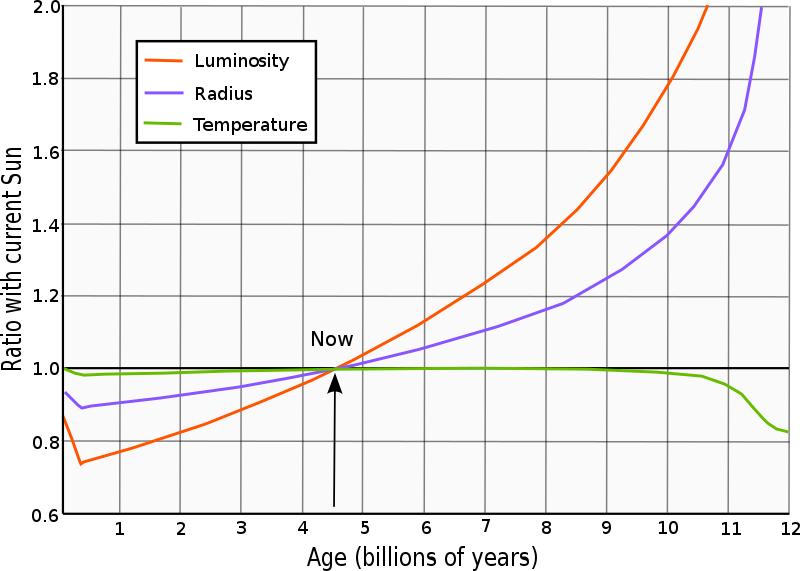
solar radius
unit of measurement
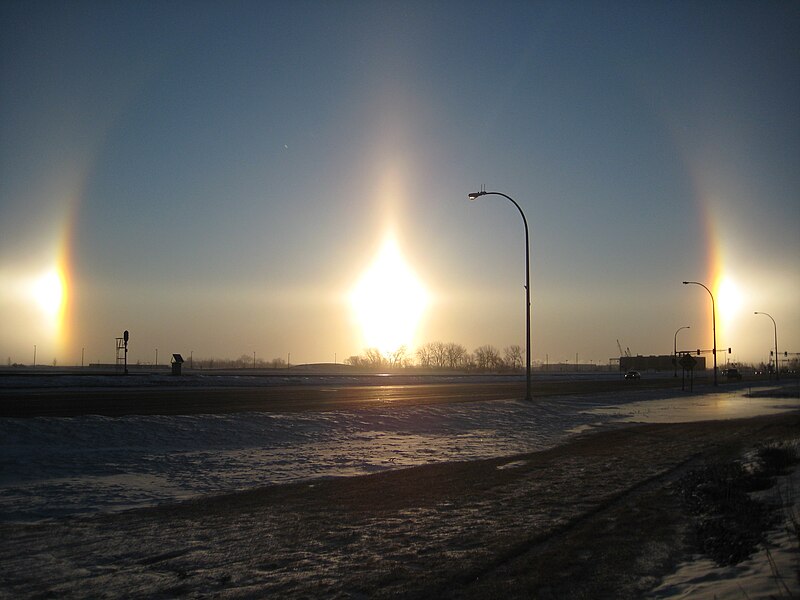
sun dog
atmospheric optical phenomenon

solar power
conversion of energy from sunlight into electricity
solar luminosity
unit of radiant flux in astronomy

phototropism
thumb|The light from the lamp (1.) functions as a detectable change in the plant's environment. As a result, the plant exhibits a reaction of phototropism—directional growth (2.) toward the light stimulus.
thumbnail|Auxin distribution controls phototropism.
1. Sunlight strikes the plant from directly above. Auxin (pink dots) encourages growth straight up.
2, 3, 4. Sunlight strikes the plant at an angle. Auxin is concentrated on one side, stimulating growth at an angle from the preceding stem.
thumb|Phototropism in Solanum lycopersicum.

solar constant
intensity of sunlight
crepuscular ray
rays of sunlight that appear to radiate from the point in the sky where the sun is located
facula
bright spot
granule
convection cell in the photosphere of a star

helioseismology
Helioseismology is the study of the structure and dynamics of the Sun through its oscillations. These are principally caused by sound waves that are continuously driven and damped by convection near the Sun's surface. It is similar to geoseismology, or asteroseismology, which are respectively the studies of the Earth or stars through their oscillations. While the Sun's oscillations were first detected in the early 1960s, it was only in the mid-1970s that it was realized that the oscillations propagated throughout the Sun and could allow scientists to study the Sun's deep interior. The term was
solar telescope
special purpose telescope used to observe the Sun
faint young Sun paradox
apparent mystery that the early Earth seems to have had liquid water, even though the young Sun was less bright, thus presumably completely freezing the Earth
bow shock
boundary between a magnetosphere and an ambient magnetized medium, for example when the solar wind encounters the magnetic field of Earth

heliometer
300px|thumb|right|Heliometer at the Kuffner observatory (Vienna, Austria)
alt=Brass Heliometer Split lens (glass lens held in brass housing, with split down the middle, and screw mechanism to move one half relative to the other)|thumb|Heliometer split lens, displayed at Custer Observatory, Long Island, New York.
A heliometer (from Greek 'sun' and 'measure') is an instrument originally developed from the mid-eighteenth to early nineteenth centuries for measuring the variation of the Sun's diameter at different seasons of the year, but the modern version of the instrument is capable of much wide
solar neutrino problem
major discrepancy between measurements of the numbers of neutrinos flowing through the Earth and theoretical models of the solar interior

heliophysics
thumb|upright=1.5|This image presents various wavelengths of light produced by the Sun.
solar transition region
Section of Sun's atmosphere
coronal loop
structure in the lower corona and transition region of the Sun
diffuse sky radiation
Solar radiation scattered and absorbed in Earth's atmosphere

heliotropism
thumb |400px |Daisies (Bellis perennis) face the Sun after opening in the morning and will follow the Sun through the day.
Heliotropism, a form of tropism, is the diurnal or seasonal motion of plant parts (flowers or leaves) in response to the direction of the Sun.
solar physics
branch of astrophysics
solar rotation
the pattern of rotation of components of the Sun
Solar dynamo
physical process that generates a star's magnetic field
solar neutrino
neutrinos produced in the core of the sun through various nuclear fusion reactions

spectroheliograph
thumb|The solar disk observed in four different wavelengths of ultraviolet radiation by the Atmospheric Imaging Assembly spectroheliograph on board the [[Solar Dynamics Observatory. From left to right, the wavelengths imaged are 171, 304, 335, and 94 Å. Colors are false and added in postprocessing.]]
The spectroheliograph is an instrument used in astronomy which captures a photographic image of the Sun at a single wavelength of light, a monochromatic image. The wavelength is usually chosen to coincide with a spectral wavelength of one of the chemical elements present in the Sun.
Birkat Hachama
Jewish blessing, thanking God for creating the sun, recited when the sun completes its cycle every 28 years on a Tuesday at sundown
Lahaina Noon
tropical solar phenomenon
Position of the Sun
Apparent location of the Sun in the sky
starquake
surface shaking on interstellar bodies in general

solar viewer
type of eye-wear used to view the sun
solar elevation angle
angle between the zenith and the centre of the Sun's disc
Solar equator
circle of latitude
sun sign astrology
form of astrology, commonly found in newspapers, which considers only the position of the Sun at birth, placed within one of the twelve zodiac signs, which is then related to the current movements of all the planets
Helmet streamer
sunward-traveling plasma voids observed in the Sun’s outer atmosphere
sun
heraldic figure

sungazing
thumb|alt=A man with his back to the camera stares directly at a twilight sun.|A man sungazing
Solar transit
The transit of an astronomical object in front of the Sun from the Earth's perspective
sun glitter
sparkling light formed when sunlight reflects from water waves
sunbeam
thumb|Sunbeams in Nevada during a sunset
thumb|Daytime sunbeams as seen from the ISS, illustrating their parallel nature
A sunbeam, in meteorological optics, is a beam of sunlight that appears to radiate from the position of the Sun. Shining through openings in clouds or between other objects such as mountains and buildings, these beams of particle-scattered sunlight are essentially parallel shafts separated by darker shadowed volumes. Their apparent convergence in the sky is a visual illusion from linear perspective. The same illusion causes the apparent convergence of parallel lines on a lon
Space climate
Branch of solar physics and aeronomy
Nanoflares
thumb|A close-up of one of the loop brightenings. The frame on the far right is the most zoomed in, showing the putative nanoflare.
thumb|"This false-color temperature map shows solar active region AR10923, observed close to center of the sun's disk. Blue regions indicate plasma near 10 million degrees K." Credit: Reale, et al. (2009), NASA.
Ellerman bombs
Brightenings in the Sun's chromosphere
solar simulator
device that provides illumination approximating natural sunlight
Solar azimuth angle
Azimuth angle of the Sun's position
Coronal seismology
Technique of studying the Sun's corona
International Heliophysical Year
sun chart