Category
page 1Supernumerary body parts

hermaphrodite
300px|thumb|Cornu aspersum|Garden snails mating
A hermaphrodite () is a sexually reproducing organism that produces both male and female gametes. Animal species in which individuals are either male or female are gonochoric, which is the opposite of hermaphroditic.
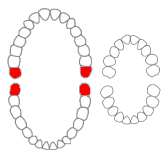
wisdom tooth
rearmost teeth of the mouth that erupt during adulthood

polydactyly

hyperdontia
Hyperdontia is the condition of having supernumerary teeth, or teeth that appear in addition to the regular number of teeth (32 in the average adult). They can appear in any area of the dental arch and can affect any dental organ. The opposite of hyperdontia is hypodontia, where there is a congenital lack of teeth, which is a condition seen more commonly than hyperdontia. The scientific definition of hyperdontia is "any tooth or odontogenic structure that is formed from tooth germ in excess of usual number for any given region of the dental arch." The additional teeth, which may be few or many
diphallia
Diphallia, penile duplication (PD), diphallic terata, or diphallasparatus is an extremely rare developmental abnormality in which a male is born with two penises. The first reported case was by Johannes Jacob Wecker in 1609. Its occurrence is 1 in 5.5 million newborn.
nubbin
additional nipple occurring in mammals
fetus in fetu
fetus-like tissue mass within a fetus, abnormality of twin pregnancy
polydactyl cat
cats with genetic anomaly that causes extra toes
uterus didelphys
human disease

polycephaly
thumb|The Giacomo and Giovanni Battista Tocci|Tocci Brothers, c. 1881

polymelia
Polymelia is a birth defect in which an affected individual has more than the usual number of limbs. It is a type of dysmelia. In humans and most land-dwelling vertebrates, this means having five or more limbs. The extra limb is most commonly shrunken or deformed. The term is from Greek πολυ- "many", μέλεα "limbs".
cervical rib
supernumerary rib bone
dysmelia
thumb|Piglet (animal)|Piglet with [[dipygus at Ukrainian National Chernobyl Museum in Kyiv]]
Dysmelia (from the Greek (), "bad" + (), "limb" + English suffix -ia) is a congenital disorder of a limb resulting from a disturbance in embryonic development.
polyorchidism
Polyorchidism is the incidence of more than two testicles. It is a very rare congenital disorder, with fewer than 200 cases reported in medical literature and six cases (two horses, two dogs and two cats) in veterinary literature.
duplicated ureter
human disease