Category
page 1Syntax

syntax
In linguistics, syntax ( ) is the study of how words and morphemes well-formed combine to form larger units such as phrases and sentences. Central concerns with syntax include word order, grammatical relations, hierarchical sentence structure (constituency), agreement, the nature of crosslinguistic variation, and the relationship between form and meaning (semantics). Diverse approaches, such as generative grammar and functional grammar, offer unique perspectives on syntax, reflecting its complexity and centrality to understanding human language.
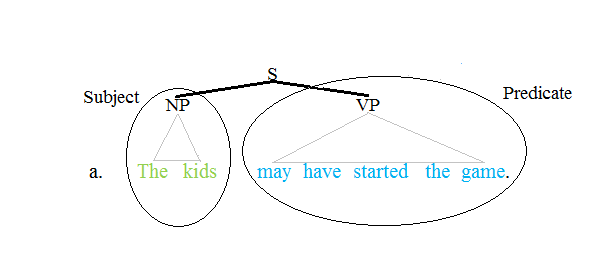
predicate
sentence constituent

compound
lexeme that consists of more than one stem
pleonasm
Pleonasm (; , ) is redundancy in linguistic expression, such as "black darkness", "burning fire", or "the man he said". It is a manifestation of tautology by traditional rhetorical criteria. Pleonasm may also be used for emphasis, or because the phrase has become established in a certain form. Tautology and pleonasm are not consistently differentiated in literature.
adposition
Adpositions are a class of words used to express spatial or temporal relations (in, under, towards, behind, ago, etc.) or mark various semantic roles (of, for). The most common adpositions are prepositions (which precede their complement) and postpositions (which follow their complement).
ellipsis
omission from a clause of one or more words that are nevertheless understood in the context of the remaining elements
word order
study of the order of the syntactic constituents of a language, and how different languages can employ different orders
clitic
In morphology and syntax, a clitic ( , backformed from Greek "leaning" or "enclitic") is a morpheme that has syntactic characteristics of a word, but depends phonologically on another word or phrase. In this sense, it is syntactically independent but phonologically dependent—always attached to a host. A clitic is pronounced like an affix, but plays a syntactic role at the phrase level. In other words, clitics have the form of affixes, but the distribution of function words.
formal grammar
structure of a formal language
agreement
linguistic concept; change of the form of a word depending on the other words to which it relates
valency
the number of arguments controlled by a predicate
anaphora
type of expression whose reference depends upon another referential element
relative clause
grammatical structure in some languages
parse tree
ordered, rooted tree that represents the syntactic structure of a string according to some context-free grammar
context-free language
formal language that is a member of the set of languages defined by context-free grammars
coherence
in linguistics, what makes a text semantically meaningful
consonant mutation
type of consonant change depending on context and surrounding words
interrogative
An interrogative clause is a clause whose form is typically associated with question-like meanings. For instance, the English sentence "Is Hannah sick?" has interrogative syntax which distinguishes it from its declarative counterpart "Hannah is sick". Also, the additional question mark closing the statement assures that the reader is informed of the interrogative mood. Interrogative clauses may sometimes be embedded within a phrase, for example: "Paul knows who is sick", where the interrogative clause "who is sick" serves as complement of the embedding verb "know".
nominative–accusative language
language which treats subjects of intransitive verbs like subjects of transitive verbs
constituent
word or a group of words that functions as a single unit within a hierarchical structure
RAS syndrome
using an acronym followed by one of the words composing that acronym
government
in linguistics, relationship between word and its dependents
redundancy
in linguistics, information that is expressed more than once
Colorless green ideas sleep furiously
sentence coined by Noam Chomsky to describe proper syntax with improper semantics
antecedent
concept in grammar
coordination
complex syntactic structure that links together two or more element

biolinguistics
thumb|Massimo Piattelli-Palmarini
Biolinguistics can be defined as the biological and evolutionary study of language. It is highly interdisciplinary as it draws from various fields such as sociobiology, linguistics, psychology, anthropology, mathematics, and neurolinguistics to elucidate the formation of language. It seeks to yield a framework by which one can understand the fundamentals of the faculty of language. This field was first introduced by Massimo Piattelli-Palmarini, professor of Linguistics and Cognitive Science at the University of Arizona. It was first introduced in 1971, at an i
sociology of language
branch of sociology
subordination
principle of the hierarchical organization of linguistic units

treebank
thumb|upright=1.35|right|Most syntactic treebanks annotate variants of either Phrase structure grammar|phrase structure (left) or dependency structure (right).
coreference
In linguistics, coreference, sometimes written co-reference, occurs when two or more expressions refer to the same person or thing; they have the same referent. For example, in Bill said Alice would arrive soon, and she did, the words Alice and she refer to the same person.
hypotaxis
Hypotaxis is the grammatical arrangement of functionally similar but "unequal" constructs (from Greek hypo- "beneath", and taxis "arrangement"); certain constructs have more importance than others inside a sentence.
government and binding theory
theory of syntax and a phrase structure grammar in the tradition of transformational grammar developed principally by Noam Chomsky in the 1980s
phrase structure grammar
type of grammar based on constituent entities
danda
In Indic scripts, the daṇḍa (Sanskrit: दण्ड '''' "stick") is a punctuation mark. The grapheme consists of a single vertical stroke.
syntactic ambiguity
sentences with structures permitting multiple possible interpretations

c-command
In generative grammar and related frameworks, a node in a parse tree c-commands its sister node and all of its sister's descendants. In these frameworks, c-command plays a central role in defining and constraining operations such as syntactic movement, binding, and scope. Tanya Reinhart introduced c-command in 1976 as a key component of her theory of anaphora. The term is short for "constituent command".
abstract syntax
syntactic structure independent of any particular representation or encoding
Turtle
format for expressing data in the RDF data model
code-mixing
Code-mixing is the mixing of two or more languages or language varieties in speech.
content clause
clause elaborated by a main clause
differential object marking
linguistic syntax feature in which certain objects of verbs are marked to reflect various syntactic and semantic factors
Linguistics Wars
academic dispute in American generative linguistics, stemming from a falling-out between Noam Chomsky and some of his early students and colleagues, which took place mostly in the 1960s and 1970s
topicalization
Topicalization is a mechanism of syntax that establishes an expression as the sentence or clause topic by having it appear at the front of the sentence or clause (as opposed to in a canonical position later in the sentence). This involves a phrasal movement of determiners, prepositions, and verbs to sentence-initial position. Topicalization often results in a discontinuity and is thus one of a number of established discontinuity types, the other three being wh-fronting, scrambling, and extraposition. Topicalization is also used as a constituency test; an expression that can be topicalized is d
fallacy of accent
linguistic ambiguity caused by unusual stress
topic-prominent language
language that organizes its syntax to emphasize the topic–comment structure of the sentence
generative semantics
research program in theoretical linguistics
grammatical relation
syntactic function of words in a sentence
wh-movement
In linguistics, wh-movement (also known as wh-fronting, wh-extraction, or wh-raising) is the formation of syntactic dependencies involving interrogative words. An example in English is the dependency formed between what and the object position of doing in "What are you doing?". Interrogative forms are sometimes known within English linguistics as wh-words, such as what, when, where, who, and why, but also include other interrogative words, such as how. This dependency has been used as a diagnostic tool in syntactic studies as it can be observed to interact with other grammatical constraints.
syntagmatic analysis
term
zero
empty segment in linguistic morphology

time–manner–place
In linguistic typology, time–manner–place is a sentence structure that defines the order of adpositional phrases and adverbs in a sentence: "yesterday", "by car", "to the store". Japanese, Afrikaans, Dutch, Mandarin, and German use this structure.
catena
unit of syntax and morphology
feature
any characteristic used to classify a phoneme or word
phrase structure rule
rewrite rule used to describe a given language's syntax, used to break down a natural language sentence into its syntactic categories (both lexical and phrasal); used in transformational grammar; first proposed by Noam Chomsky in 1957
Microlinguistics
Microlinguistics is a branch of linguistics that concerns itself with the study of language systems in the abstract, without regard to the meaning or national content of linguistic expressions. In micro-linguistics, language is reduced to the abstract mental elements of syntax and phonology. It contrasts with macro-linguistics, which includes meanings, and especially with sociolinguistics, which studies how language and meaning function within human social systems. The term micro-linguistics was first used in print by George L. Trager, in an article published in 1949, in Studies in Linguistics
resultative
In linguistics, a resultative (abbreviated '''') is a form that expresses that something or someone has undergone a change in state as the result of the completion of an event. Resultatives appear as predicates of sentences, and are generally composed of a verb (denoting the event), a post-verbal noun phrase (denoting the entity that has undergone a change) and a so-called resultative phrase (denoting the state achieved as the result of the action named by the verb) which may be represented by an adjective, a prepositional phrase, or a particle, among others. For example, in the English senten
immediate constituent analysis
Theory in linguistics
quirky subject
subject of a sentence in a case other than the nominative
m-command
In generative grammar and related frameworks, m-command is a syntactic relation between two nodes in a syntactic tree. A node X m-commands a node Y if the maximal projection of X dominates Y, but neither X nor Y dominates the other.