Category
page 1Tabernacle and Temples in Jerusalem

Leviticus
third book of the Bible (Hebrew, Protestant, Catholic)
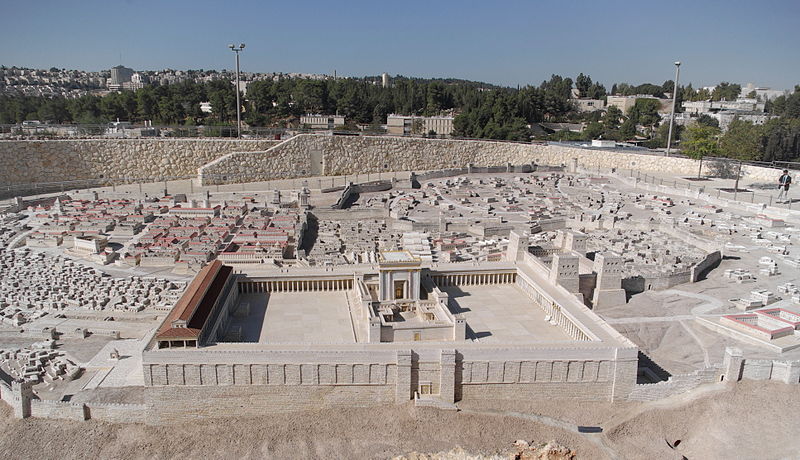
Temple in Jerusalem
Structures on the Temple Mount in Jerusalem serving as Israelite religious centers

The Temple Institute
organization in Jerusalem

Temple Mount
religious hilltop in the Old City of Jerusalem

Ark of the Covenant
in Judaism, a wooden chest containing the two stone tablets of the Ten Commandments

Solomon's Temple
Holy temple in ancient Jerusalem before its destruction by Nebuchadnezzar II

cherub
thumb|A tetramorph cherub, in [[Eastern Orthodox iconography]]
A cherub (; : cherubim; kərūḇ, pl. kərūḇīm) is one type of supernatural being in the Abrahamic religions. The numerous depictions of cherubim assign to them many different roles, such as protecting the entrance of the Garden of Eden.

Shavuot
thumb|Coloured papercutting|papercut in mixed technique depicting symbols pertinent to Judaism and nature. The inscription reads: "Yom Chag Ha Shavuot Ha Zeh". In the [[Jewish Museum of Switzerland's collection.]]

Second Temple
Jewish Temple on the Temple Mount in Jerusalem between c. 516 BCE and 70 CE

tabernacle
thumb|Model of the tabernacle in Timna Valley#Timna Valley Park|Timna Valley Park, Israel
thumb|The tabernacle, engraving from Robert Arnauld d'Andilly's 1683 translation of [[Josephus.]]
Holy of Holies
term in the Hebrew Bible
Third Temple
a yet to be built Jewish Temple in Jerusalem, mentioned in Jewish and Christian prophetic literature
counting of the Omer
counting of the days from Passover to Shavuot

korban
thumb|The High Priest offers the sacrifice of a goat performing korban

ephod
thumb|High Priest of Israel wearing the sacred vestments. The ephod is depicted here in yellow.

Moriah
thumb|Map of Jerusalem in 1925, showing the location of Mount Moriah according to Jewish sources
thumb|The area around Mount Gerizim is identified by the [[Samaritans as the "land of Moriah", or "Moreh".]]
Moriah (Hebrew: ) is the name given to a region in the Book of Genesis where the binding of Isaac by Abraham is said to have taken place. Jews identify the region mentioned in Genesis and the specific mountain in which the near-sacrifice is said to have occurred with "Mount Moriah", mentioned in the Book of Chronicles as the place where Solomon's Temple is said to have been built, and both t

Bezalel
thumb|The Goldsmith, gouache on board, c. 1896–1902, by James Tissot (The Jewish Museum, New York)
thumb|Bezalel, Oholiab and an assistant produce vessels for the tabernacle (engraving by Pieter Jacopsz Paets, 1645)
In Exodus 31:1-6 and chapters 36 to 39, Bezalel, Bezaleel, or Betzalel (, ) was the chief artisan of the Tabernacle and was in charge of building the Ark of the Covenant, assisted by Oholiab. The section in chapter 31 describes his selection as chief artisan, in the context of Moses' vision of how God wanted the tabernacle to be constructed, and chapters 36 to 39 recount the constr
Status quo at Holy Land sites
understanding among religious communities in Jerusalem and Bethlehem

Kodashim
150px|thumb|Pidyon haben
Kodashim () is the fifth of the six orders, or major divisions, of the Mishnah, Tosefta and the Talmud, and deals largely with the services within the Temple in Jerusalem, its maintenance and design, the korbanot, or sacrificial offerings that were offered there, and other subjects related to these topics, as well as, notably, the topic of kosher slaughter.
Seder Moed
Seder Moed (, romanized: Sēder Môʿēd, lit. "Order of Appointed Time") is the second of the six orders, or major divisions, of the Mishnah, Tosefta, and the Talmud, and primarily deals with the laws and observances of holidays such as Shabbat, Yom Kippur, Rosh Hashanah and Passover.

showbread
Showbread (), in the King James Version shewbread, in a Biblical or Jewish context, refers to the cakes or loaves of bread which were always present, on a specially-dedicated table, in the Temple in Jerusalem as an offering to God. An alternative, and more appropriate, translation would be presence bread, since the Bible requires that the bread be constantly in the presence of God (). The twelve loaves were ritually consumed in the presence of God each week by the Aaronic priesthood ().
Mercy seat
gold lid placed on the Ark of the Covenant
holy anointing oil
perfume used to anoint the vessels of the Jewish Tabernacle

Pesahim
Pesachim (, lit. "Paschal lambs" or "Passovers"), also spelled Pesahim, is the third tractate of Seder Moed ("Order of Festivals") of the Mishnah and of the Talmud. The tractate discusses the topics related to the Jewish holiday of Passover, and the Passover sacrifice, both called "Pesach" in Hebrew. The tractate deals with the laws of matza (unleavened bread) and maror (bitter herbs), the prohibitions against owning or consuming chametz (leaven) on the festival, the details of the Paschal lamb that used to be offered at the Temple in Jerusalem, the order of the feast on the first evening of t
Zevachim
Zevachim (; lit. "Sacrifices") is the first tractate of Seder Kodashim ("Holy Things") of the Mishnah, the Talmud and the Tosefta. This tractate discusses the topics related to the sacrificial system of the Temple in Jerusalem, namely the laws for animal and bird offerings, and the conditions which make them acceptable or not, as specified in the Torah, primarily in the book of Leviticus ( and on). The tractate has fourteen chapters divided into 101 mishnayot, or paragraphs. There is a Gemara – rabbinical commentary and analysis – for this tractate in the Babylonian Talmud, and no Gemara in th
Template:Temple Mount
Wikimedia template
The Three Weeks
period of mourning commemorating the destruction of the first and second Jewish Temples
Middot
tractate of the Mishnah and Talmud
Simchat Beit HaShoeivah
Jewish celebration
Menachot
Tractate Menachot (; "Meal Offerings") is the second tractate of the Order of Kodashim. It has Gemara in the Babylonian Talmud and a Tosefta.
Gibeonites
Nethinim ( nəṯīnīm, lit. "given ones", or "subjects"), or Nathinites or Nathineans, was the name given to the Temple assistants in ancient Jerusalem. The term was applied originally in the Book of Joshua (where it is found in its verbal form) to the Gibeonites. Later, in the Book of Ezra, they are counted alongside the Avdei Shlomo ("Servants of Solomon"). It is likely that the Nethinim descended from non-Israelites. Opinion is divided as to whether the Gibeonites in Joshua are to be connected to the Nethinim of later texts. Others theorize that they were the descendants of Midianite war capti
Galilee earthquake of 363
Pair of earthquakes affecting the Galilee region
Temple tax
ancient Jewish religious practice
Temple Denial
assertion that none of the Temples in Jerusalem ever existed or were not located on the Temple Mount
Mizrah
thumb|right|Mizrah papercut, Eastern Europe, 19th century (from [[Pidkamin, Ukraine)]]
Wilson's Arch
ancient stone arch that is part of Jerusalem's Western Wall
Incense offering
Offering on the altar of incense in the time of the Tabernacle and the First and Second Temple period