Category
page 1Taxa described in 1874
Entomophthoraceae
Entomophthoraceae is a family of fungi in the order Entomophthorales. This has been supported by molecular phylogenetic analysis (Gryganskyi et al. 2012). Most species in the family are obligately entomopathogenic. There are two subfamilies, Erynioideae and Entomophthoroideae, which were proposed in 2005.

Postia
Postia is a genus of brown rot fungi in the family Fomitopsidaceae.
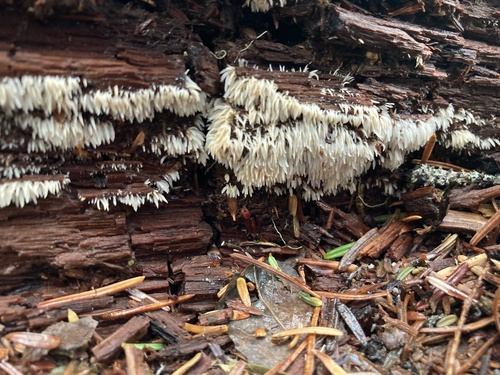
Mucronella
Mucronella is a genus of fungi in the family Clavariaceae. Species in the genus resemble awl-shaped teeth that grow in groups without a common subiculum (supporting layer of mycelium).
Entyloma
Entyloma is a genus of smut fungi in the family Entylomataceae. The genus was described by Anton de Bary in 1874. A 2008 estimates places about 180 species in the genus. The anamorph form of Entyloma is Entylomella.
Tegostoma
Tegostoma is a genus of moths of the family Crambidae.
Spongipellis
Spongipellis is a genus of fungus in the family Polyporaceae. The genus is widely distributed and contains ten species. The genus was circumscribed by French mycologist Narcisse Théophile Patouillard in 1887. The genus name combines the Latin words spongia ("sponge") and pellis ("skin").
Boeica
Boeica is a genus of flowering plants belonging to the family Gesneriaceae. Its native range is Tropical Asia, ranging from the eastern Himalayas to Indochina, southern China, and Peninsular Malaysia.
Trittame
Trittame is a genus of brushed trapdoor spiders first described by German arachnologist Ludwig Carl Christian Koch in 1874. It is endemic to Australia.
Mionandra
Mionandra is a genus of flowering plants belonging to the family Malpighiaceae.
Micromeles
Micromeles is a genus of flowering plants belonging to the family Rosaceae. Its native range is Afghanistan to the Russian Far East, Japan, and Sumatra.
Platygramme
Platygramme is a genus of lichen-forming fungi in the family Graphidaceae consisting of about 27 species. The genus was circumscribed by Antoine Laurent Apollinaire Fée in 1874. The type species of the genus is P. caesiopruinosa. These bark-dwelling lichens are found in moist, shaded forests across tropical and warm temperate regions worldwide, where they form pale crusts that develop distinctive flattened, plate-like fruiting structures. A combination of several features characterizes Platygramme: the brown ascospores, a spore-producing layer (hymenium) speckled with granules, and elonga
Treichelia
Treichelia is a genus of plants in the Campanulaceae. It contains two known species, both endemic to Cape Provinces of South Africa.
Ptychographa xylographoides
Ptychographa is a fungal genus in the family Xylographaceae. It is a monospecific genus, containing the single species Ptychographa xylographoides. This inconspicuous lichen grows as a barely visible coating of dark grains on rotting logs and branches in undisturbed old forests. The species is most readily identified by its narrow, elongated black fruiting structures that run parallel to the wood grain.
Orphniospora
Orphniospora is a small genus of lichen-forming fungi in the family Fuscideaceae. The genus was established in 1874 by the German lichenologist Gustav Wilhelm Körber and comprises three saxicolous (rock-dwelling) crustose species. These lichens are distinguished by their unusual spores, which are nearly spherical, single-celled, and produced only a few at a time in each spore-bearing structure. Despite being placed in the family Fuscideaceae in recent classifications, molecular studies have shown that Orphniospora does not actually belong to this family, leaving its correct taxonomic position
Otoglyphis
Otoglyphis is a genus of flowering plants in the family Asteraceae. It includes two species of annual herbs native to mainly non-salty steppes and deserts in North Africa and the Arabian Peninsula.
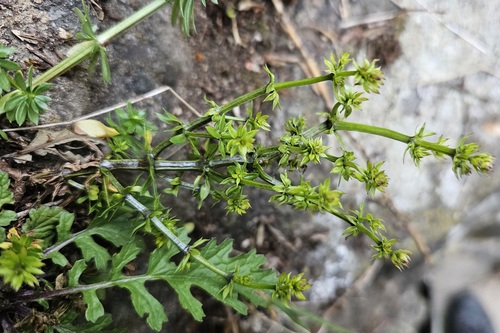
Melanotaenium
The Melanotaenium is a genus of smut fungi in the family Melanotaeniaceae.