Category
page 1Taxa described in 1879

Phyllocarida
Phyllocarida is a subclass of crustaceans, comprising the extant order Leptostraca and the extinct orders Hymenostraca and Archaeostraca. This clade of marine crustaceans diversified extensively during the Ordovician.
left|thumb|Undescribed fossil of a very large phyllocarid from the Yukon ([[Devonian)]]
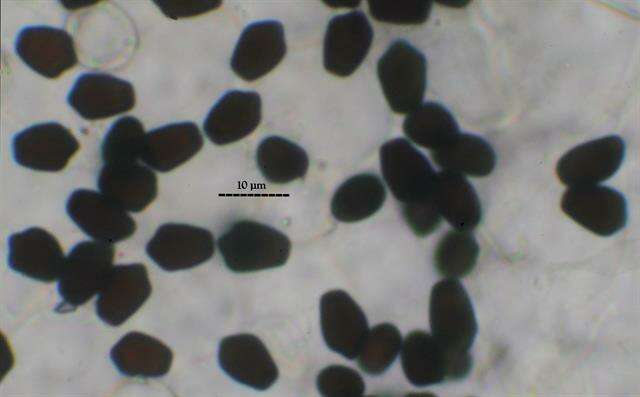
Coprinellus
Coprinellus is a genus of mushroom-forming fungi in the family Psathyrellaceae. The genus was circumscribed by the Finnish mycologist Petter Adolf Karsten in 1879. Most Coprinellus species were transferred from the once large genus Coprinus. Molecular studies published in 2001 redistributed Coprinus species to Psathyrella, or the segregate genera Coprinopsis and Coprinellus.
%20Locatie%2C%20Hortus%20(Haren%2C%20Groningen)%2002.JPG)
Hydnellum
Hydnellum is a genus of tooth fungi in the family Bankeraceae (order Thelephorales). Widely distributed in the Northern Hemisphere, the genus contains around 120 species. The fruitbodies of its members grow by slowly enveloping nearby bits of grass and vegetation. There is great variability in the form of Hydnellum fruitbodies, which are greatly influenced by environmental conditions such as rainfall and humidity, drying winds, and temperature. They are too tough and woody to eat comfortably. Several species have become the focus of increasing conservation concern following widespread declines
.JPG)
Bjerkandera
Bjerkandera is a genus of wood-rotting fungi in the family Phanerochaetaceae.

Antrodia
Antrodia is a genus of fungi in the family Fomitopsidaceae. Antrodia species have fruit bodies that typically resupinate (i.e., lying flat or spread out on the growing surface), with the hymenium exposed to the outside; the edges may be turned so as to form narrow brackets. Most species are found in temperate and boreal forests, and cause brown rot.
Microglossum
Microglossum is a genus of fungi in the family Leotiaceae. Ascocarps (fruit bodies) occur in soil and resemble earth tongues, but are microscopically distinct. Microglossum atropurpureum, a species typical of waxcap grassland in Europe, is of global conservation concern and is listed as "vulnerable" on the IUCN Red List of Threatened Species.
Ischnoderma
Ischnoderma is a genus of polypore fungi. Species in the genus have dark brown and tomentose fruit bodies that become darker brown to black and smooth when mature. The genus, widespread in temperate regions, contains an estimated 10 species.
Linuchidae
Linuchidae is a family of crown jellyfish.
Episcada
Episcada is a genus of clearwing (ithomiine) butterflies, named by Frederick DuCane Godman and Osbert Salvin in 1879. They are in the brush-footed butterfly family, Nymphalidae.
Hypoleria
Hypoleria is a genus of clearwing (ithomiine) butterflies, named by Frederick DuCane Godman and Osbert Salvin in 1879. They are in the brush-footed butterfly family, Nymphalidae.
Mummucia
Mummucia is a genus of mummuciid camel spiders, first described by Eugène Simon in 1879.
Pleistacantha
Pleistacantha is a genus of crabs in the family Oregoniidae. The genus occurs throughout many coasts in Europe, Africa, Asia, and Oceania.
Xyloolaena
Xyloolaena is a genus within Sarcolaenaceae family.
Nectonema
Nectonema is a genus of marine horsehair worms first described by Addison E. Verrill in 1879. It is the only genus in the family Nectonematidae described by Henry B. Ward in 1892, in the order Nectonematoidea, and in the class Nectonematoida. The genus contains five species; all species have a parasitic larval stage inhabiting crustacean hosts and a free-living adult stage that swims in open water.
Notharctinae
Notharctinae is an extinct subfamily of primates that were common in North America during the early and middle Eocene (55-34 million years ago). The six genera that make up the group (Cantius, Pelycodus, Copelemur, Hesperolemur, Notharctus, and Smilodectes) contain species that are among the most primitive of the adapiform group, which is one of the most primitive groups of primates. The evolutionary history of this subfamily has been comparatively well documented and has been used to argue for evolutionary gradualism. Though it is generally accepted that adapiforms gave rise to modern day lem
Parequula
Parequula is a genus of silver biddy fishes from Australia, in the family Gerreidae.
Cyphonocerus
Cyphonocerus is a genus of fireflies (Lampyridae) within the monotypic subfamily Cyphonocerinae.
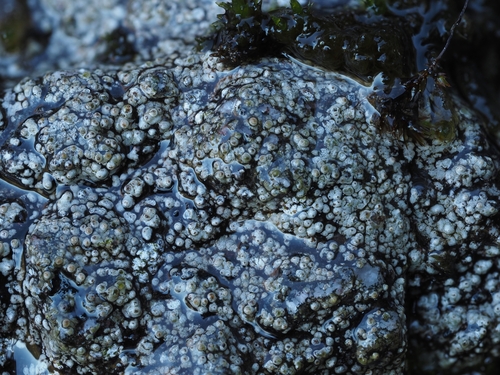
Koerberiella
Koerberiella is a genus of lichenized fungi within the Lecideaceae family.
Godmania
Godmania is a genus of flowering plants in the family Bignoniaceae. It includes two species of trees native to the tropical Americas, ranging from central Mexico to Bolivia and northeastern Brazil.
Sabacon
Sabacon is a genus of the monotypic harvestman family Sabaconidae, with 59 species (as of 2023).
Pseudoscada
Pseudoscada is a genus of clearwing (ithomiine) butterflies, named by Frederick DuCane Godman and Osbert Salvin in [1879]. They are in the brush-footed butterfly family, Nymphalidae.
Gomalia
Gomalia is a genus of marbled skippers in the butterfly family Hesperiidae. There are three described species in Gomalia.
Gylippus
genus of arachnids
Leprocaulon
Leprocaulon is a genus of lichen-forming fungi in the family Leprocaulaceae. Members of the genus Leprocaulon are commonly called cottonthread lichens. These small lichens typically form soft, powdery coatings on their growing surfaces, sometimes developing tiny white thread-like structures that create a cottony appearance. The genus contains eleven recognised species found primarily in North America and Europe.
Glyptoxanthus
Glyptoxanthus is a genus of crabs in the family Xanthidae, containing eight species. It was originally erected by Alphonse Milne-Edwards in 1879 for six species previously placed in the genus Actaea and elsewhere. Although previously included in subfamily Euxanthinae, the genus has a quite distinct morphology from other genera in that group, and was placed in 2011 in the new, monotypic subfamily, Glyptoxanthinae by Jose Christopher Mendoza and Danièle Guinot.
Urceolus
Urceolus (, 'pitcher') is a genus of heterotrophic flagellates belonging to the Euglenozoa, a phylum of single-celled eukaryotes or protists. Described by Russian biologist Konstantin Mereschkowsky in 1877, its type species is Urceolus alenizini. Species of this genus are characterized by deformable flask-shaped cells that exhibit at least one flagellum that is active at the tip, arising from a neck-like structure that also hosts the feeding apparatus. They are found in a variety of water body sediments across the globe. According to evolutionary studies, Urceolus belongs to a group of Eugleno
Phaeospora
Phaeospora is a genus of fungi in the class Dothideomycetes; its familial placement is uncertain.
Julella
Julella is a genus of ascomycete fungi. Most species are non-lichenised, bark-dwelling saprophytes, though some collections appear to be facultatively lichenised with the green alga Trentepohlia. The fungi produce immersed, black, flask-shaped perithecia with a dark . Their asci are double-walled and contain two or eight large, colourless, (multi-chambered) ascospores. Asexual fruiting bodies (pycnidia) produce simple, rod-shaped conidia. No secondary metabolites are known. The genus was introduced by Jean-Henri Fabre in 1879. Modern treatments recognise only a few species, and its family plac