Category
page 1Taxa described in 1954
.JPG)
Candelariaceae
Candelariaceae is a family of lichen-forming fungi in the order Candelariales. It contains seven genera and about 73 species of lichens that are typically characterised by their bright yellow colour. These lichens have diverse growth forms, including crusty, scaly, and small leaf-like structures, and are found worldwide, particularly in arid and mountainous regions of both hemispheres. The family includes well-known genera such as Candelaria, Candelariella, and Placomaronea, with their classification continuing to evolve based on molecular studies. Recent phylogenies find Candelina and Placoma
Psalistopoides
Psalistopoides is a genus of spiders in the family Pycnothelidae. It was first described in 1934 by Mello-Leitão. , it contains 2 species from Brazil.
Hendeola
REDIRECT List of Triaenonychidae species
Heteroxenotrichula
Heteroxenotrichula is a marine genus of Gastrotricha.
Protogarypinus
Protogarypinus is a genus of pseudoscorpions in the Garypinidae family. It is endemic to Australia. It was described in 1954 by Austrian arachnologist Max Beier.
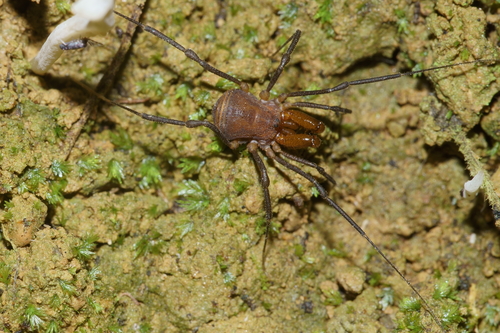
Prasmiola
Prasmiola unica is the only member of the genus Prasmiola in the harvestman family Triaenonychidae. It is found near Wellington, New Zealand, and is known from a single specimen. The New Zealand Threat Classification System status for this species is 'nationally critical'.
Xeromyces bisporus
Xeromyces is a monotypic genus of fungus in the family Monascaceae. Its only species, Xeromyces bisporus, was first described by L.R. Fraser in 1954. No subspecies are listed in the Catalogue of Life.
Dactylotrochus
Dactylotrochus is a genus of large polyp stony corals from the Red Sea and western Pacific Ocean. It is monotypic with a single species, Dactylotrochus cervicornis. It inhabits the deep sea and is believed to be azooxanthellate.
Nanostictis
Nanostictis is a genus of lichenicolous (lichen-dwelling) fungi in the family Stictidaceae. These tiny fungi produce minute fruiting bodies that remain embedded within their host lichens and are characterised by very slender, thread-like ascospores divided by multiple cross-walls. The genus contains nine species that parasitise various lichen hosts, though its relationship to similar genera remains uncertain due to the lack of molecular studies on any Nanostictis species.