Category
page 1Taxa described in 2004
Lichinomycetes
REDIRECT Lichinales
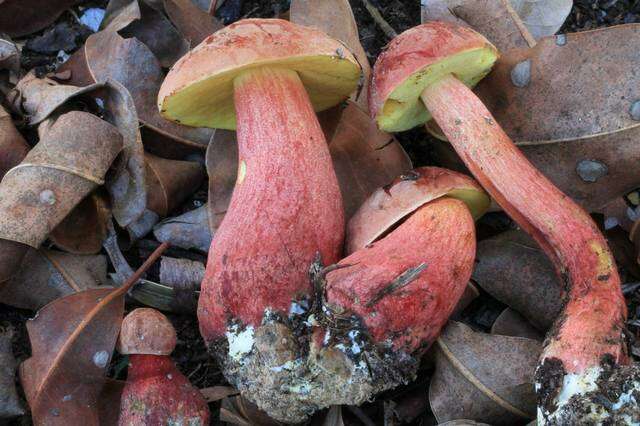
Heimioporus
Heimioporus is a genus of fungi in the family Boletaceae. The genus is widely distributed in tropical and subtropical regions, and contains about 15 species.

Melanohalea
Melanohalea is a genus of foliose lichens in the family Parmeliaceae. It contains 30 mostly Northern Hemisphere species that grow on bark or on wood. The genus is characterised by the presence of pseudocyphellae (tiny pores that allow for gas exchange), usually on warts or on the tips of isidia, a non-pored and a medulla containing depsidones or lacking secondary metabolites. Melanohalea was circumscribed in 2004 as a segregate of the morphologically similar genus Melanelia, which was created in 1978 for certain brown Parmelia species. The methods used to estimate the evolutionary history of M
.JPG)
Melanelixia
Melanelixia is a genus of foliose lichens in the family Parmeliaceae. It contains 15 Northern Hemisphere species that grow on bark or on wood. The genus is characterized by a pored or fenestrate epicortex (a thin homogeneous polysaccharide layer on the surface of the cortex), and the production of lecanoric acid as the primary chemical constituent of the medulla. Melanelixia was circumscribed in 2004 as a segregate of the related genus Melanelia.
Cabalodontia
Cabalodontia is a genus of fungi in the family Steccherinaceae. The genus was circumscribed by Marcen Piątek in 2004 for five species formerly placed in Phlebia. It is named in honour of Polish phycologist Jolanta Cabała. The type species, C. queletii, has an odontoid hymenophore featuring toothlike projections.
Rhizochaete
Rhizochaete is a genus of nine species of poroid crust fungi in the family Phanerochaetaceae. The genus is closely related to Phanerochaete. Aside from the widespread Rhizochaete radicata and the Asian species R. borneensis, most species of Rhizochaete fungi are found in North and South America.
Ajellomycetaceae
thumb|right|Blastomyces dermatitidis
Ostropomycetidae
The Ostropomycetidae are a subclass of mostly lichen-forming fungi in the class Lecanoromycetes. It contains nine orders and 37 families.
Hertelidea
Hertelidea is a genus of crustose lichens in the family Stereocaulaceae. Characteristics of the genus include carbon-black ring or outer margin (exciple) around the fruit body disc (apothecium), eight-spored, Micarea-type asci and mostly simple, hyaline ascospores that lack a transparent outer layer. Hertelidea species mostly grow on wood, although less frequently they are found on bark or soil. While the type species, Hertelidea botryosa, has a widespread distribution, most of the other species are found only in Australia.
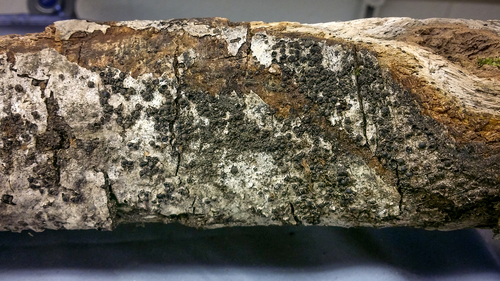
Amphirosellinia
Amphirosellinia is a genus of five species of fungi in the family Xylariaceae. It was circumscribed in 2004 with A. nigrospora as the type species. The genus name refers to the similarities in morphology it shares with the genus Rosellinia. Amphirosellinia species grow inside the bark of dicot trees, forming stromata (dense structural tissue) encased by black, carbonized perithecia. The ascospores are brown and ellipsoid to cylindrical in shape. The anamorph forms of Amphirosellinia have geniculate (zig-zag) conidiogenous regions.
Globuliciopsis
Globuliciopsis is a genus of corticioid fungi in the order Polyporales. It currently contains two species found in Central and South America.
Taiwanofungus
Taiwanofungus is a fungal genus of unknown familial placement in the order Polyporales. The genus contains two species: the type, Taiwanofungus camphoratus, and T. salmoneus. Taiwanofungus was circumscribed by Taiwanese mycologists in 2004. T. camphoratus is a medicinal fungus that is found in Taiwan, where it grows on the endemic tree species Cinnamomum kanehirae. It was first described in 1990 by Mu Zang and Ching-Hua Su as a species of Ganoderma. T. salmoneus, originally placed in Antrodia, was validly added to the genus in 2012.
Formosa
genus of bacteria
Austrella
Austrella is a small genus of lichen-forming fungi in the family Pannariaceae.
Parvodontia
Parvodontia is a fungal genus in the family Cystostereaceae. This is a monotypic genus, containing the single species Parvodontia luteocystidia, a crust fungus that grows on bamboo in Brazil.
Parvodontia was first described in 2004 by Hjortstam and Ryvarden. The genus was established to classify a crust fungus found on bamboo in Brazil.