Category
page 1Taxa named by Florentino Ameghino

Peramelemorphia
The order Peramelemorphia includes the bandicoots and bilbies. All members of the order are endemic to Australia-New Guinea and most have the characteristic bandicoot shape: a plump, arch-backed body with a long, delicately tapering snout, very large upright ears, relatively long, thin legs, and a thin tail. Their size varies from about 140 grams up to 4 kilograms, but most species are about one kilogram.

Phorusrhacidae
Phorusrhacids, colloquially known as terror birds, are an extinct family of large carnivorous, mostly flightless birds that were among the largest apex predators in South America during the Cenozoic era. Their definitive fossil records range from the Middle Eocene to the Late Pleistocene around , though some specimens suggest that they were present since the Early Eocene.
Florentino Ameghino
natural scientist and museum director from Argentina (1854-1911)
Microbiotheria
Microbiotheria is an australidelphian marsupial order that encompasses two families, Microbiotheriidae and Woodburnodontidae, and is represented by only one extant species, the monito del monte, and a number of extinct species known from fossils in South America, Western Antarctica, and northeastern Australia.

Phorusrhacos
Phorusrhacos ( ) is an extinct genus of giant flightless terror birds that inhabited South America during the Miocene epoch. Phorusrhacos was one of the dominant land predators in South America at the time it existed. It is thought to have lived in woodlands and grasslands.
Paucituberculata
Paucituberculata is an order of South American marsupials. Although currently represented only by the seven living species of shrew opossums, this order was formerly much more diverse, with more than 60 extinct species named from the fossil record, particularly from the late Oligocene to early Miocene epochs. The earliest paucituberculatans date to the late Paleocene (Itaboraian South American land mammal age). The group went through a pronounced decline in the middle Miocene epoch, which resulted in the extinction of all families of this order except for the living shrew opossums (Caenolestid
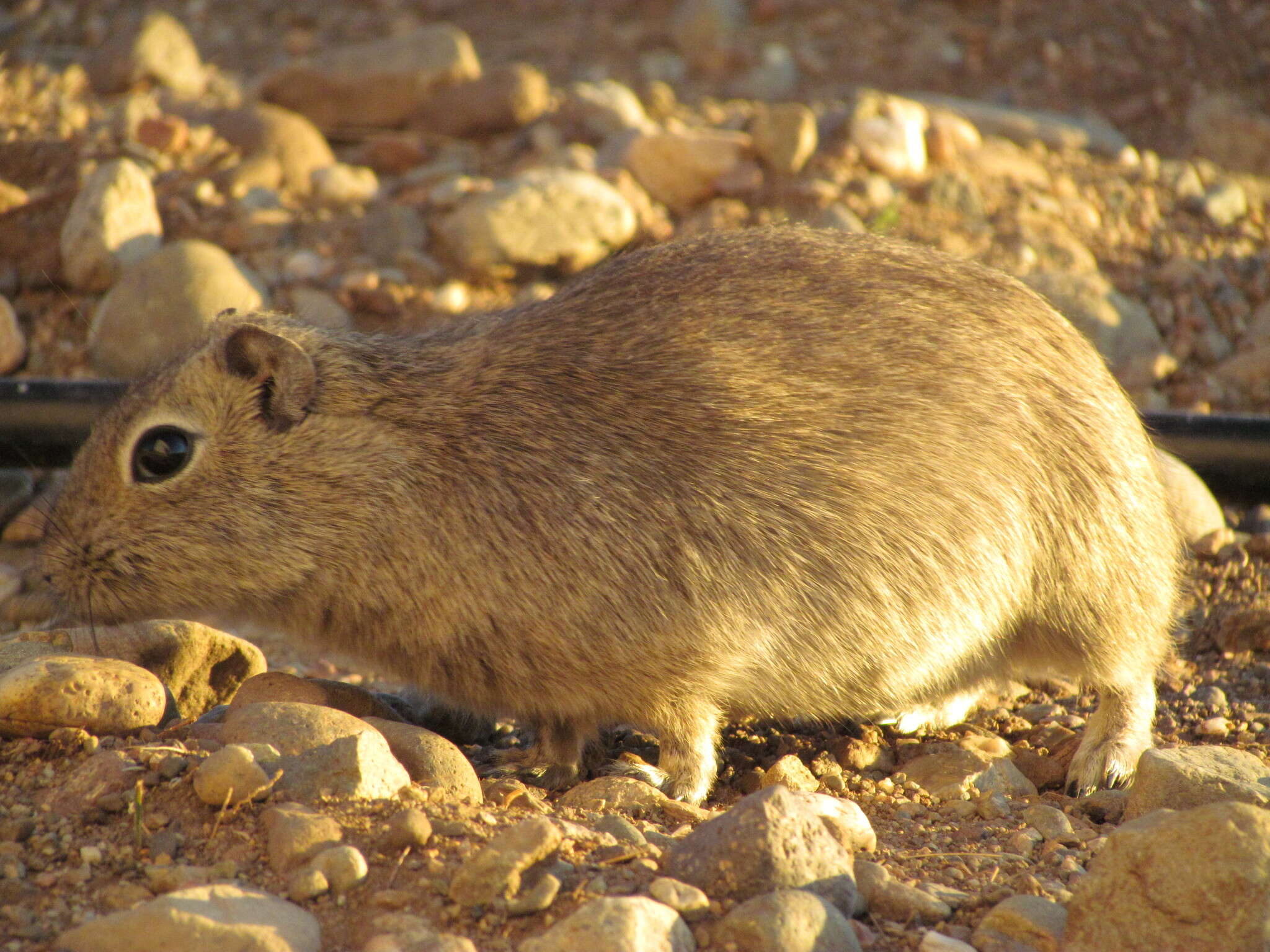
Microcavia
Microcavia (mountain cavies) is a genus of rodents in the family Caviidae. They are unique within their family in that their premolar teeth do not grow and replace the original deciduous cheek teeth until after the animal is born; in other genera this occurs in the womb.
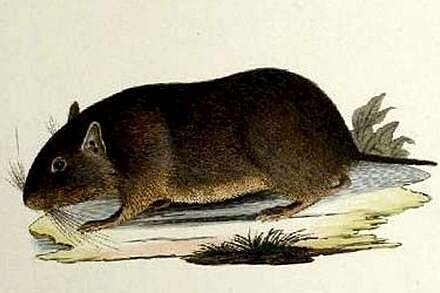
Aconaemys
Aconaemys is a genus of rodent in the family Octodontidae.
It contains the following species:
Chilean rock rat (Aconaemys fuscus)
Porter's rock rat (Aconaemys porteri)
Sage's rock rat (Aconaemys sagei)
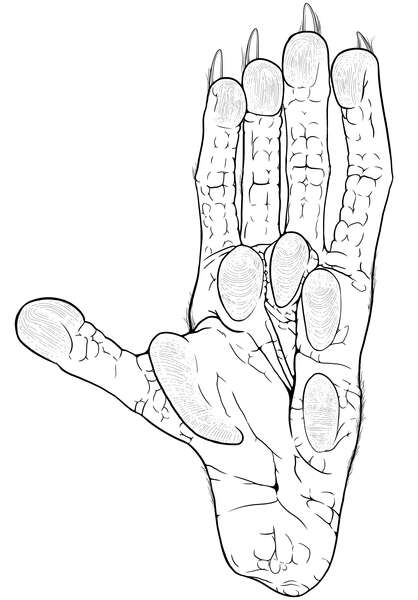
Microbiotheriidae
Microbiotheriidae is a family of australidelphian marsupials represented by only one extant species, the monito del monte, and a number of extinct species known from fossils in South America, Western Antarctica, and northeastern Australia.
%20(14749571352).jpg)
Litopterna
Litopterna (from "smooth heel") is an extinct order of South American native ungulates that lived from the Paleocene to the Pleistocene-Holocene around 62.5 million to 12,000 years ago (or possibly as late as 3,500 years ago), and were also present in West Antarctica during the Eocene. They represent the second most diverse group of South American ungulates after Notoungulata. It is divided into nine families, with Proterotheriidae and Macraucheniidae being the most diverse and last surviving families.

Borhyaena
Borhyaena is an extinct genus of South American metatherian within borhyaenaid, a family of mammalian predators part of the now extinct order Sparassodonta. The genus lived from 21 to 15.5 million years ago from the Early to Middle Miocene.

Chapalmalania
Chapalmalania is an extinct genus of procyonid from the Late Miocene or Early Pliocene to Early Pleistocene (Montehermosan to Uquian) of Argentina (Andalhualá Formation), Venezuela (San Gregorio Formation, Venezuela), and Colombia (Ware Formation, Cocinetas Basin, La Guajira).

Peltephilus
thumb|Skull of P. ferox
Peltephilus, the horned armadillo, is an extinct genus of armadillo xenarthran mammals that first inhabited Argentina during the Oligocene epoch, and became extinct in the Miocene epoch. Notably, the scutes on its head were so developed that they formed horns. Aside from the horned gophers of North America, it is the only known fossorial horned mammal.
.jpg)
Necrolestes
Necrolestes (from Ancient Greek νεκρός (necrós), meaning "dead", and λῃστής (lēistḗs), meaning "robber") is an extinct genus of mammals, which lived during the Early Miocene in what is now Argentine Patagonia. It is the most recent known genus of Meridiolestida, an extinct group of mammals more closely related to therians (marsupials and placentals) than to monotremes, which were the dominant mammals in South America during the Late Cretaceous. It contains two species, N. patagonensis and N. mirabilis; the type species N. patagonensis was named by Florentino Ameghino in 1891 based on remains f

Pyrotherium
Pyrotherium (from Ancient Greek πῦρ (pûr), meaning "fire", and θηρίον (theríon), meaning "beast") is an extinct genus of South American ungulates, in the order Pyrotheria, that lived in what is now Argentina and Bolivia during the Late Oligocene. It was named Pyrotherium because the first specimens were excavated from an ancient volcanic ash deposit. Fossils of the genus have been found in the Deseado and Sarmiento Formations of Argentina and the Salla Formation of Bolivia.

Mylodontidae
Mylodontidae is a family of extinct South American and North American ground sloths within the suborder Folivora of order Pilosa, living from around 23 million years ago (Mya) to 11,000 years ago. This family is most closely related to another family of extinct ground sloths, Scelidotheriidae, as well as to the extant arboreal two-toed sloths, family Choloepodidae; together these make up the superfamily Mylodontoidea. Phylogenetic analyses based on morphology uncovered the relationship between Mylodontidae and Scelidotheriidae; in fact, the latter was for a time considered a subfamily of mylod

Hapalops
thumb|left|Life restoration of Hapalops longiceps and Propalaehoplophorus australis
thumb|left|Skeleton

Cladosictis
Cladosictis (meaning "branch weasel") is an extinct genus of South American metatherian from Patagonia, Argentina (Chichinales, Cerro Bandera, Sarmiento and Santa Cruz Formations) and Chile (Río Frias Formation).

Trigonostylops
Trigonostylops is an extinct genus of South American meridiungulatan ungulate, from the Late Paleocene to Late Eocene (Itaboraian to Tinguirirican in the SALMA classification) of South America (Argentina and Peru) and Antarctica (Seymour Island). It is the only member of the family Trigonostylopidae.
Notostylops
Notostylops ("south pillar face") is a genus of extinct South American notoungulates from Eocene Argentina. Fossils of the genus have been found in the Sarmiento, Casamayor, Andesitas Huancache and Koluel Kaike Formations.
Image:Notostylopss.png|Size comparison of Notostylops murinus with a human.
Image:Notostylops murinus Wikipedia Juandertal.jpg|Life reconstruction.

Niolamia
Niolamia is an extinct genus of South American meiolaniid turtle with a long and complex history. Like its relatives, Niolamia was a robust and heavily armored terrestrial turtle with large, horn like scales covering its head and a tail encased by rings of bone. This heavily armored build may have served the animal during intraspecific combat during courtship, though such encounters likely did not involve the horns and frill, which are thought to serve more of a display function. Scans of the skull reveal that Niolamia likely had a great sense of smell but only low frequency hearing, indicatin

Adinotherium
Adinotherium (meaning "not terrible beast") is an extinct genus of toxodontid, large bodied hoofed ungulates which inhabited South America during the Middle to Late Miocene, from 17.5 to 6.8 Ma and existed for approximately , Santacrucian to Huayquerian in the South American land mammal ages (SALMA). Fossils of Adinotherium have been found in the Santa Cruz and Ituzaingó Formations of Argentina and the Chucal and Río Frías Formations of Chile.
%20(14563211299).jpg)
Proterotheriidae
Proterotheriidae is an extinct family of litoptern ungulates known from the Eocene-Late Pleistocene of South America. Members of the group were small to medium-sized cursorial herbivores with brachydont teeth, with their toes showing progressive reduction, with later members of the group bearing weight on a single large toe similar to living horses.

Thoatherium
Thoatherium (meaning "active swift-beast") is an extinct genus of litoptern mammals from the Early Miocene of Argentina. Fossils of the genus have been found in the Santa Cruz Formation in Argentina. With a length of , the gazelle-like Thoatherium was a small representative of the order Litopterna. Judging from its long legs, it was a fast runner. Thoatherium had remarkably reduced toes; only one horse-like hoof remained. Thoatherium even lacked splint bones, which are remnants of the second and fourth toe found in modern horses. Judging from its generalised, brachydont teeth, Thoatherium fed
Clasmodosaurus
Clasmodosaurus (meaning "fragmentary tooth reptile") is a genus of titanosaurian sauropod dinosaur from the Mata Amarilla Formation and the Cerro Fortaleza Formation. It lived during the Late Cretaceous in what is now Argentina. It is known from five fossilized and assorted teeth, but is diagnosed by a unique combination of characters.

Theosodon
Theosodon is an extinct genus of litoptern mammal from the Early to Middle Miocene of South America.

Protypotherium
Protypotherium is an extinct genus of notoungulate mammals native to South America during the Oligocene and Miocene epochs. A number of closely related animals date back further, to the Eocene. Fossils of Protypotherium have been found in the Deseadan Fray Bentos Formation of Uruguay, Muyu Huasi and Nazareno Formations of Bolivia, Cura-Mallín and Río Frías Formations of Chile, and Santa Cruz, Salicas, Ituzaingó, Aisol, Cerro Azul, Cerro Bandera, Cerro Boleadoras, Chichinales, Sarmiento and Collón Curá Formations of Argentina.
Argyrolagus
Argyrolagus is an extinct genus of South American metatherian, belonging to the order Polydolopimorpha from the Early Pliocene Monte Hermoso Formation, Patagonia, Argentina.
Notostylopidae
Notostylopidae is an extinct family comprising five genera of notoungulate mammals known from the Late Paleocene (Riochican) to Early Oligocene (Tinguirirican) of Argentina, Brazil and Chile in South America

Prothylacinus
Prothylacinus is an extinct genus of South American metatherian, that lived during the Early Miocene.

Nothrotheriidae
Nothrotheriidae is a family of extinct ground sloths that lived from approximately 17.5 mya—10,000 years ago, existing for approximately . Previously placed within the tribe Nothrotheriini or subfamily Nothrotheriinae within Megatheriidae, they are now usually placed in their own family, Nothrotheriidae. Nothrotheriids appeared in the Burdigalian, some 19.8 million years ago, in South America. The group includes the comparatively slightly built Nothrotheriops, which reached a length of about . While nothrotheriids were small compared to some of their megatheriid relatives, their claws provided

Pachyrukhos
Pachyrukhos is an extinct genus of hegetotheriid notoungulate from the Early to Middle Miocene (Colhuehuapian-Friasian in the SALMA classification) of Argentina and Chile. Fossils of this genus have been found in the Collón Curá, Sarmiento and Santa Cruz Formations of Argentina and the Río Frías Formation of Chile.
Didolodus
Didolodus is an extinct genus of mammals from Middle Eocene Argentina. It is an ungulate mammal of uncertain affinities, possibly related to Litopterna, though this is uncertain due to the lack of reliable post-cranial remains, and for now remains Meridiungulata incertae sedis. Its remains were found in the Sarmiento Formation of Patagonia.
Interatheriidae
Interatheriidae is an extinct family of notoungulate mammals from South America. Interatheriids are known from the Middle Eocene (Mustersan) to the Early Pleistocene (Uquian). These animals were principally small-sized, occupying a habitat like hares, marmots and viscachas. The majority were very small, like rodents.

Diadiaphorus
Diadiaphorus is an extinct genus of litoptern mammal from the Miocene of Argentina (Ituzaingó, Pinturas, Chiquimil and Santa Cruz Formations) and Bolivia (Nazareno Formation), South America.
Isotemnidae
Isotemnidae is a paraphyletic extinct family of notoungulate mammals known from the Paleocene (Las Flores Formation, Itaboraian) to Middle Miocene (Honda Group, Laventan) of South America.
Leontiniidae
Leontiniidae is an extinct family comprising eighteen genera of notoungulate mammals known from the Middle Eocene (Mustersan) to Late Miocene (Huayquerian) of South America.
Thomashuxleya
Thomashuxleya is an extinct genus of notoungulate mammal, named after famous 19th-century biologist Thomas Huxley.
Physornis
Physornis is an extinct genus of giant flightless predatory birds of the family Phorusrhacidae or "terror birds", most closely related to Paraphysornis, that lived in Argentina. The type species is P. fortis. It lived during the Middle to Late Oligocene (Deseadan). Few fossils are known, but the available material suggests that Physornis was one of the largest phorusrhacids.
Hemiauchenia
Hemiauchenia is an extinct genus of lamine camelids that evolved in North America in the Miocene epoch about 10 million years ago. This genus diversified and entered South America in the Late Pliocene about three to two million years ago, as part of the Great American Biotic Interchange. The genus became extinct at the end of the Pleistocene. The monophyly of the genus has been considered questionable, with phylogenetic analyses finding the genus to paraphyletic or polyphyletic, with some species suggested to be more closely related to living lamines (llamas and relatives) than to other Hemiau
Homunculus
genus of mammals
Proborhyaena
Proborhyaena is an extinct genus of proborhyaenid sparassodont that lived during the Oligocene of South America. It is considered to be the largest of the sparassodonts.
Parastrapotherium
Parastrapotherium is an extinct genus of South American land mammal that existed from the Late Oligocene (Deseadan SALMA) to the Early Miocene (Colhuehuapian SALMA). The genus includes some of the largest and smallest known astrapotherians, but has no generally recognized description.
Catagonus
Catagonus is a genus of peccaries that contains the living Chacoan peccary, C. wagneri, and several extinct species. The genus has always been restricted to South America.
Rhynchippus
Rhynchippus ("beaked horse") is an extinct genus of notoungulate mammals from the Late Oligocene (Deseadan in the SALMA classification) of South America. The genus was first described by Florentino Ameghino in 1897 and the type species is R. equinus, with lectotype MACN A 52–31. Fossils of Rhynchippus have been found in the Agua de la Piedra and Sarmiento Formations of Argentina, the Salla and Petaca Formations of Bolivia, the Tremembé Formation of Brazil, and the Moquegua Formation of Peru.
Pyrotheriidae
Pyrotheriidae (from Ancient Greek πῦρ (pûr), meaning "fire", and θηρίον (theríon), meaning "beast") is the only family in the order Pyrotheria, provided one does not include the Paleocene genus, Carodnia. These extinct, elephant-like ungulates include the genera Baguatherium, Carolozittelia, Griphodon, Propyrotherium, and Pyrotherium. Fossils of the family have been found in Argentina, Brazil, Bolivia and Peru.
Henricosborniidae
Henricosborniidae is a family of extinct notoungulate mammals known from the Late Paleocene to Middle Eocene of Argentina, Bolivia and Brazil. The name honors U.S. paleontologist Henry Fairfield Osborn.
Interatherium
Interatherium is an extinct genus of interatheriid notoungulate that lived from the Early to Middle Miocene (Colhuehuapian-Mayoan). Fossils of this genus have been found in the Santa Cruz, Collón Curá and Sarmiento Formations in Argentina.
Loncosaurus argentinus
Loncosaurus (meaning uncertain; either Araucanian "chief" or Greek "lance" "lizard") is an extinct genus of ornithopod dinosaur from the Upper Cretaceous of Provincia de Santa Cruz, Argentina. The type (and only known) species is Loncosaurus argentinus, described by the famous Argentinian paleontologist Florentino Ameghino, but is considered a dubious name. Details on this animal are often contradictory, befitting a genus that was long confused for a theropod.
Cyonasua
Cyonasua (meaning "dog-coati" in Greek) is an extinct genus of procyonid from the Late Miocene to Middle Pleistocene of South America. Fossils of Cyonasua have been found in Argentina (Ituzaingó, Epecuén, Huayquerías, Monte Hermoso, Chapadmalal, Maimará, Ensenada, La Playa, Chiquimil, Andalhuala, and Cerro Azul Formations), Bolivia (Tariquía Formation), Uruguay (Camacho Formation), and Venezuela (San Gregorio Formation). The oldest well-dated fossils of Cyonasua are approximately 7.3 million years old. Most fossils of Cyonasua are late Miocene to early late Pliocene (Huayquerian to Chapadmalal
Trigodon gaudryi
Trigodon is an extinct genus of the family Toxodontidae, a large-bodied notoungulate which inhabited South America during the Late Miocene to Early Pliocene (Mayoan to Montehermosan in the SALMA classification), living from 11.61 to 4.0 Ma which existed for approximately . The type species is T. gaudryi. It bore a superficial resemblance to a rhinoceros, in that it had a horn on its forehead, and was one of a few horned notoungulates, including Adinotherium and Leontinia.
Leontinia
Leontinia is an extinct genus of leontiniid notoungulate. Fossils have been found in the Deseado and Sarmiento Formations in Argentina and Tremembé Formation of Brazil, and are the most abundant remains of any animal found there. The genus dates back to the Late Oligocene, Deseadan in the SALMA classification.
Antifer
Antifer is an extinct genus of large herbivorous deer belonging to the tribe Odocoileini native to South America during the Pleistocene, becoming extinct around 12,000 years ago. It was one of the largest South American deer genera, with an estimated body mass of up to , comparable to red deer, considerably exceeding the marsh deer, the largest living South American deer species in size. The genus has large antlers that could reach a length of over .
Scelidotheriinae
Scelidotheriidae is a family of extinct ground sloths within the order Pilosa, suborder Folivora and superfamily Mylodontoidea, related to the other extinct mylodontoid family, Mylodontidae, as well as to the living two-toed sloth family Choloepodidae. The only other extant family of the suborder Folivora is the distantly related Bradypodidae. Erected as the family Scelidotheriidae by Ameghino in 1889, the taxon was demoted to a subfamily of Mylodontidae by Gaudin in 1995. However, recent collagen sequence data indicates the group is less closely related to Mylodon and Lestodon than Choloepus
Catonyx
Catonyx is an extinct genus of ground sloth of the family Scelidotheriidae, endemic to South America during the Pliocene and Pleistocene epochs. It lived from 2.5 Ma to about 10,000 years ago, existing for approximately . The most recent date obtained is about 9600 B.P.
Pampatherium
Pampatherium (from the Pampas Plain, and Ancient Greek θηρίον (theríon), meaning "beast") is an extinct genus of xenarthran cingulates that lived in the Americas during the Pleistocene. Some species went extinct right at the Pleistocene-Holocene border.
Eocardia
Eocardia is an extinct genus of rodent from the Early to Middle Miocene of Argentina (Santa Cruz Formation) and Chile, South America. The long creature was related to guinea pigs and the capybara.
Eulamaops parallelus
Eulamaops is an extinct genus of camelid belonging to the tribe Lamini, endemic to South America during the Pleistocene (Lujanian, 781,000—12,000 years ago), existing about . Fossil remains of Eulamaops have been found in the Luján Formation in Argentina in areas that would have been open grass and shrub land. It is estimated to have weighed 150 kilograms
Protamandua
Protamandua is an extinct genus of anteaters. Its closest living relatives are the giant anteater (Myrmecophaga tridactyla) and tamanduas (genus Tamandua). Fossils of Protamandua are restricted to the Santa Cruz Formation of Argentina. It may have been a common ancestor of Myrmecophaga and Tamandua.
Paraptenodytes
Paraptenodytes is an extinct genus of penguins which contains two or three species sized between a Magellanic penguin and an emperor penguin (Aptenodytes forsteri). They are known from fossil bones ranging from a partial skeleton and some additional material in the case of P. antarcticus, the type specimen for the genus, and a single humerus in the case of P. brodkorbi. The latter species is therefore often considered invalid; a recent study considers it indeed valid, but distinct enough not to belong into Paraptenodytes. The fossils were found in the Santa Cruz and Chubut Provinces of Patagon