Category
page 1Taxa named by Lawrence Lambe

Edmontosaurus
Edmontosaurus ( ) (meaning "lizard from Edmonton"), often colloquially and historically known as Anatosaurus or Anatotitan (meaning "duck lizard" and "giant duck"), is a genus of hadrosaurid (duck-billed) dinosaur. It contains two known species: Edmontosaurus regalis and Edmontosaurus annectens. Fossils of E. regalis have been found in rocks of western North America that date from the late Campanian age of the Cretaceous period 73 million years ago, while those of E. annectens were found in the same geographic region from rocks dated to the end of the Maastrichtian age, 66 million years a
%20(20765048851).jpg)
Styracosaurus
Styracosaurus ( ; meaning "spiked lizard" from the Ancient Greek / "spike at the butt-end of a spear-shaft" and / "lizard") is an extinct genus of herbivorous dinosaur from the Late Cretaceous (Campanian stage) of North America. It had four to six long parietal spikes extending from its neck frill, a smaller jugal horn on each of its cheeks, and a single horn protruding from its nose, which may have been up to long and wide. The function or functions of the horns and frills have been debated for many years.

Euoplocephalus
Euoplocephalus ( ) is a genus of large herbivorous ankylosaurid dinosaurs, living during the Late Cretaceous of Canada. It has only one named species, Euoplocephalus tutus.

Gordosaurus
Gorgosaurus ( ; ) is a genus of tyrannosaurid theropod dinosaur that lived in western North America during the Late Cretaceous Period (Campanian), between about 76.5 and 75 million years ago. Fossil remains have been found in the Canadian province of Alberta and the U.S. state of Montana. Paleontologists recognize only the type species, G. libratus, although other species have been erroneously referred to the genus.

Struthiomimus
Struthiomimus (meaning "ostrich mimic", from the Ancient Greek στρούθειος/stroutheios, meaning "of the ostrich", and μῖμος/mimos, meaning "mimic" or "imitator") is a genus of ornithomimid dinosaurs from the Late Cretaceous of what is now western North America. They were long-legged, bipedal, ostrich-like dinosaurs with toothless beaks. The type species, Struthiomimus altus, is one of the more common, smaller dinosaurs found in Dinosaur Provincial Park. Their overall abundance, in addition to their toothless beak, suggests that these animals were mainly herbivorous or (more likely) omnivorous,

Centrosaurus
Centrosaurus ( ; ) is a genus of centrosaurine ceratopsid dinosaur from the Campanian age of the Late Cretaceous of Canada. Its remains have been found in the Dinosaur Park Formation, dating from 76.5 to 75.5 million years ago. The type and only species seen as valid today is Centrosaurus apertus.
%20(20765045131).jpg)
Chasmosaurus
Chasmosaurus ( ) is a genus of ceratopsid dinosaur from the Late Cretaceous Period in North America. Its given name means 'opening lizard', referring to the large openings (fenestrae) in its frill (Greek chasma, meaning 'opening', 'hollow', or 'gulf'; and sauros, meaning 'lizard'). With a length of and a weight of —or anywhere from 2,200 to nearly 5,000 lbs—Chasmosaurus was of a slightly smaller to "average" size, especially when compared to larger ceratopsids (such as Triceratops, which were about the size of an African bush elephant).

Stegoceras
Stegoceras is a genus of pachycephalosaurid (dome-headed) dinosaur that lived in what is now North America during the Late Cretaceous period, about 77.5 to 74 million years ago (mya). The first specimens from Alberta, Canada, were described in 1902, and the type species Stegoceras validum was based on these remains. The generic name means "horn roof", and the specific name means "strong". Several other species have been placed in the genus over the years, but these have since been moved to other genera or deemed junior synonyms. Currently only S. validum and S. novomexicanum, named in 2011 fro

Gryposaurus
Gryposaurus (meaning "hooked-nosed (Greek grypos) lizard"; sometimes incorrectly translated as "griffin (Latin gryphus) lizard") was a genus of duckbilled dinosaur that lived about 80 to 75 million years ago, in the Late Cretaceous (late Santonian to late Campanian stages) of North America. Named species of Gryposaurus are known from the Dinosaur Park Formation in Alberta, Canada, and two formations in the United States: the Lower Two Medicine Formation in Montana and the Kaiparowits Formation of Utah. A possible additional species from the Javelina Formation in Texas may extend the temporal r

Panoplosaurus
Panoplosaurus is a genus of armoured dinosaur from the Late Cretaceous of Alberta, Canada. Few specimens of the genus are known, all from the middle Campanian of the Dinosaur Park Formation, roughly 76 to 75 million years ago. It was first discovered in 1917, and named in 1919 by Lawrence Lambe, named for its extensive armour, meaning "well-armoured lizard". Panoplosaurus has at times been considered the proper name for material otherwise referred to as Edmontonia, complicating its phylogenetic and ecological interpretations, at one point being considered to have existed across Alberta, New Me
Lawrence Lambe
Canadian geologist and palaeontologist from the Geological Survey of Canada (GSC)

Leidyosuchus
Leidyosuchus (meaning "Leidy's crocodile") is an extinct genus of eusuchian, either an alligatoroid crocodilian or a stem-group crocodilian, from the Late Cretaceous of Alberta. It was named in 1907 by Lawrence Lambe, and the type species is L. canadensis. It is known from a number of specimens from the middle Campanian age Dinosaur Park Formation. It was a medium-sized alligatoroid, with a maximum skull length greater than 40 centimeters (16 in).
left|thumb|Leidyosuchus canadensis skull dorsal view.
left|thumb|Leidyosuchus canadensis skull lateral view.
A number of species had been
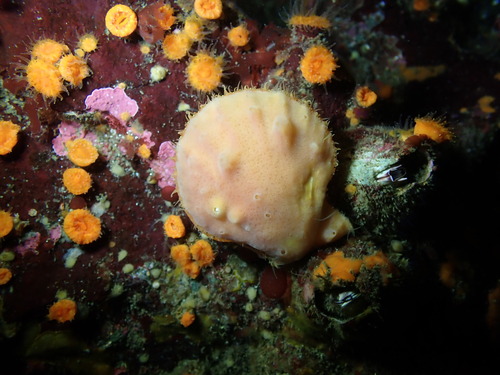
Mycale adhaerens
species of sponge
Stephanosaurus
Stephanosaurus (meaning "crown lizard") is a dubious genus of hadrosaurid dinosaur with a complicated taxonomic history.
Edmontosaurus regalis
extinct species of ornithopod dinosaurs (Ornithopoda)