Category
page 1Taxa named by Lorenz Oken

Pan
genus of mammals, includes 2 species: common chimpanzee and bonobo
%20(cropped).jpg)
Panthera
Panthera is a genus within the family Felidae, and one of two extant genera in the subfamily Pantherinae. It contains the largest living members of the cat family. There are five living species: the jaguar, leopard, lion, snow leopard and tiger. Numerous extinct species are also named, including the cave lion and American lion.

Pterois
Lionfish (genus Pterois) are venomous marine fish native to the Indo-Pacific. They are characterized by conspicuous warning coloration with red or black bands and ostentatious dorsal fins tipped with venomous spines. Pterois radiata, Pterois volitans, and Pterois miles are the most commonly studied species in the genus. Pterois species are popular aquarium fish. P. volitans and P. miles are recent and significant invasive species in the west Atlantic, Caribbean Sea, and Mediterranean Sea.

Hemidactylus
Hemidactylus (from Ancient Greek ἡμι- (hēmi-), meaning 'half', and δάκτυλος (dáktulos), meaning 'finger') is a genus of the common gecko family, Gekkonidae. It has 199 described species, newfound ones being described every few years. These geckos are found in all the tropical regions of the world, extending into the subtropical parts of Africa and Europe. They excel in colonizing oceanic islands by rafting on flotsam, and are for example found across most of Polynesia. In some archipelagoes, cryptic species complexes are found. Geckos like to live in and out of houses. They have been introduce
Conger
Conger ( ) is a genus of marine congrid eels. It includes some of the largest types of eels, ranging up to or more in length, in the case of the European conger. Large congers have often been observed by divers during the day in parts of the Mediterranean Sea, and both European and American congers are sometimes caught by fishermen along the European and North American Atlantic coasts.
Ptyodactylus
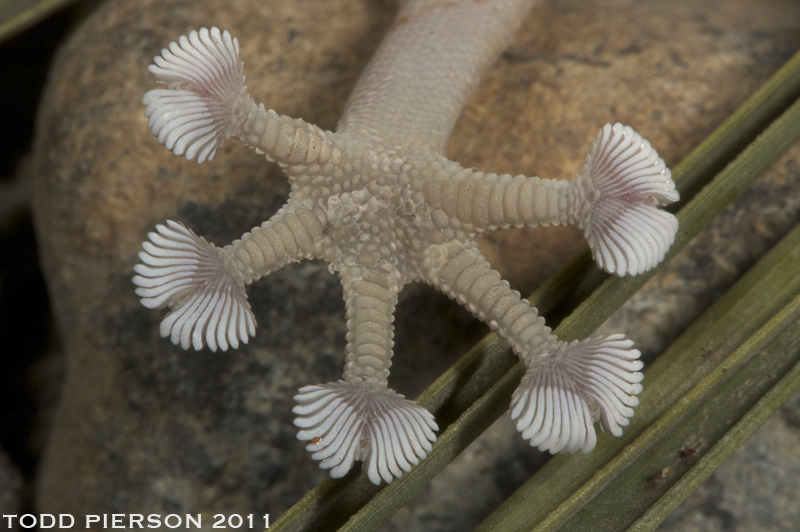
Ptyodactylus is a genus of geckos, which are commonly known as fan-fingered geckos.
The genus has 12 described species.
Thecadactylus
Thecadactylus is a gekko genus from the tropical Americas. They are known as the turnip-tailed geckos. The genus belongs to the gecko family Phyllodactylidae. Until 2007, it was believed to be monotypic, with T. rapicauda the sole species. Then however, the population from upstream southern Amazon basin was discovered to be very distinct and was named a new species, T. solimoensis. A third species was described in 2011.
Schilbe
Schilbe is a genus of schilbid catfishes native to Africa. Some are colloquially called butter catfish, though this may also refer to the Asian genus Ompok of the family Siluridae.

Diagramma
Diagramma is a genus of marine ray-finned fishes belonging to the family Haemulidae, grunts native to the Indian Ocean and the western Pacific Ocean.
Priacanthus
Priacanthus is a genus of marine ray-finned fishes belonging to the family Priacanthidae, the bigeyes. As of 2012 there are 12 species in the genus.
Triacanthus
Triacanthus is a genus of marine ray-finned fish belonging to the family Triacanthidae, the triplespines or tripodfishes. The two species in this genus are found in the Indian Ocean and the western Pacific Ocean.

Favia
Favia is a genus of reef-building stony corals in the family Mussidae. Members of the genus are massive or thickly encrusting colonial corals, either dome-shaped or flat, and a few are foliaceous. There is a great diversity of form even among individuals of the same species. The corallites project slightly above the surface of the coral and each has its own wall. In most species, the corallites are plocoid and in some, monocentric. The septa and costae linked to the corallite wall are well developed and covered by fine teeth. The polyps only extend and feed during the night. Each one has a sma

Stellifer
Stellifer is a genus of fish in the family Sciaenidae, the drums and croakers. It is found in New World waters. Many species are known commonly as stardrums.
.jpg)
Monacanthus
Monacanthus is a genus of filefishes.
Nidifugous
organisms that leave the nest shortly after hatching or birth
Piabucus
Piabucus is a genus of freshwater tetras in the family Iguanodectidae. All three species are found in South America, largely the Amazon and its major tributaries. None of them are longer than half a foot long, with the largest reaching a maximum size of , and they are slender, with relatively deep chests and long pectoral fins. Their scales are pale or silvery, with lateral lines that stand out.
Galaxea
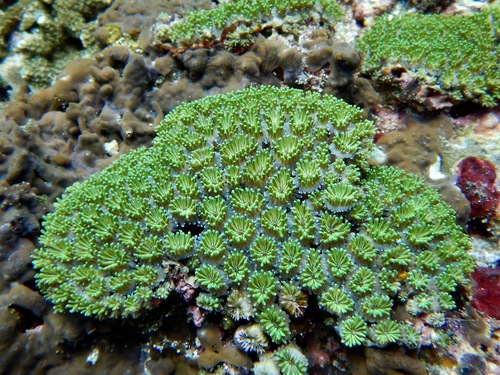
Galaxea is a genus of colonial stony corals in the family Euphylliidae. Common names include crystal, galaxy, starburst and tooth coral. They are abundant on reefs in the Indo-Pacific region and the Red Sea. They are found in water less than deep and favour turbid sites. They are sometimes kept in reef aquaria.
Doto
genus of molluscs
Otolithes
Otolithes is a small genus of marine ray-finned fishes belonging to the family Sciaenidae, the drums and croakers. The three recognised species in the genus are found in the Indo-West Pacific region.
Plesiops
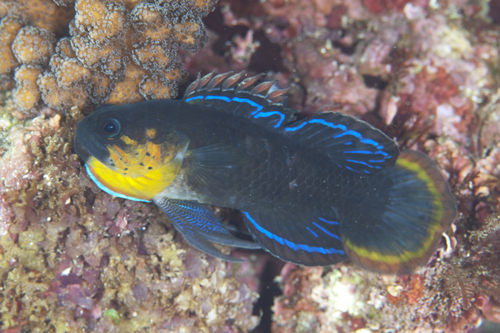
Plesiops is a genus of ray-finned fishes in the family Plesiopidae. It is a genus of small fishes which vary in length from and and which live in shallow coral flats or around heads of coral. They have elongated pelvic fins and the other fins are marked with colourful patterns such as stripes and these give name to the common names "longfin" and "prettyfin". They are thought to be nocturnal and are infrequently seen in the wild. They are carnivorous and their diet is made up of crustaceans, gastropods and small fishes and sometimes on brittle stars. A defining characteristic of this genus is t
Thyone
genus of echinoderms
Mussa
genus of cnidarians
Pennella
Pennella is a genus of large copepods which are common parasites of large pelagic fishes. They begin their life cycle as a series of free-swimming planktonic larvae. The females metamorphose into a parasitic stage when they attach to a host and enter into its skin. The males are free swimming. Due to their large size and mesoparasitic life history there have been a number of studies of Pennella, the members of which are among the largest of the parasitic Copepoda. All species are found as adults buried into the flesh of marine bony fish, except for a single species, Pennella balaenopterae whic