Category
page 1Taxonbars without primary Wikidata taxon IDs
%20(Sylvilagus%20palustris).jpg)
rabbit
Rabbits, or bunnies, are small mammals in the family Leporidae (which also includes the hares), which is in the order Lagomorpha (which also includes pikas). They are familiar throughout the world as a small herbivore, a prey animal, a domesticated form of livestock, and a pet, having a widespread effect on ecologies and cultures. The most widespread rabbit genera are Oryctolagus and Sylvilagus. The former, Oryctolagus, includes the European rabbit, Oryctolagus cuniculus, which is the ancestor of the hundreds of breeds of domestic rabbit and has been introduced on every continent except Antarc

mule
The mule is a domestic equine hybrid between a donkey and a horse. It is the offspring of a male donkey (a jack) and a female horse (a mare). The horse and the donkey are different species, with different numbers of chromosomes; of the two possible first-generation hybrids between them, the mule is easier to obtain and more common than the hinny, which is the offspring of a male horse (a stallion) and a female donkey (a jenny).
.jpg)
turnip
The turnip or white turnip (Brassica rapa subsp. rapa) is a root vegetable commonly grown in temperate climates worldwide for its white, fleshy taproot. Small, tender varieties are grown for human consumption, while larger varieties are grown as feed for livestock. The name turnip used in many regions may also be used to refer to rutabaga (or neep or swede), which is a different but related vegetable.
peafowl
Peafowl is a common name for two bird species of the genus Pavo and one species of the closely related genus Afropavo within the tribe Pavonini of the family Phasianidae (the pheasants and their allies). Male peafowl are referred to as peacocks, and female peafowl are referred to as peahens. Despite this, peacock is usually used to refer to both sexes, in common language.

liger
The liger is a hybrid offspring of a male lion (Panthera leo) and a tigress, or female tiger (Panthera tigris). The liger has parents in the same genus but of different species. The liger is distinct from the opposite hybrid called the tigon (of a male tiger and a lioness), and is the largest of all known extant felids. They enjoy swimming, which is a characteristic of tigers, and are very sociable like lions. Notably, ligers typically grow larger than either parent species, unlike tigons.

domestic goose
breed of domesticated bird (Aves)

domestic duck
farm animal

Larinae
thumb|right|Immature (probably 2nd year) Armenian gull in flight, flying over [[Lake Sevan]]
Gulls or seagulls are seabirds of the subfamily Larinae. They are most closely related to terns and skimmers, and are placed with them in the family Laridae. They are also related, more distantly, to auks and skuas, and more distantly still to waders. Until the 21st century, most gulls were placed in the genus Larus, but that arrangement is now considered polyphyletic, leading to the readoption and revision of several genera.
.jpg)
tigon
The tigon is a hybrid offspring of a male tiger (Panthera tigris) and a female lion, or lioness (Panthera leo). They exhibit visible characteristics from both parents: they can have both spots from the mother (lions carry genes for spots – lion cubs are spotted and some adults retain faint markings) and stripes from the father. Any mane that a male tigon may have will appear shorter and less noticeable than a lion's mane and is closer in type to the ruff of a male tiger.
hinny
A hinny is a domestic equine hybrid, the offspring of a male horse (a stallion) and a female donkey (a jenny). It is the reciprocal cross to the more common mule, which is the product of a male donkey (a jack) and a female horse (a mare). The hinny is distinct from the mule both in physiology and temperament as a consequence of genomic imprinting; it is also less common.
Japanese encephalitis
infection of the brain caused by the Japanese encephalitis virus
Africanized bee
hybrid species of bee

Radiata
Radiata or Radiates is a historical taxonomic rank that was used to classify animals with radially symmetric body plans. The term Radiata is no longer accepted, as it united several different groupings of animals that do not form a monophyletic group under current views of animal phylogeny. The similarities once offered in justification of the taxon, such as radial symmetry, are now taken to be the result of either incorrect evaluations by early researchers or convergent evolution, rather than an indication of a common ancestor. Because of this, the term is used mostly in a historical context.

Monera
Monera () (Greek: (), "single", "solitary") is historically a biological kingdom that is made up of unicellular prokaryotes. As such, it is composed of single-celled organisms that lack a nucleus.
methicillin-resistant Staphylococcus aureus
bacterium responsible for difficult-to-treat infections in humans

Darwin's finches
group of related bird species in the Galápagos Islands

marine flowering plant
Seagrasses are the only flowering plants which grow in marine environments. There are about 60 species of fully marine seagrasses which belong to four families (Posidoniaceae, Zosteraceae, Hydrocharitaceae and Cymodoceaceae), all in the order Alismatales (in the clade of monocotyledons). Seagrasses evolved from terrestrial plants which recolonised the ocean 70 to 100 million years ago.
hepatitis D
Human disease

zebroid
A zebroid is the offspring of any cross between a zebra and any other equine to create a hybrid. In most cases, the sire is a zebra stallion but not every time. The offspring of a donkey sire and zebra dam, called a donkra, and the offspring of a horse sire and a zebra dam, called a hebra, do exist, but are rare and are usually sterile. Zebroids have been bred since the 19th century. Charles Darwin noted several zebra hybrids in his works.
Australopithecine
The australopithecines (), formally Australopithecina or Hominina, are generally any species in the related genera of Australopithecus and Paranthropus. It may also include members of Kenyanthropus, Ardipithecus, and Praeanthropus. The term comes from a former classification as members of a distinct subfamily, the Australopithecinae. They are classified within the Australopithecina subtribe of the Hominini tribe. These related species are sometimes collectively termed australopithecines, australopiths, or homininians. They are the extinct, close relatives of modern humans and, together with th

myxomatosis
Myxomatosis is a disease caused by Myxoma virus, a poxvirus in the genus Leporipoxvirus. The natural hosts are tapeti (Sylvilagus brasiliensis) in South and Central America, and brush rabbits (Sylvilagus bachmani) in North America. The myxoma virus causes only a mild disease in these species, but causes a severe and usually fatal disease in European rabbits (Oryctolagus cuniculus), the species of rabbit commonly raised for companionship and as a food source.

Circaetinae
Circaetinae is a subfamily of the family Accipitridae which contains a group of medium to large broad-winged birds of prey. The group is sometimes treated as tribe Circaetini. These birds mainly specialise in feeding on snakes and other reptiles, which is the reason most are referred to as "snake-eagles" or "serpent-eagles". The exceptions are the bateleur, a more generalised hunter, and the Philippine eagle, which preys on mammals and birds.
gecko
Geckos are small, mostly carnivorous lizards that have a wide distribution, found on every continent except Antarctica. Belonging to the suborder Gekkota, geckos are found in warm climates. They range from .
Old World vulture
informal group of birds, use Q13428438 for the Aegypiinae

Filozoa
The Filozoa are a monophyletic grouping within the Opisthokonta. They include animals and their nearest unicellular relatives (organisms which are more closely related to animals than to fungi or Mesomycetozoa).
Ursus maritimus × Ursus arctos
hybrid between polar bear and grizzly bear
Cape lion
subspecies of mammal (fossil)
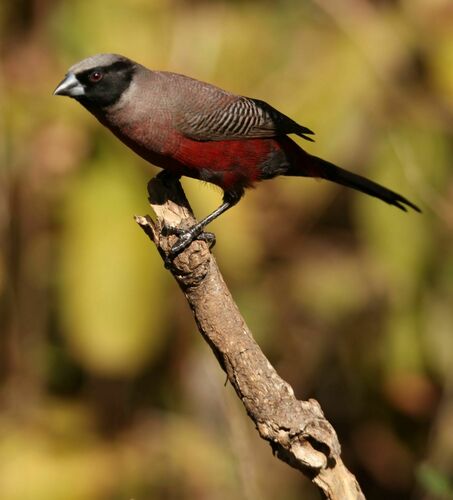
Black-faced Waxbill
species of bird
SAR
eukaryotes supergroup

Opabinia
Opabinia regalis is an extinct, stem group marine arthropod found in the Middle Cambrian Burgess Shale Lagerstätte (505 million years ago) of British Columbia. Opabinia was a soft-bodied animal, measuring up to 7 cm in body length, and had a segmented trunk with flaps along its sides and a fan-shaped tail. The head showed unusual features: five eyes, a mouth under the head and facing backwards, and a clawed proboscis that most likely passed food to its mouth. Opabinia lived on the seafloor, using the proboscis to seek out small, soft food. Fewer than twenty good specimens have been descri

Zənzibar leopard
subspecies of mammal

Orange-breasted Fig Parrot
species of bird
Solo Man
hominid fossil - extinct

anamniotes
The anamniotes are an informal group of vertebrates comprising all fish and amphibians, which lay their eggs in aquatic environments. They are distinguished from the amniotes (reptiles, birds and mammals), which can reproduce on dry land either by laying shelled eggs or by carrying fertilized eggs within the female. Older sources, particularly before the 20th century, may refer to anamniotes as "lower vertebrates" and amniotes as "higher vertebrates", based on the antiquated idea of the evolutionary great chain of being.
Diaphoretickes
Diaphoretickes () is a major evolutionary lineage, or clade, of eukaryotic organisms spanning over 600,000 species. They comprise an enormous diversity of life forms, from single-celled protozoa to multicellular plants and numerous types of algae. The clade was discovered through phylogenetic analyses in the 21st century that revealed a close relationship between the supergroups Archaeplastida (or plants in a broad sense), Haptista, Cryptista, and SAR (Stramenopiles, Alveolata and Rhizaria).
%20Lorryia%20formosa%202%20edit.jpg)
mite
Mites are small arachnids (eight-legged arthropods) of two large orders, the Acariformes and the Parasitiformes, which were historically grouped together in the subclass Acari. However, most recent genetic analyses do not recover the two as each other's closest relative within Arachnida, rendering the group invalid as a clade. Most mites are tiny, less than in length, and have a simple, unsegmented body plan. The small size of most species makes them easily overlooked; some species live in water, many live in soil as decomposers, others live on plants, sometimes creating galls, while others ar
Yuanmou Man
subspecies of the genus Homo (fossil)

Obazoa
Obazoa is a sister clade of Amoebozoa (which together form Amorphea). The term Obazoa is based on the OBA acronym for Opisthokonta, Breviatea, and Apusomonadidae, the group's three constituent clades.

Perninae
The raptor subfamily Perninae includes a number of medium-sized broad-winged bird of prey species known as perns. These are birds of warmer climates, although the Pernis species (European honey buzzard and crested honey buzzard) have a more extensive range.

toxocariasis
Toxocariasis is an illness of humans caused by the dog roundworm (Toxocara canis) and, less frequently, the cat roundworm (Toxocara cati). These are the most common intestinal roundworms of dogs, coyotes, wolves and foxes and domestic cats, respectively. Humans are among the many "accidental" or paratenic hosts of these roundworms.
North African elephant
subspecies of mammal
Alphapithovirus
Alphapithovirus is a genus of giant virus known from two species, Alphapithovirus siberiense, which infects amoebae, and Alphapithovirus massiliense. It is DNA-based and is a member of the nucleocytoplasmic large DNA viruses clade. It was discovered in 2014, when a viable specimen was found in a 30,000-year-old ice core harvested from permafrost in Siberia, Russia. It is the third-largest known giant virus, behind only Megaklothovirus horridgei and Klothovirus casanovai.
Trinil tiger
subspecies of mammal

Saxicolinae
subfamily of birds
Panthera fossilis
fossil species of big cats (Pantherinae)

boysenberry
thumb|Boysenberry, June - Los Angeles, California
Ugli fruit
trademark for the Jamaican tangelo
dzo
A dzo () is a hybrid between the yak and the domestic cow. The word dzo technically refers to a male hybrid, while a female is known as a or . In Mongolian, it is called a ' (хайнаг). There is also the English portmanteau term of yattle'—a combination of the words yak and cattle, as well as yakow—a combination of the words yak and cow.
Amorphea
Amorphea is a taxonomic supergroup that includes the basal Amoebozoa and Obazoa. That latter contains the Opisthokonta, which includes the fungi, animals and the choanoflagellates. The taxonomic affinities of the members of this clade were originally described and proposed by Thomas Cavalier-Smith in 2002.
lumpy skin disease
bovine disease

Leptodactylus fallax
species of amphibian

influenza A virus subtype H7N9
subtype of the influenza A virus

Banded Yellow Robin
species of bird
crayfish plague
crayfish disease caused by Aphanomyces astaci
ground sloth
informal group of mammals (fossil)
Human T-lymphotropic virus
anti htlv
honeypot ant
ants which have specialized workers that are gorged with food to the point that their abdomens swell enormously
Nanjing Man
subspecies of the genus Homo (fossil)
Peștera cu Oase
geographical object

Jaekelopterus
Jaekelopterus is an extinct genus of eurypterid, a group of extinct aquatic arthropods. Fossils of Jaekelopterus have been discovered in deposits of Middle Silurian to Early Devonian age, from the Wenlock epoch to Emsian stage.' There are three known species:' the type species J. rhenaniae from Devonian brackish to fresh water strata in the Rhineland, J. howelli from Devonian estuarine strata in Wyoming, and J. marylandicus from Silurian deposits in Maryland. The generic name combines the name of German paleontologist Otto Jaekel, who described the type species, and the Greek word () mean