Category
page 1Tephra

pumice
thumb|Kutkhiny Baty, a pumice rock formation outcrop located 4 km from the source of the Ozyornaya (Sea of Okhotsk)|Ozyornaya River (Lake Kurile), near the southern tip of the [[Kamchatka Peninsula, Russia]]

volcanic ash
volcanic material formed during explosive eruptions with the diameter of the grains less than 2 mm

tephra
thumb|Volcanic tephra at Brown Bluff, Antarctica (2016)
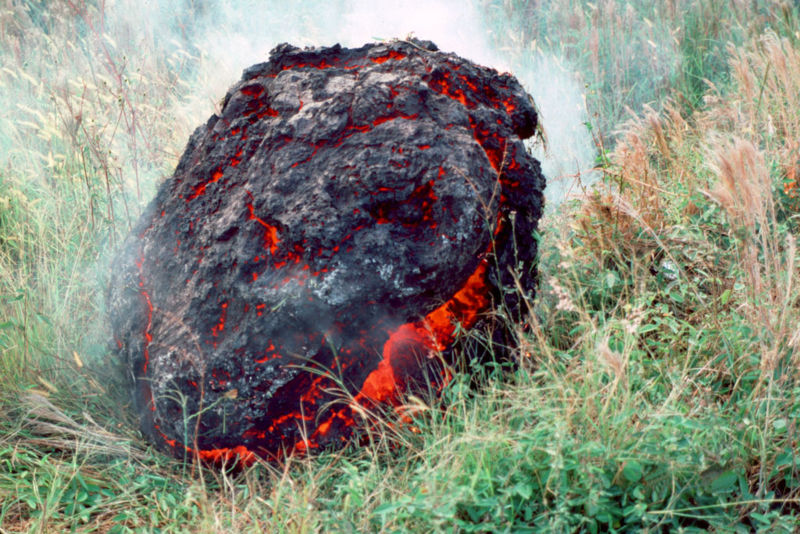
volcanic bomb
volcanic projectile, recognisable later by shape

lapilli
thumb|right|340px|Lapilli on Kilauea

ignimbrite
thumb|Rocks from the Bishop tuff from California, United States, uncompressed with [[pumice on left; compressed with fiamme on right]]
thumb|The caprock in this photo is the ignimbrite layer of the [[Rattlesnake Formation in Oregon.]]

scoria
Scoria or cinder (plural: scoriae) is a pyroclastic, highly vesicular, dark-colored volcanic rock formed by ejection from a volcano as a molten blob and cooled in the air to form discrete grains called clasts. It is typically dark in color (brown, black or purplish-red), and basaltic or andesitic in composition. Scoria has relatively low density, as it is riddled with macroscopic ellipsoidal vesicles (gas bubbles), but in contrast to pumice, most scoria usually has a specific gravity greater than or at 1 and sinks or remains in place in water rather than float at the surface. However, some sco
eruption column
cloud of ash and tephra released during an explosive volcanic eruption

tephrochronology
250px|thumb|right|Tephra horizons in south-central Iceland. The thick and light coloured layer at the height of the [[volcanologist's hands is rhyolitic tephra from Hekla.]]
Lizard Head
mountain in United States of America