Category
page 1Theoretical physics

theory of relativity
two interrelated physics theories by Albert Einstein
.svg)
symmetry
thumb|upright=1.25|Symmetry (left) and asymmetry (right)
thumb|upright=0.8|A spherical symmetry group with [[octahedral symmetry. The yellow region shows the fundamental domain.]]
thumb|upright=0.8|A fractal-like shape that has [[reflectional symmetry, rotational symmetry and self-similarity, three forms of symmetry. This shape is obtained by a finite subdivision rule.]]

spacetime
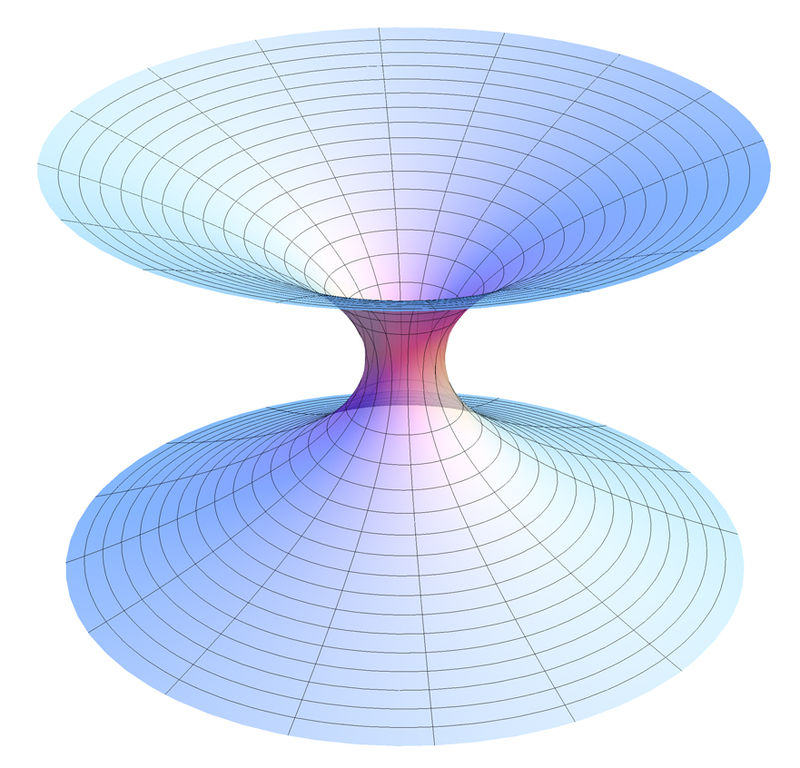
In physics, spacetime, also called the space-time continuum, is a mathematical model that fuses the three dimensions of space and the one dimension of time into a single four-dimensional continuum. Spacetime diagrams are useful in visualizing and understanding relativistic effects, such as how different observers perceive where and when events occur.
theoretical physics
branch of physics concerned with formulating theory rather than performing experiments

supersymmetry
Supersymmetry is a theoretical framework in physics that suggests the existence of a symmetry between particles with integer spin (bosons) and particles with half-integer spin (fermions). It proposes that for every known particle, there exists a partner particle with different spin properties. There have been multiple experiments on supersymmetry that have failed to provide evidence that it exists in nature. If evidence is found, supersymmetry could help explain certain phenomena, such as the nature of dark matter and the hierarchy problem in particle physics.
Galilean transformation
transform between the coordinates of two reference frames which differ only by constant relative motion within the constructs of Newtonian physics
spontaneous symmetry breaking
physical phenomenon in which the vacuum expectation value of a field is not invariant under a symmetry of the action, so that a symmetry present at high temperatures is broken at low temperatures
holographic principle
physical principle in which physics inside a bounded region is fully captured by physics at the boundary of the region
Lorenz system
System of ordinary differential equations first studied by Edward Lorenz
fine-tuned universe
the proposition that the occurrence of life in the universe is very sensitive to the values of certain fundamental physical constants and that the observed values are, for some reason, improbable
spherical cow
character of a humorous metaphor for highly simplified scientific models of complex real life phenomena
Higgs field
scalar field whose vacuum expectation value spontaneously breaks electroweak gauge symmetry
radius of curvature
radius of a circle which best approximates a curve in a given point
operator in physics
function acting on the space of physical states in physics
spacetime curvature
mathematical model used in general relativity
symmetry breaking
effect or phenomenon that is not invariant under a presumed or approximate symmetry of a physical system
variational principle
a scientific principle used within the calculus of variations, which develops general methods for finding functions which extremize the value of quantities that depend upon those functions
Nordic Institute for Theoretical Physics
research institute
irreducible representation
type of linear representation
cloaking device
theoretical device to render objects invisible
particle physics phenomenology
application of theoretical physics to experimental data by making quantitative predictions based upon known theories
Luttinger liquid
a theoretical model describing interacting electrons (or other fermions) in a one-dimensional conductor (e.g. quantum wires such as carbon nanotubes)
causal set
locally finite partially ordered set, used to model discretized Lorentzian spacetime
toy model
deliberately simplistic model with many details removed so that it can be used to explain a mechanism concisely, also useful in a description of the fuller model
problem of time
conceptual conflict between general relativity and quantum mechanics
spin foam
in quantum gravity, a structure consisting of two-dimensional faces for path integrals
Penrose graphical notation
graphical notation for multilinear algebra calculations
Gregory M. Garibian
physicist (1924–1991)
symmetry in quantum mechanics
properties underlying modern physics
Background independence
concept of universality in physical science
Bogdanov Affair
French academic dispute
Progress of Theoretical and Experimental Physics
scientific journal
Classical unified field theories
theoretical attempts to unify the forces of nature
transactional interpretation
interpretation of quantum mechanics according to which retarded (forward in time) and advanced (backward in time) waves form a quantum interaction as a Wheeler–Feynman handshake
Green–Kubo relations
equation relating transport coefficients to correlation functions
Explicit symmetry breaking
symmetry breaking in physics
fluxon
In physics, a fluxon is a quantum of electromagnetic flux. The term may have any of several related meanings.
timeline of fundamental physics discoveries
timeline
gauge group
group of gauge symmetries in a gauge theory
Eikonal approximation
method of approximation useful in wave scattering equations
IXS Enterprise
NASA conceptual interstellar ship
Nordtvedt effect
effect in theoretical astrophysics
Darboux transformation
mathematical method
density matrix renormalization group
numerical variational technique devised to obtain the low energy physics of quantum many-body systems with high accuracy