Category
page 1Theories of gravity

Newton's law of universal gravitation
classical mechanics physical law

gravitational field
direction and intensity of gravity in every point of space

quantum gravity
field of theoretical physics

cosmological constant
constant representing stress-energy density of the vacuum in Einstein's equation, which accounts for the rate of expansion of the universe
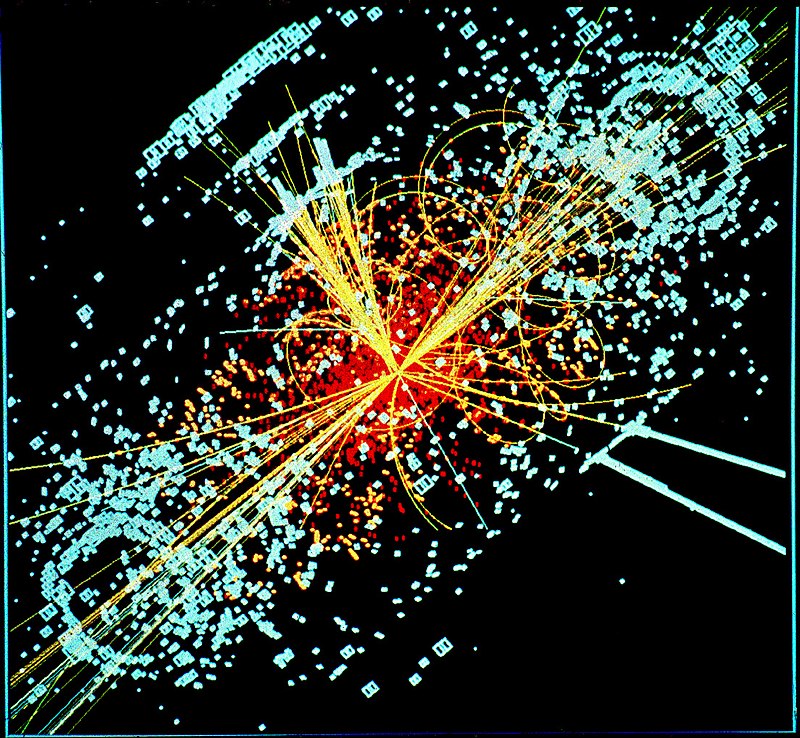
theory of everything
hypothetical single, all-encompassing, coherent theoretical framework of physics
supergravity
In theoretical physics, supergravity (supergravity theory; SUGRA for short) is a modern field theory that combines the principles of supersymmetry and general relativity; this is in contrast to non-gravitational supersymmetric theories such as the Minimal Supersymmetric Standard Model. Supergravity is the gauge theory of local supersymmetry. Since the supersymmetry (SUSY) generators form together with the Poincaré algebra and superalgebra, called the super-Poincaré algebra, supersymmetry as a gauge theory makes gravity arise in a natural way.
unified field theory
type of physical field theory unifying fundamental forces
loop quantum gravity
theory that attempts to canonically quantize gravity via Ashtekar variables
Kaluza–Klein theory
field theory on a spacetime with small, compact extra dimensions beyond the large observed dimensions
Modified Newtonian dynamics
alternative explanation of the non-Newtonian rotation of galaxies
Mach's principle
principle that inertia is determined by the large-scale distribution of matter
twistor theory
physical theory that encodes fields on Minkowski space into complex analytic objects on twistor space via the Penrose transform
entropic gravity
theory in modern physics that describes gravity as an entropic force
Einstein–Cartan theory
classical theory of gravitation
Le Sage's theory of gravitation
obsolete kinetic theory of gravity that explained Newton’s gravitational force in terms of streams of unseen particles impacting material objects from all directions
Brans–Dicke theory
scalar–tensor theory of gravitation
parameterized post-Newtonian formalism
classification system for different theories of gravity
Gauss's law for gravity
restatement of Newton's law of universal gravitation

history of gravitational theory
Theories in physics that postulate mechanisms of interaction governing the movements of bodies with mass
An Exceptionally Simple Theory of Everything
preprint
alternatives to general relativity
proposed theories of gravity
geometrodynamics
In theoretical physics, geometrodynamics is an attempt to describe spacetime and associated phenomena completely in terms of geometry. Technically, its goal is to unify the fundamental forces and reformulate general relativity as a configuration space of three-metrics, modulo three-dimensional diffeomorphisms. The origin of this idea can be found in an English mathematician William Kingdon Clifford's works. This theory was enthusiastically promoted by John Wheeler in the 1960s, and work on it continues in the 21st century.
Nordström's theory of gravitation
predecessor to the theory of relativity
graviscalar
In theoretical physics, the hypothetical particle called the graviscalar or radion emerges as an excitation of general relativity's metric tensor, i.e. gravitational field, but is indistinguishable from a scalar in four dimensions, as shown in Kaluza–Klein theory. The scalar field \phi comes from a component of the metric tensor g_{55} where the figure 5 labels an additional fifth dimension. The only variations in the scalar field represent variations in the size of the extra dimension. Also, in models with multiple extra dimensions, there exist several such particles. Moreover, in theories wi
Mechanical explanations of gravitation
attempts to explain the action of gravity by aid of basic mechanical processe
tensor–vector–scalar gravity
relativistic generalization of Mordehai Milgrom's MOND paradigm
f(R) gravity
theory of gravity whose Lagrangian is some function of the Ricci scalar R
Rainbow Gravity theory
physics theory sometimes referred to as "gravity's rainbow"
induced gravity
model in which space-time curvature and its dynamics emerge as a mean field approximation of underlying microscopic degrees of freedom
teleparallelism
Teleparallelism (also called teleparallel gravity), was an attempt by Albert Einstein to base a unified theory of electromagnetism and gravity on the mathematical structure of distant parallelism, also referred to as absolute or teleparallelism. In this theory, a spacetime is characterized by a curvature-free linear connection in conjunction with a metric tensor field, both defined in terms of a dynamical tetrad field.
bimetric gravity
theory of gravity with two metric tensors
scalar–tensor–vector gravity
Modified theory of gravity developed by John Moffat
DGP model
Proposed model of gravity
gauge theory gravity
theory of gravitation cast in the mathematical language of geometric algebra
world crystal
Theoretical model of gravity
superfluid vacuum theory
theory of fundamental physics