Category
page 1Theory of relativity

theory of relativity
two interrelated physics theories by Albert Einstein

spacetime
In physics, spacetime, also called the space-time continuum, is a mathematical model that fuses the three dimensions of space and the one dimension of time into a single four-dimensional continuum. Spacetime diagrams are useful in visualizing and understanding relativistic effects, such as how different observers perceive where and when events occur.

wormhole
thumb|upright=1.3|A wormhole visualized as a two-dimensional surface. Route (a) is the shortest path through normal space between points 1 and 2; route (b) is a shorter path through a wormhole.

inertial frame of reference
frame of reference not undergoing acceleration
principle of relativity
physics principle stating that the laws of physics must be the same in all reference frames
rest mass
mass of a physical system independent of its motion; equals its total mass when at rest
world line
unique path of an object as it travels through 4-dimensional spacetime

four-vector
In special relativity, a four-vector (or 4-vector, sometimes Lorentz vector) is an element of a four-dimensional vector space object with four components, which transform under Lorentz transformations with respect to a change of basis. Its magnitude is determined by an indefinite quadratic form, the preservation of which defines the Lorentz transformations, which include spatial rotations and boosts (a change by a constant velocity to another reference frame).
correspondence principle
physics principle that quantum theories reproduce classical physics in the limit of large quantum numbers, formulated by Niels Bohr in 1920

faster-than-light
thumb|330x330px|Because the sphere travels faster than light, the observer sees nothing until it has already passed. Then, two images appear: one of the sphere arriving (on the right) and one of it departing (on the left).
Faster-than-light (superluminal or supercausal) travel and communication are the conjectural propagation of matter or information faster than the speed of light in vacuum (). The special theory of relativity implies that only particles with zero rest mass (i.e., photons) may travel at the speed of light, and that nothing may travel faster.
absolute time and space
theoretical foundation of Newtonian mechanics
light cone
path taken by a flash of light through spacetime
proper time
elapsed time between two events as measured by a clock that passes through both events
Poincaré group
group of isometries of Minkowski spacetime
gravitational time dilation
time dilation due to gravitational potential
relativistic mechanics
theory of motion and forces for objects close to the speed of light
electromagnetic tensor
mathematical object that describes the electromagnetic field in spacetime
Sagnac effect
effect due to rotation in special relativity
electromagnetic four-potential
relativistic vector field
philosophical presentism
view that neither the future nor the past exist
Unruh effect
prediction that an accelerating observer will observe blackbody radiation where an inertial observer would observe none
spacetime event
in physics, situation or occurrence located at a specific point in space and time
relativistic quantum mechanics
quantum mechanics taking into account particles near or at the speed of light
spacetime curvature
mathematical model used in general relativity
Rindler coordinates
coordinate system on a subset of Minkowski space adapted to a uniformly accelerating observer undergoing hyperbolic motion
Ehrenfest paradox
paradox involving the impossibility of a rotating rigid disk in special relativity
Einstein synchronisation
convention for synchronising clocks at different places by means of signal exchanges
Lorentz scalar
quantity in the theory of relativity which is invariant under a Lorentz transformation
causal structure
concept in mathematical physics
Bell's spaceship paradox
thought experiment in special relativity: “a string hangs between two spaceships that start accelerating simultaneously equally in an inertial frame; will the string break?”
Coordinate time
Time scale
criticism of the theory of relativity
overview about the criticism of the theory of relativity
list of black holes
Wikimedia list article
classical limit
concept of modern physics theories that they should, under some circumstances, approximate the predictions of classical physics
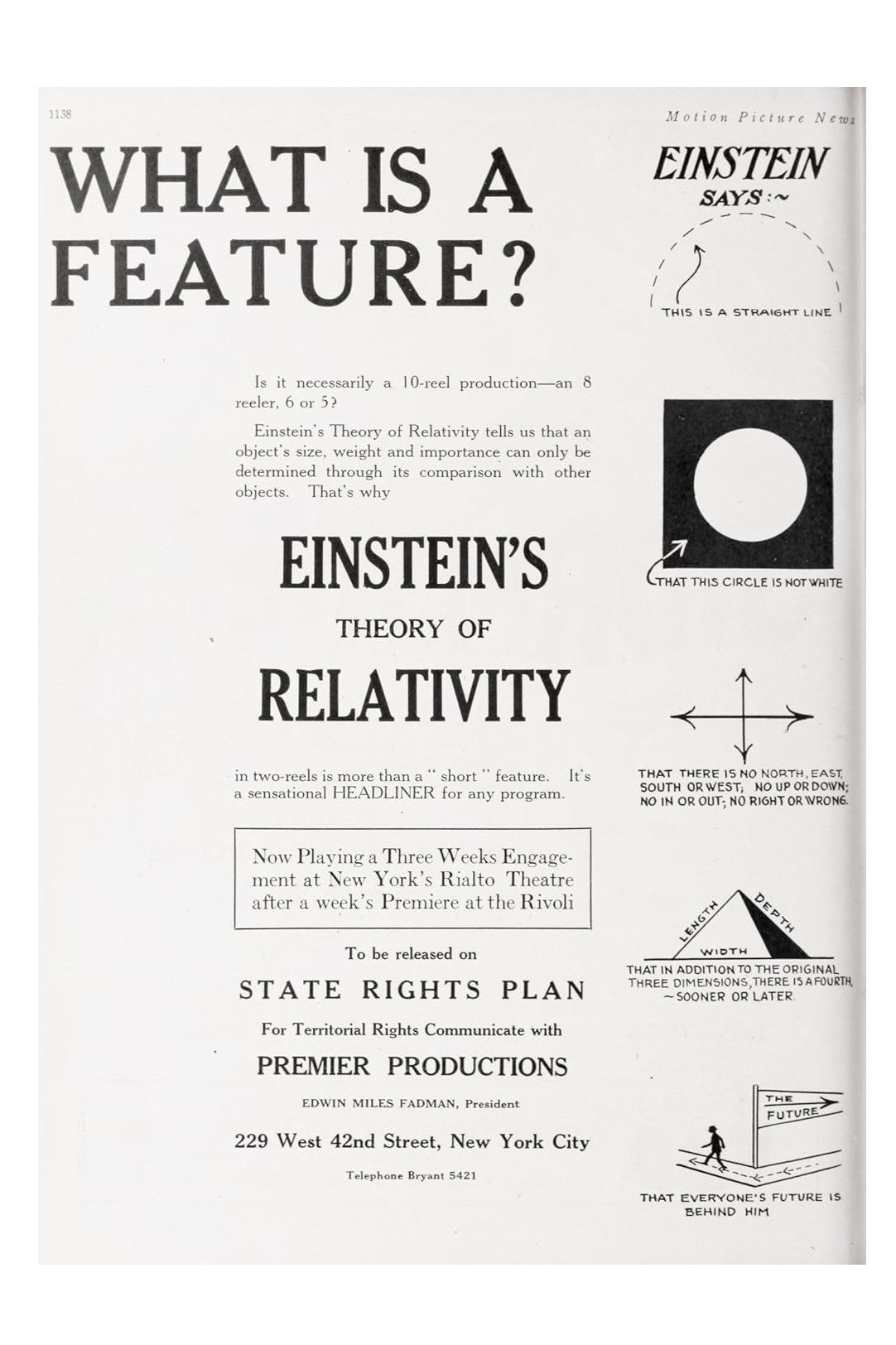
The Einstein Theory of Relativity
1923 silent film about the theory of relativity directed by Max Fleischer and Dave Fleischer
nonsingular black hole models
Models of black holes without gravitational singularities
relativistic star
category of star
Relativity priority dispute
Debate about priority credit for the theories of general and special relativity
hyperbolic motion
motion of an object with constant proper acceleration in special relativity
relativistic dynamics
combination of relativistic and quantum concepts
four-tensor
In physics, specifically for special relativity and general relativity, a four-tensor is an abbreviation for a tensor in a four-dimensional spacetime.
time translation symmetry
mathematical transformation in physics that moves the times of events through a common interval
proper length
length of an object in the object's rest frame

Die Grundlagen der Einsteinschen Relativitäts-Theorie
1922 silent film
Absolute rotation
rotation independent of any external reference
GW190814
The Meaning of Relativity
written work by Albert Einstein