Category
page 1Thermodynamic processes
adiabatic process
thermodynamic process with zero heat transfer

isothermal process
thermodynamic process in which the temperature remains constant
thermodynamic equilibrium
state of thermodynamic system(s) where no net macroscopic flow of matter or energy occurs

thermodynamic system
precisely specified macroscopic region of the universe, defined by boundaries
isochoric process
thermodynamic process at constant volume
isobaric process
thermodynamic process in which pressure remains constant
thermodynamic cycle
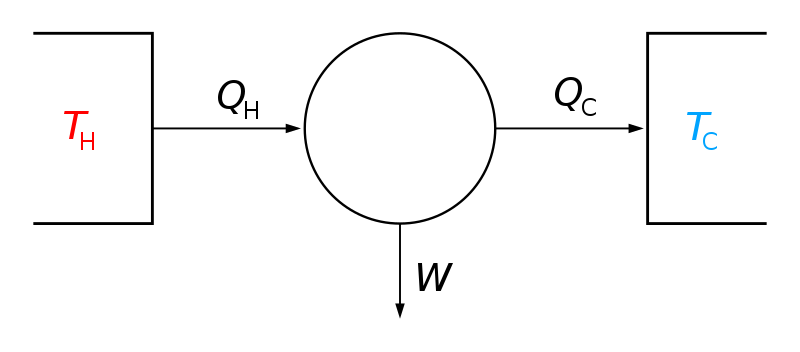
linked sequence of thermodynamic processes that involve transfer of heat and work into and out of the system,while varying pressure, temperature, and other state variables within the system, and that eventually returns the system to its initial state
thermodynamic process
energetic development of a thermodynamic system proceeding from an initial state to a final state

supercooling
thumb|Supercooled water, still in liquid state
thumb|Start of solidification as a result of leaving the state of rest
Supercooling, also known as undercooling, is the process of lowering the temperature of a liquid below its freezing point without it becoming a solid. Per the established international definition, supercooling means "cooling a substance below the normal freezing point without solidification". While it can be achieved by different physical means, the postponed solidification is most often due to the absence of seed crystals or nuclei around which a crystal structure can form. Th
reversible process
process which can be "reversed" by changing some parameter of it/system
isentropic process
thermodynamic process that is reversible and adiabatic
polytropic process
type of thermodynamic process
dissipation
In thermodynamics, dissipation is the result of an irreversible process that affects a thermodynamic system. In a dissipative process, energy (internal, bulk flow kinetic, or system potential) transforms from an initial form to a final form, where the capacity of the final form to do thermodynamic work is less than that of the initial form. For example, transfer of energy as heat is dissipative because it is a transfer of energy other than by thermodynamic work or by transfer of matter, and spreads previously concentrated energy. Following the second law of thermodynamics, in conduction and ra
exothermic process
thermodynamic reaction
exergonic reaction
type of chemical reaction
quasistatic process
thermodynamic process in which equilibrium is maintained for the duration of the process
endothermic process
thermodynamic process that absorbs energy from its surroundings
endergonic reaction
type of chemical reaction

superheating
In thermodynamics, superheating (sometimes referred to as boiling retardation, or boiling delay) is the phenomenon in which a liquid is heated to a temperature higher than its boiling point, without boiling. This is a so-called metastable state or metastate, where boiling might occur at any time, induced by external or internal effects. Superheating is achieved by heating a homogeneous substance in a clean container, free of nucleation sites, while taking care not to disturb the liquid.
isenthalpic process
thermodynamic process with no change in enthalpy
air separation
chemical process