Category
page 1Theurgy

Kabbalah
thumb|upright=1.2|Latin translation of Joseph Gikatilla|Gikatilla's Shaarei Ora

Neoplatonism
Neoplatonism, also called late platonism, is a version of Platonic philosophy that emerged in the 3rd century AD against the background of Hellenistic philosophy and religion. The term does not encapsulate a set of distinct ideas based on a form of Platonism as much as a series of Platonic thinkers coming primarily from a certain ancient historical period. Among the common ideas it maintains is monism, the doctrine that all of reality can be derived from a single principle, "the One".
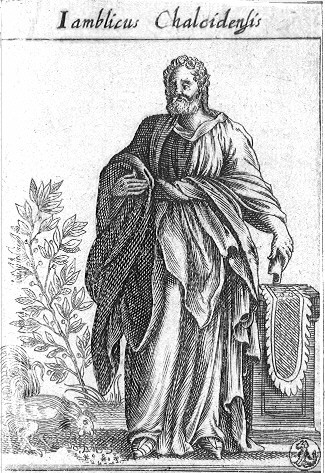
Iamblichus
Iamblichus ( ; ; ; ) was a Syrian Arab Neoplatonist philosopher who determined a direction later taken by Neoplatonism. Iamblichus was also the biographer of the Greek mystic, philosopher, and mathematician Pythagoras. In addition to his philosophical contributions, his is important for the study of the sophists because it preserved about ten pages of an otherwise unknown sophist known as the Anonymus Iamblichi.

Proclus
Proclus Lycius (; 8 February 412 – 17 April 485), called Proclus the Successor (, ), was a Greek Neoplatonist philosopher, one of the last major classical philosophers of late antiquity. He set forth one of the most elaborate and fully developed systems of Neoplatonism and, through later interpreters and translators, exerted an influence on Byzantine philosophy, early Islamic philosophy, scholastic philosophy, and German idealism, especially G. W. F. Hegel, who called Proclus's Platonic Theology "the true turning point or transition from ancient to modern times, from ancient philosophy to

hermeticism
Hermeticism, or Hermetism, is a philosophical and religious tradition rooted in the teachings attributed to Hermes Trismegistus, a syncretic figure combining elements of the Greek god Hermes and the Egyptian god Thoth. This system encompasses a wide range of esoteric knowledge, including aspects of alchemy, astrology and theurgy, significantly influencing various mystical and occult traditions throughout history. The writings attributed to Hermes Trismegistus, often referred to as the Hermetica, were produced over a period spanning many centuries () and may be very different in content and sco
Hermetic Order of the Golden Dawn
magical order active in Great Britain
Theurgy
Theurgy (; , ), also known as divine magic, is one of two major branches of the magical arts, the other being practical magic or thaumaturgy. Theurgy describes the ritual practices associated with the invocation or evocation of the presence of one or more deities, especially with the goal of achieving henosis (uniting with the divine) and perfecting oneself.
Merkabah
throne-chariot of God in the visions of Ezekiel

Hermetica
The Hermetica are texts attributed to the legendary Hellenistic figure Hermes Trismegistus, a syncretic combination of the Greek god Hermes and the Egyptian god Thoth. These texts may vary widely in content and purpose, but by modern convention are usually subdivided into two main categories, the "technical" and "religio-philosophical" Hermetica.
Monas Hieroglyphica
literary work
Hermetic Qabalah
Western esoteric tradition involving mysticism and the occult
deity yoga
Vajrayana practice involving visualization of mental images of a deity