Category
page 1Tides

tide
300px|thumb|upright=1|Simplified schematic of only the lunar portion of Earth's tides, showing (exaggerated) high tides at the sublunar point and its antipodal point|antipode for the hypothetical case of an ocean of constant depth without land, and on the assumption that Earth is not rotating; otherwise there is a lag angle. Solar tides not shown.|alt=
right|thumb|Earth's rotation drags the position of the tidal bulge ahead of the position directly under the Moon showing the lag angle.
thumb|In Maine (U.S.), low tide occurs roughly at moonrise and high tide with a high Moon, corresponding to t
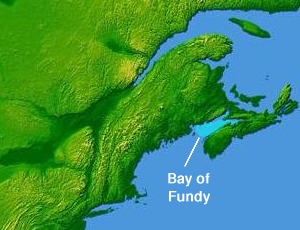
Bay of Fundy
bay on the Atlantic coast of Canada noted for high tides
tidal force
secondary effect of the force of gravity of one body on another

tidal energy
technology to convert the energy from tides into useful forms of power
Hill sphere
with regards to an astronomical body, the region in which it dominates the attraction of satellites
intertidal zone
area between tide marks
tidal island
island accessible by foot at low tide
tide pool
rocky pool on seashore, separated as pool at low tide, filled with seawater
galactic tide
tidal force experienced by objects subject to the gravitational field of a galaxy
Earth tide
displacement of the solid earth's surface caused by the gravity of the Moon and Sun
Amsterdam Ordnance Datum
vertical datum in use in large parts of Western Europe, originally created for use in the Netherlands
amphidromic point
point of zero amplitude of one harmonic constituent of the tide
tidal range
vertical difference between the high tide and the succeeding low tide

tidal river
river whose flow and level are influenced by tides
theory of tides
aspect of history
Horizontal Falls
tidal phenomenon in Western Australia where the tide rises and falls faster on one side of a gap than the other, creating a waterfall up to 5m high on a spring tide
tidal race
fast-moving tidal flow passing through a constriction, forming waves, eddies and strong currents
Love number
parameters describing a planet's rigidity
slack water
short period in a body of tidal water when the water is completely unstressed, and there is no movement either way in the tidal stream, and which occurs before the direction of the tidal stream reverses
Lunitidal interval
time lag from the Moon passing overhead, to the next high or low tide.