Category
page 1Tissues (biology)

blood
Blood is a body fluid in the circulatory system of humans and other vertebrates that delivers necessary substances such as nutrients and oxygen to the cells of the body, and transports metabolic waste products away from those same cells.

tissue
cellular organizational level intermediate between cells and a complete organism; cells that are grouped together with a common function

epithelium
Epithelium or epithelial tissue is a thin, continuous, protective layer of cells with little extracellular matrix. An example is the epidermis, the outermost layer of the skin. Epithelial (mesothelial) tissues line the outer surfaces of many internal organs, the corresponding inner surfaces of body cavities, and the inner surfaces of blood vessels. Epithelial tissue is one of the four basic types of animal tissue, along with connective tissue, muscle tissue and nervous tissue. Epithelial tissues lack blood or lymph supply, but are supplied by nerves.

xylem
thumb|323x323px|Xylem (blue) transports water and minerals from the roots upwards.|alt=
phloem
thumb|upright=1.2|Phloem (orange) transports products of photosynthesis to various parts of the plant.|alt=
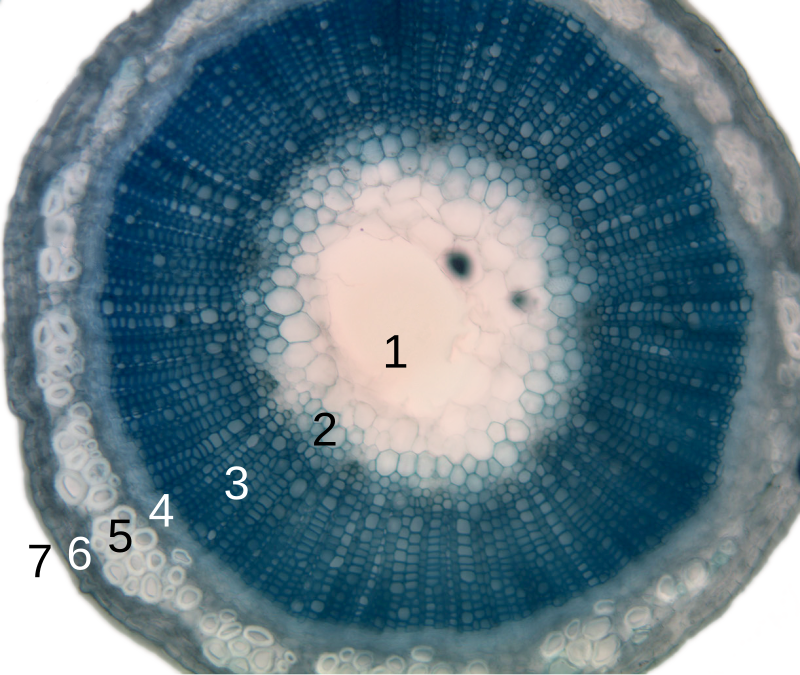
thumb|Cross-section of a flax plant stem:

cork
material derived from the cork oak

nervous tissue
main component of the nervous system

tooth enamel
outer tooth tissue

dentin
thumb|Cross-section of a tooth. B is dentin.

endothelium
The endothelium (: endothelia) is a single layer of squamous endothelial cells that line the interior surface of blood vessels and lymphatic vessels. The endothelium forms an interface between circulating blood or lymph in the lumen and the rest of the vessel wall.
epidermis
outermost single layer of cells in plants. the outer protective layer of cells of a plant, which may be thickened by a cuticle
.jpg)
parenchyma
thumb|upright=1.6|Lung parenchyma showing damage due to large subpleural Focal lung pneumatosis|bullae.
dental pulp
neurovascular bundle in the tooth

hypertrophy
Hypertrophy is an increase in the size of individual cells. In multicellular organisms, growth is typically achieved through a combination of this cellular enlargement and hyperplasia, which is an increase in the number of cells. While distinct processes, they often occur concurrently. Hypertrophy can lead to a relative increase in the volume of a tissue or organ, and contributes to the overall growth of an organism. In organisms characterized by eutely, where the total number of somatic cells is fixed upon reaching maturity, post-embryonic growth is achieved almost exclusively through hypertr
vascular tissue
complex conducting tissue in plants

cellulite
Cellulite () or gynoid lipodystrophy (GLD) is the herniation of subcutaneous fat within fibrous connective tissue that manifests as skin dimpling and nodularity, often on the pelvic region (specifically the buttocks), lower limbs, and abdomen. Cellulite occurs in most postpubescent females. A review gives a prevalence of 85–98% of women of European descent, but it is considerably less common in women of East Asian descent. It is believed to be physiological rather than pathological. It can result from a complex combination of factors, including diet, sedentary lifestyle, hormonal balance, or h

extracellular matrix
structure external to cells, which provides structural support for cells or tissues

ossification
thumb|300 px|right|Bone is broken down by osteoclasts, and rebuilt by osteoblasts, both of which communicate through cytokine (TGF-β, IGF) signalling.
Ossification (also called osteogenesis or bone mineralization) in bone remodeling is the process of laying down new bone material by cells named osteoblasts. It is synonymous with bone tissue formation. There are two processes resulting in the formation of normal, healthy bone tissue: Intramembranous ossification is the direct laying down of bone into the primitive connective tissue (mesenchyme), while endochondral ossification involves cartilag
aponeurosis
An aponeurosis (; : aponeuroses) is a flattened tendon by which muscle attaches to bone or fascia. Aponeuroses exhibit an ordered arrangement of collagen fibres, thus attaining high tensile strength in a particular direction while being vulnerable to tensional or shear forces in other directions. They have a shiny, whitish-silvery color, are histologically similar to tendons, and are very sparingly supplied with blood vessels and nerves. When dissected, aponeuroses are papery and peel off by sections. The primary regions with thick aponeuroses are in the ventral abdominal region, the dorsal lu
vascular bundle
a longitudinal strand of vascular tissue in the stems and leaves of higher plants
abdominal obesity
excess fat around the stomach and abdomen
basement membrane
thin layer of dense material found in tissues between cells and the adjacent connective tissue
serous membrane
smooth coating of body cavities (thorax and abdomen), smooth, shiny, translucent and content with a thin layer of liquid
ground tissue
ground tissue is one of three main tissue systems: protective, ground, and vascular, each tissue system has a different role and functionality inside plant tissues
stroma
in animal tissue, refers to the connective, supportive framework of a biological cell, tissue, or organ
soft tissue
the tissues that connect, support, or surround other structures and organs of the body, not being hard tissue; tendons, ligaments, fascia, skin, fibrous tissues, fat, and synovial membranes (connective tissue), and muscles, nerves and blood vessels
flesh
Flesh is any aggregation of soft tissues of an organism. Various multicellular organisms have soft tissues that may be called "flesh". In mammals, including humans, flesh encompasses muscles, fats and other loose connective tissues, but sometimes excludes non-muscular organs (liver, lung, spleen, kidney) and typically discarded parts (hard tendon, brain tissue, intestines, etc.). More generally, it may be considered the portions of the body that are soft and delicate. In a culinary context, consumable animal flesh is called meat, while processed visceral tissues are known as offal.
secondary growth
Lateral growth of a plant axis (shoot axis or root) that is an increase in thickness resulting from formation of secondary vascular tissues by the vascular cambium.
resistin
Resistin, also known as adipose tissue-specific secretory factor (ADSF) or C/EBP-epsilon-regulated myeloid-specific secreted cysteine-rich protein (XCP1), is a cysteine-rich peptide hormone that is derived from adipose tissue and, in humans, is encoded by the RETN gene.

mesothelium
The mesothelium is a membrane composed of simple squamous epithelial cells of mesodermal origin, which forms the lining of several body cavities: the pleura (pleural cavity around the lungs), peritoneum (abdominopelvic cavity including the mesentery, greater and lesser omentum, falciform ligament and the perimetrium) and pericardium (around the heart).
Template:Biological tissues
Wikimedia template
Sieve tube element
elongated cell in the phloem tissue of flowering plants
muscle hypertrophy
enlargement or overgrowth of a muscle organ

frenulum
thumb|Anatomy of the human mouth, including the frenulum of the tongue
myeloid tissue
tissue of bone marrow

sclereid
thumb|Fresh mount of a sclereid in a banana fruit
Sclereids are a reduced form of sclerenchyma cells with highly thickened, lignified cellular walls that form small bundles of durable layers of tissue in most plants. The presence of numerous sclereids form the cores of apples and produce the gritty texture of guavas.

trabecula
right|thumb|200x200px|Inside of a bone showing the trabecular structure
thumb|A typical carcinoid tumor of the [[lung showing a trabecular pattern of elongated groups of cells.]]
A trabecula (: trabeculae, from Latin for 'small beam') is a small, often microscopic, tissue element in the form of a small beam, strut or rod that supports or anchors a framework of parts within a body or organ. A trabecula generally has a mechanical function, and is usually composed of dense collagenous tissue (such as the trabecula of the spleen). It can be composed of other material such as muscle and bone. In th
interstitium
In anatomy, the interstitium is a contiguous fluid-filled space existing between a structural barrier, such as a cell membrane or the skin, and internal structures, such as organs, including muscles and the circulatory system. The fluid in this space is called interstitial fluid, this fluid comprises water and solutes which drains into the lymphatic system. The interstitial compartment is composed of connective and supporting tissues within the body called the extracellular matrix that are situated outside the blood, lymphatic vessels, and the parenchyma of organs. The role of the interstitium
Paraganglion
A paraganglion (pl. paraganglia) is a group of non-neuronal cells derived of the neural crest. They are named for being generally in close proximity to sympathetic ganglia. They are essentially of two types: (1) chromaffin or sympathetic paraganglia made of chromaffin cells and (2) nonchromaffin or parasympathetic paraganglia made of glomus cells. They are neuroendocrine cells, the former with primary endocrine functions and the latter with primary chemoreceptor functions.
high endothelial venules
venules in some lymphatic organs
dense regular connective tissue
provides connection between different tissues in the human body
tissue microarray
device for analysing many histological tissue samples
Bulliform cell
Plant cell type
dense irregular connective tissue
provides strength, making the skin resistant to tearing
ganoine
thumb|250px|The glassy appearance of the scales of this spotted gar is due to ganoine.
thumb|The mineral texture of alligator gar scales consists of bundles of cross-plied hydroxyapatite minerals oriented towards the scale's surface.
Ganoine or ganoin is a glassy, often multi-layered mineralized tissue that covers the scales, cranial bones and fin rays in some non-teleost ray-finned fishes, such as gars and bichirs, as well as lobe-finned coelacanths. It is composed of rod-like, pseudoprismatic apatite crystallites, with less than 5% of organic matter. Existing fish groups featuring ganoin are
Morphallaxis
Morphallaxis is the regeneration of specific tissue in a variety of organisms due to loss or death of the existing tissue. The word comes from the Greek allazein, (αλλάζειν) which means to change.
rugae
thumb|270x270px|Rugae folds behind the anterior teeth in the hard palate of the mouth
neurovascular bundle
structure binding nerves and vessels
periorbita
The periorbita is the area around the orbit. Sometimes it refers specifically to the layer of tissue surrounding the orbit that consists of periosteum. However, it may refer to anything that is around the orbit, such as in periorbital cellulitis.
biomimetic materials
materials made by techniques imitating biological processes
ossification center
point where ossification of the cartilage begins
enamel rod
dental enamel