Category
page 1Titans (mythology)

Prometheus
In Greek mythology, Prometheus (; ) is a Titan responsible for creating or aiding humanity in its earliest days. He defied the Olympian gods by taking fire from them and giving it to humanity in the form of technology, knowledge and, more generally, civilization.

titan
thumb|upright=1.3|The Fall of the Titans (1596-98), a mythological painting by Dutch painter [[Cornelis van Haarlem.]]

Cronus
In ancient Greek religion and mythology, Cronus, Cronos, or Kronos ( or ; ) was the leader and youngest of the Titans, the children of Gaia (Earth) and Uranus (Sky). He overthrew his father and ruled during the mythological Golden Age until he was overthrown by his son Zeus and imprisoned in Tartarus. According to Plato, however, the deities Phorcys, Cronus, and Rhea were the eldest children of Oceanus and Tethys.

Atlas
deity in Greek mythology

Rhea
female Titan in Greek mythology, mother of Zeus and mother of Hera

Oceanus
In Greek mythology, Oceanus or Okeanos was one of the Titans, the children of Uranus (Sky) and Gaia (Earth), and the god of great river which encircled the entire world. He was the brother and husband of the Titaness Tethys, and by her was the father of the river gods and the Oceanids.

Selene
In ancient Greek mythology and religion, Selene (; ) is the goddess and personification of the Moon. Also known as Mene (; ), she is traditionally the daughter of the Titans Hyperion and Theia, and sister of the sun god Helios and the dawn goddess Eos. She drives her moon chariot across the heavens. Several lovers are attributed to her in various myths, including Zeus, Pan, her brother Helios and the mortal Endymion. In post-classical times, Selene was often identified with Artemis, much as her brother, Helios, was identified with Apollo. Selene and Artemis were also associated with Hecate and

Helios
In ancient Greek religion and mythology, Helios (; ; Homeric Greek: ) is the god who personifies the Sun. His name is also Latinized as Helius, and he is often given the epithets Hyperion ("the one above") and Phaethon ("the shining"). Helios is often depicted in art with a radiant crown and driving a horse-drawn chariot through the sky. He was a guardian of oaths and also the god of sight. Though Helios was a relatively minor deity in Classical Greece, his worship grew more prominent in late antiquity thanks to his identification with several major solar divinities of the Roman period, partic

Themis
In Greek mythology and religion, Themis (; ) is the goddess and personification of justice, divine order, law, and custom. She is one of the twelve Titan children of Gaia and Uranus, and the second wife of Zeus. She is associated with oracles and prophecies, including the Oracle of Delphi.

Eos
In ancient Greek mythology and religion, Eos (; Ionic and Homeric Greek Ēṓs, Attic Héōs, "dawn", or ; Aeolic Aúōs, Doric Āṓs) is the goddess and personification of the dawn, who rose each morning from her home at the edge of the river Oceanus to deliver light and disperse the night. In Greek tradition and poetry, she is characterized as a goddess with a great sexual appetite, who took numerous human lovers for her own satisfaction and bore them several children. Like her Roman counterpart Aurora and Rigvedic Ushas, Eos continues the name of an earlier Indo-European dawn goddess, Hausos. Eos, o

Mnemosyne
In Greek mythology, Mnemosyne (; ) was one of the Titans, who are the children of Uranus (Sky) and Gaia (Earth). She was the goddess of memory and the mother of the nine Muses by Zeus. The name Mnemosyne is derived from the Greek word mnēmē ('remembrance, memory').

Leto
In ancient Greek mythology and religion, Leto (; ) is a childhood goddess, the daughter of the Titans Coeus and Phoebe, the sister of Asteria, and the mother of Apollo and Artemis.
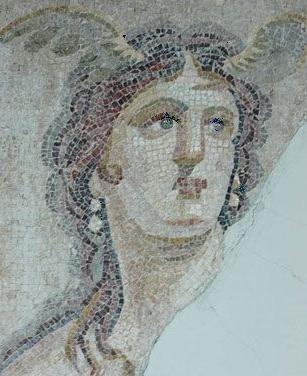
Tethys
ancient Greek mythological figure; mother of the river gods and the Oceanids

Theia
In Greek mythology, Theia (; ) also called Thea, Thia, Euryphaessa, Aethra or Basileia, was one of the Titans, the children of Uranus (Sky) and Gaia (Earth).

Hyperion
Titan in Greek mythology
Iapetos
In Greek mythology, Iapetus or Iapetos (; ; ), also Japetus or Japetos, was one of the Titans, the son of Uranus (Sky) and Gaia (Earth) and father of Atlas, Prometheus, Epimetheus, and Menoetius. He was also called the father of Buphagus and Anchiale in other sources.

Phoebe
titan in Greek mythology

Epimetheus
In Greek mythology, Epimetheus (; ) is the brother of Prometheus, with the complementary pair serving as archetypal representations of mankind. Both are sons of the Titan Iapetus; while Prometheus ("forethought, or foresight") is portrayed as ingeniously clever, Epimetheus ("afterthought, or hindsight") is considered inept and foolish. In some accounts of the myth, Epimetheus unleashes the unforeseen troubles in Pandora's box.
Coeus
In Greek mythology, Coeus (; ), also called Koios or Polus, was one of the Titans, the children of Uranus (Sky) and Gaia (Earth).
Kreios
In Greek mythology, Crius, Krios or Kreios (; or ) was one of the Titans, the children of Uranus (Sky) and Gaia (Earth).
Titanomachy
thumb|300px|Cornelis Cornelisz van Haarlem, [[The Fall of the Titans, 1596–1598.]]

Dione
Greek goddess, mother of Aphrodite
Pallas
Titan in Greek mythology
Astraeus
In Greek mythology, Astraeus () or Astraios () is the son of Crius and Eurybia and the consort of Eos (goddess of the dawn). He is said to be the father of the winds.
Perses
ancient Greek mythological Titan

Asteria
In Greek mythology, Asteria or Asterie ( ; ) is a daughter of the Titans Phoebe and Coeus (Polus) and the sister of Leto. According to Hesiod, by the Titan Perses she had a single child, a daughter named Hecate, the goddess of witchcraft. Other authors made Asteria the mother of the fourth Heracles and Hecate by Zeus.
Ophion
Primordial Greek creator deity
Aura
divine personification of the breeze in Greek and Roman mythology
Menoetius
Menoetius or Menoetes (; ) was a name that refers to three distinct persons from Greek mythology:
Lelantos
Lelantos or Lelantus () is a minor mythological figure that appears in the late epic Dionysiaca by Nonnus of Panopolis, written in the early fifth century AD.

Anytos
thumb|200px|Head of titan Anytus, from the temple of Despoina at [[Lykosoura in Arkadia. National Archaeological Museum, Athens]]
The Fall of the Titans
painting by Cornelis van Haarlem
Šanta
Šanta (Santa) was a god worshiped in Bronze Age Anatolia by Luwians and Hittites. It is presumed that he was regarded as a warlike deity, and that he could additionally be associated with plagues and possibly with the underworld, though the latter proposal is not universally accepted. In known texts he frequently appears alongside Iyarri, a deity of similar character. He is first attested in documents from Kanesh dated to the Old Assyrian period, and continues to appear in later treaties, ritual texts and theophoric names. He is also present in an offering lists from Emar written in Akkadian,