Category
page 1Topography

geomorphology
thumb|upright=1.4|Badlands incised into [[shale at the foot of the North Caineville Plateau, Utah, within the pass carved by the Fremont River and known as the Blue Gate. G. K. Gilbert studied the landscapes of this area in great detail, forming the observational foundation for many of his studies on geomorphology.]]
thumb|Surface of Earth, showing higher elevations in red
%2C%20Autumn%20landscape%20in%20Rybiniszki%2C%201902.jpeg)
landscape
A landscape is the visible features of an area of land, its landforms, and how they integrate with natural or human-made features, often considered in terms of their aesthetic appeal. A landscape includes the physical elements of geophysically defined landforms such as mountains, hills, water bodies such as rivers, lakes, ponds and the sea, living elements of land cover including indigenous vegetation, human elements including different forms of land use, buildings, and structures, and transitory elements such as lighting and weather conditions. Combining both their physical origins and the cu

zenith
thumb|upright=1.25|right|Diagram showing the relationship between the zenith, the nadir, and different types of [[horizon]]
The zenith (, ) is the imaginary point on the celestial sphere directly "above" a particular location. "Above" means in the vertical direction (plumb line) opposite to the gravity direction at that location (nadir). The zenith is the "highest" point on the celestial sphere. The direction opposite of the zenith is the nadir.

topography
thumb|upright=1.3|A topographic map of Stowe, Vermont with [[contour lines]]
thumb|upright|This false color|false-color satellite image illustrates topography of the urban core of the [[New York metropolitan area, with Manhattan at its center.]]

summit
thumb|upright=1.05|A climber taking the final few steps to the summit of Imja Tse (Island Peak) in [[Nepal, 2004]]
thumb|View from the summit of Switzerland's highest peak, [[Monte Rosa]]

altitude
thumb|Altitude is a vertical measurement between a reference datum and an object.
Altitude is a distance measurement, usually in the vertical or "up" direction, between a reference datum and a point or object. The exact definition and reference datum varies according to the context (e.g., aviation, geometry, geographical survey, sport, or atmospheric pressure). Although the term altitude is commonly used to mean the height above sea level of a location, in geography the term elevation is often preferred for this usage.
height above mean sea level
elevation of a location in reference to a historic mean sea level taken as a vertical datum

terrain
thumb|Present-day altimetry and [[bathymetry. Data from the National Geophysical Data Center's TerrainBase Digital Terrain Model.]]
thumb|Relief map of Sierra Nevada (Spain)|Sierra Nevada, Spain
upright|thumb|A shaded and colored image (i.e. terrain is enhanced) of varied terrain from the Shuttle Radar Topography Mission. This shows an elevation model of New Zealand's [[Alpine Fault, running about long. The escarpment is flanked by a vast chain of hills between the fault and the mountains of the Southern Alps. Northeast is towards the top.]]
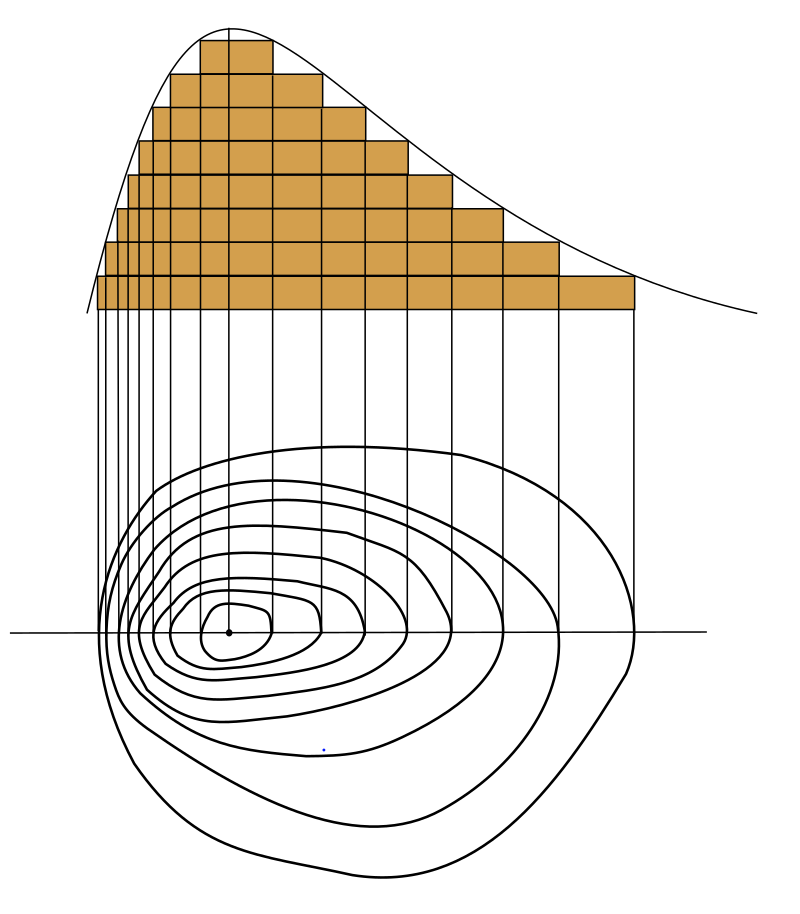
contour line
curve joining points with equal value on a 2D graphic representation

topographic prominence
measure for the independence of a summit defined as its relative height based on the difference between its absolute elevation and the lowest contour line encircling it but containing no higher summit within it

topographic map
medium to large scale map that shows a precise map of the terrain

selenography
thumb|right|345px|alt=Topography of the Moon measured from the Lunar Orbiter Laser Altimeter on the mission Lunar Reconnaissance Orbiter, referenced to a sphere of radius 1737.4 km|Topography of the Moon.
thumb|Moon 360 animation in 4K resolution|4K

elevation
thumb|upright=1.4|Vertical distance comparison
coastline paradox
counterintuitive observation that the coastline of a landmass does not have a well-defined length
topographic isolation
minimum great-circle distance to a point of equal elevation, representing a radius of dominance in which the peak is the highest point

areography
thumb|340px|A high-resolution colorized map of Mars based on Viking program|Viking orbiter images. Surface frost and water ice fog brighten the impact basin Hellas to the right of lower center; Syrtis Major just above it is darkened by winds that sweep dust off its basaltic surface. Residual north and south polar ice caps are shown at upper and lower right as they appear in early summer and at minimum size, respectively.
Template:Höhe
Wikimedia template
ultra-prominent peak
mountain summit with a topographic prominence of 1,500 metres (4,900 ft) or more
topographic profile
graphical representation of the topography
equatorial bulge
outward bulge around a planet's equator due to its rotation
river mile
measurement of distance from river mouth
raised-relief map
three-dimensional object representing a real terrain

Federal Office of Topography
Swisstopo is the official name for the Swiss Federal Office of Topography, Switzerland's national mapping agency.
Eötvös effect
change in perceived gravitational force caused by the change in centrifugal acceleration resulting from eastbound or westbound velocity
mill pond
body of water used as a reservoir for a water-powered mill
double summit
mountain or hill with two adjacent summits of approximately equal height, separated by a col or a saddle

North American Vertical Datum of 1988
vertical datum for orthometric heights
Line of greatest slope
steepest slope on a surface
United States Army Map Service
cartographic service of US Army
Parastaseis syntomoi chronikai
byzantine Greek text about Constantinople