Category
page 1Torah places
%20is%20seen%20at%20the%20lower%20part.jpg)
Euphrates
The Euphrates ( ; see below) is the longest and one of the most historically important rivers of West Asia. Together with the Tigris, it is one of the two defining rivers of Mesopotamia (). Originating in Turkey, the Euphrates flows through Syria and Iraq to join the Tigris in the Shatt al-Arab in Iraq, which empties into the Persian Gulf.
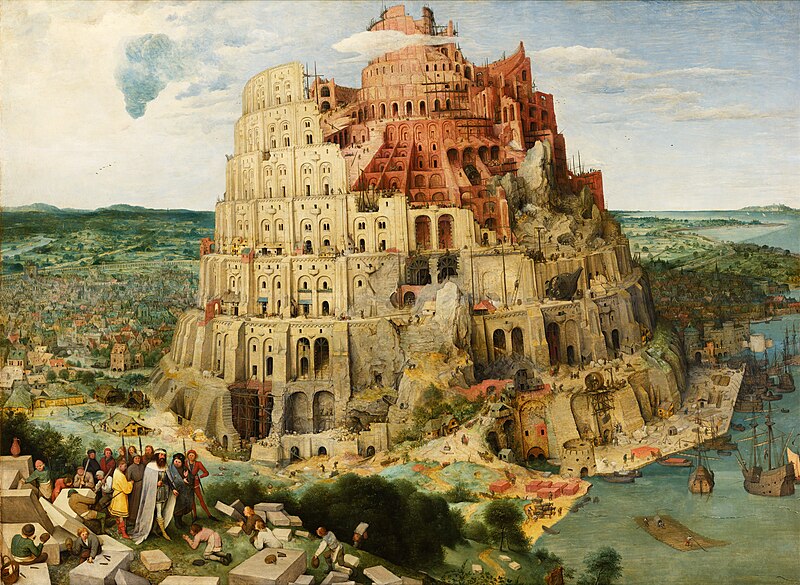
Tower of Babel
biblical pericope about hubris and the origin of languages

Garden of Eden
mythological "garden of God" in the Bible and the Qur'an

Edom
Edom (; ; ; ; Ancient Egyptian: jdwmꜥ) was an ancient kingdom that stretched across areas in the south of present-day Jordan, Palestine and Israel. Edom and the Edomites appear in several written sources relating to the late Bronze Age and to the Iron Age in the Levant, including the list of the Egyptian pharaoh Seti I from c. 1215 BC as well as in the chronicle of a campaign by Ramesses III (r. 1186–1155 BC), and the Hebrew Bible.

Moab
Moab () was an ancient Levantine kingdom whose territory is today located in southern Jordan. The land is mountainous and lies alongside much of the eastern shore of the Dead Sea. The existence of the Kingdom of Moab is attested to by numerous archaeological findings, most notably the Mesha Stele, which describes the Moabite victory over an unnamed son of King Omri of Israel, an episode also noted in 2 Kings 3. The Moabite capital was Dibon. According to the Hebrew Bible, Moab was often in conflict with its Israelite neighbours to the west.

Land of Israel
name for an area of the Southern Levant

Cavern of the Patriarchs
series of caves located in the heart of the old city of Hebron
Land of Goshen
land assigned by Pharaoh to the children of Israel when they came to sojourn in Egypt

Shinar
thumb|Cities of Mesopotamia in the 2nd millennium BC
Shin‘ar is the name for the southern region of Mesopotamia used by the Hebrew Bible.
Wadi Mujib
river canyon in Jordan

Gihon
Gihon is the name of the second river mentioned in the second chapter of the biblical Book of Genesis. The Gihon is mentioned as one of four rivers (along with the Tigris, Euphrates, and Pishon) issuing out of Eden, branching from a single river that split after watering the Garden of Eden (Genesis 2:10–14).

Bashan
thumb|View from Mount Bental/Tal Al-Gharam|Mount BentalBashan (; ; or Basanitis) is the ancient, biblical name used for the northernmost region of Transjordan during the Iron Age. It is situated in modern-day Jordan and Syria. Its western part, nowadays known as the Golan Heights, is occupied by Israel during the 1967 Six Day War.

Pishon
The Pishon ( Pīšōn; Koine Greek: Φισών Phisṓn) is one of four rivers (along with Hiddekel (Tigris), Perath (Euphrates) and Gihon) mentioned in the Biblical Book of Genesis. In that passage, a source river flows out of Eden to water the Garden of Eden and from there divides into the four named rivers. The Pishon is described as encircling "the entire land of Havilah where is gold; bdellium and onyx stone."
David's Tomb
architectural structure
Rachel's Tomb
Rachel's Tomb in Bethlehem
Land of Nod
place mentioned in the Bible, the abode of Cain

Penuel
200px|right|thumb|Depiction of Jacob wrestling with the angel at Penuel by [[Eugène Delacroix]]
Penuel () is a place described in the Hebrew Bible as being not far from Sukkot on the east of the Jordan River, south of the Zarqa in Jordan.
Aram
historical region including several Aramean kingdoms covering much of the present-day Syria, southeastern Turkey, and parts of Lebanon and Iraq.
Givat HaMoreh
mountain in Israel
Elim
Biblical place-name
Aram-Naharaim
Aram-Naharaim ( ʾĂram Nahărayim, literally "Aram of the two rivers") is the biblical term for an ancient land along the great bend of the Euphrates River.
.jpg)
Mamre
Mamre (; ), full name "Oaks of Mamre", refers to an ancient religious site originally focused on a single holy tree growing "since time immemorial" at Hebron in Canaan. It is best known from the biblical story of Abraham and the three visitors. He pitched his tents is known as the oak or terebinth of Mamre. Modern scholars have identified four sites near Hebron which, in different historical periods, could have been successively known as Mamre: Khirbet Nimra, also known as Ayn Nimreh, (a little excavated Persian and Hellenistic period site, a hypothetical identification, not proven by any arch
Battle of Siddim
Biblical event
Marah
Biblical place
Wilderness of Sin
geographic area mentioned in the Bible

Mahanaim
thumb|Territory of Gad on an 1852 map: Mahanaim can be seen in the northeast corner of the pink-shaded area of Gad
Mahanaim ( Maḥănayīm, "camps") is a place mentioned a number of times by the Bible said to be near Jabbok, in the same general area as Jabesh-gilead, beyond the Jordan River. Although two possible sites have been identified, the precise location of Mahanaim is uncertain. Tell edh-Dhahab el-Gharbi, the western one of the twin Tulul adh-Dhahab tells, is one proposed identification.
Reed Sea
waterbody mentioned in Exodus, which the Israelites are said to have crossed miraculously

Cherith
thumb|right|Ravens feed Elijah by the brook Cherith, from commons:Die Bibel in Bildern|Die Bibel in Bildern
Paddan Aram
early Aramean kingdom in Mesopotamia
Zin Desert
desert
Migdol
thumb | right | Migdol of Medinet Habu, Theban Necropolis, Egypt
Migdol, or migdal, is a Hebrew word (מגדּלה מגדּל, מגדּל מגדּול) which means either a tower (from its size or height), an elevated stage (a rostrum or pulpit), or a raised bed (within a river). Physically, it can mean fortified land, i.e. a walled city or castle; or elevated land, as in a raised bed, like a platform, possibly a lookout.
Baal-zephon
300px|thumb|Mount Ṣapōn
Ephrath
thumb | right
Ephrath, Ephrathah and Ephratah are variant spellings of the same Hebrew name () mentioned in the Bible.
Ephrath usually refers to the ancient name for Bethlehem in Judah.
It originally referred to the region around Bethlehem and was later identified with the town itself. (Genesis 35:19, Micah 5:2). A person from Ephrath is called an Ephrathite (as a geographic tribal designation; 1 Sam 17:12; Ruth 1:2).
Shur
location in the Hebrew Bible
Jehovah-jireh
thumb|350px| The Sacrifice of Isaac by Paolo Veronese, which simultaneously depicts the angel and the ram at Jehovah-jireh.
Massah and Meribah
Biblical location