Category
page 1Trickster gods

Hermes

Prometheus
In Greek mythology, Prometheus (; ) is a Titan responsible for creating or aiding humanity in its earliest days. He defied the Olympian gods by taking fire from them and giving it to humanity in the form of technology, knowledge and, more generally, civilization.

Mercury
Roman god of trade, merchants, thieves and travel

Loki
Loki is a god in Norse mythology. He is the son of Fárbauti (a jötunn) and Laufey (a goddess), and the brother of Helblindi and Býleistr. Loki is married to the goddess Sigyn and they have two sons, Narfi or Nari and Váli. By the jötunn Angrboða, Loki is the father of Hel, the wolf Fenrir and the world serpent Jörmungandr. In the form of a mare, Loki was impregnated by the stallion Svaðilfari and gave birth to the eight-legged horse Sleipnir.

Seth
God of the desert, storms, and foreigners in ancient Egyptian religion

Enki
Enki (Sumerian: dEN-KI), also known as Ea (Akkadian: dE₂-A), was the Mesopotamian god of wisdom, crafts, fresh subterranean waters, magic, and incantations. He was believed to rule the Abzû. In Mesopotamian astronomy, he was associated with the stars of the southern band of the sky. Enki's wife was Damgalnuna, and their children included Nanshe, Asalluhi, Marduk and Enbilulu. His sukkal (attendant deity) was Isimud. Servants of the god included lahmu, kulullû, and the Seven Sages.

Susanoo
__FORCETOC__
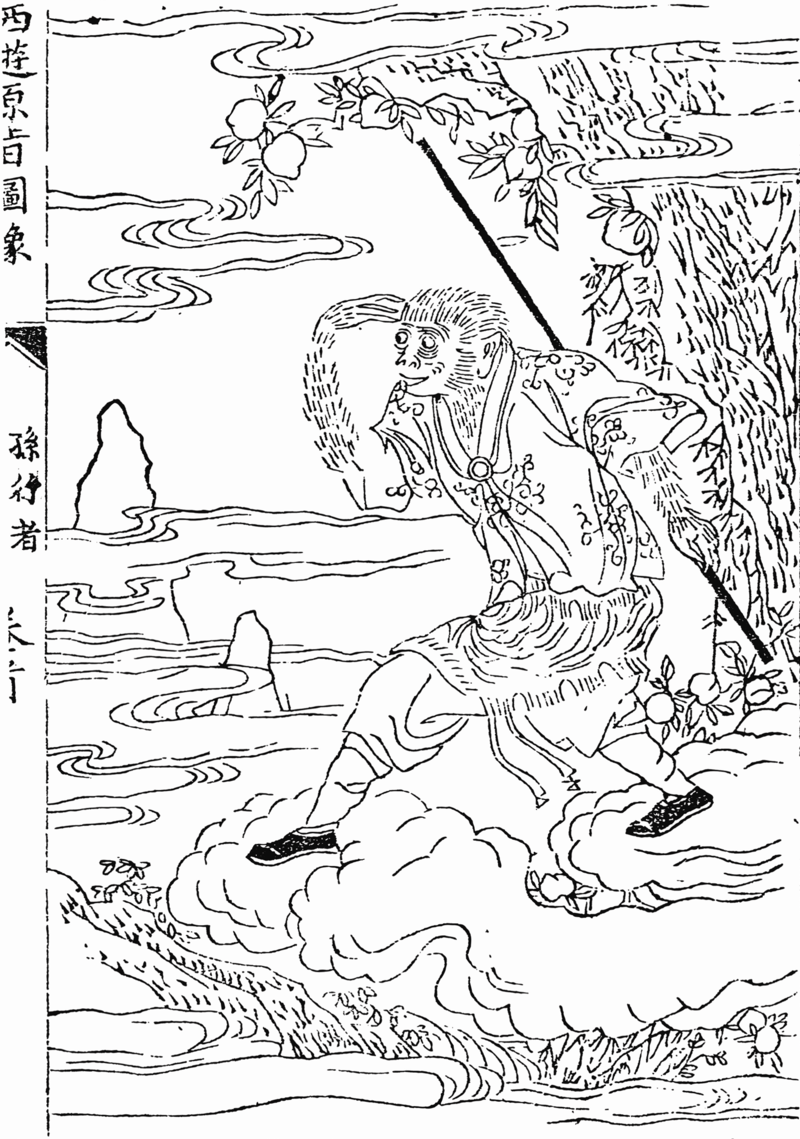
Sun Wukong
mythical character from Journey to the West

Veles
Slavic god of earth, waters and the underworld

Ananse
Lugh
Lugh or Lug (; ) is a figure in Irish mythology. A member of the Tuatha Dé Danann, a group of supernatural beings, Lugh is portrayed as a warrior, a king, a master craftsman and a saviour. He is associated with skill and mastery in multiple disciplines, including the arts. Lugh also has associations with oaths, truth, and the law, and therefore with rightful kingship. He is also associated with intelligence. Lugh is linked with the harvest festival of Lughnasadh, which bears his name. His most common epithets are Lámfada ( ; "long hand" or "long arm", possibly for his skill with a spear or his

Tezcatlipoca
thumb|The jaguar was an animal sacred to Tezcatlipoca.|link=File:Standing_jaguar.jpg
thumb|Mirrors in Mesoamerican culture#Aztecs|Aztec obsidian mirror
Manannán mac Lir
sea god in Irish mythology
Śakra
deva and heavenly king in Buddhism; lord of the heavenly realm Trāyastriṃśa; regarded as king of the gods and wielder of the thunderbolt

Māui
Māui or Maui is the great culture hero and trickster in Polynesian mythology. Very rarely was Māui actually worshipped, being less of a deity (demigod) and more of a folk hero. His origins vary from culture to culture, but many of his main exploits remain relatively similar. Comparative scholarship notes that Māui’s origins differ widely across Polynesia, with variation in his parentage, divine status, and the specific form of several major myths. Bucková’s survey of Eastern Polynesian traditions documents that core motifs, such as acquiring fire or manipulating the sun, appear throughout the

Nezha
Nezha (, Nézhā) or sometimes Nezha the Crown Prince (, ), is a protection deity in Taoism, Buddhism, Confucianism, and Chinese folk religion. His official Taoist name is "Marshal of the Central Altar" (). He was then given the title "Third Lotus Prince" () after he became a deity.

Kokopelli
thumb|200px|right|Kokopelli and Kokopelli Mana as depicted by the Hopi
Kokopelli () is a fertility deity, usually depicted as a humpbacked flute player (often with feathers or antenna-like protrusions on his head), who is venerated by some Native American cultures in the Southwestern United States. Like most fertility deities, Kokopelli presides over both childbirth and agriculture. He is also a trickster god and represents the spirit of music.
Maya Hero Twins
the central figures of the Popol Vuh
Br'er Rabbit
fictional rabbit in Uncle Remus folklore
Huehuecoyotl
In Aztec mythology, Huēhuehcoyōtl () (from huēhueh "very old" (literally, "old old") and coyōtl "coyote" in Nahuatl) is the auspicious Pre-Columbian god of music, dance, mischief, and song. He is the patron of uninhibited sexuality — his partners can be female or male of any species — and rules over the day sign in the Aztec calendar named cuetzpallin (lizard) and the fourth trecena Xochitl ("flower" in Nahuatl).

Eshu
Èṣù is the oriṣa of trickery, crossroads, duality and languages in the Yoruba religion. Eṣu is a prominent primordial divinity (a delegated Irúnmọlẹ̀ sent by the Olodumare) who descended from Ìkọ̀lé Ọ̀run, and the chief enforcer of natural and divine laws. He is in charge of law enforcement and orderliness. As the Yoruba religion spread around the world, the name of this Orisha has varied in different locations, but the beliefs remain similar.

Yaldabaoth
thumb|A lion-faced, Snakes in mythology|serpentine [[deity found on a Gnostic gem in Bernard de Montfaucon's ''L'antiquité expliquée et représentée en figures'', a depiction of Yaldabaoth.]]
Coyote
mythological character

Soslan
thumb|right|250px|Dancing Soslan, Vladikavkaz
thumb|Sosruko tower in Nalchik
Sosruko, Sosruquo, or Sosriqwa, Soslan (; , Soslan; , Sosryqwa; Sosuruq/Sosurqa) is a central character in many cycles of the Nart sagas of the North Caucasus.

Nanabozho
Nanabozho (in syllabics: , ), also known as Nanabush, is a spirit in Anishinaabe aadizookaan (traditional storytelling), particularly among the Ojibwe of North America. Nanabozho figures prominently in their storytelling, including the story of the world's creation. Nanabozho is the Ojibwe trickster figure and culture hero (these two archetypes are often combined into a single figure in First Nations mythologies, among others).

Śuri
Śuri (), Latinized as '''''', was an ancient Etruscan infernal, volcanic and solar fire god, also venerated by other Italic peoples – among them Capenates, Faliscans, Latins and Sabines – and later adopted into ancient Roman religion.

Maximón
Maximón () is a Maya deity and folk saint, represented in various forms by the Maya peoples of several towns in the Guatemalan Highlands. Oral tradition of his creation and purpose in these communities is complex, diverse, and born of the ancient Maya traditions centuries ago.
Elegua
Elegua (Yoruba: Èṣù-Ẹlẹ́gbára and Ẹlẹ́gbá, Ẹlẹ́gbára in North America, in Cuba spelled Eleggua; also known as Eleguá in Latin America and Spanish-speaking Caribbean islands) is an Orisha, a deity of roads in the religions of traditional Ifa-Orisha, Santería, Winti, Umbanda, Quimbanda, and Candomblé.
Heyoka
thumb|Ledger artwork by Lakota artist Black Hawk representing a dream of a thunder being.
Ekwensu
Ekwensu is a trickster of the Igbo people, a trickster spirit of confusion, that serves as the Alusi (god) of bargains and the tortoise. He is crafty at trade and negotiations. He is often invoked for guidance in difficult mercantile situations. He is perceived as a spirit of violence that incites people to perform violent acts. His companion was Ogbunabali.
Kutkh
thumb|Wooden carving of Kutkh made by Koryaks|Koryak artisans in Kamchatka
cultural depictions of ravens
ravens in world culture
ǀKaggen
ǀKaggen (more accurately ǀKágge̥n or ǀKaggən, sometimes corrupted to Cagn and sometimes called Mantis) is a demiurge and folk hero of the San people of southern Africa. He is a trickster god who can shape shift, usually taking the form of a praying mantis but also a bull eland, a louse, a snake, and a caterpillar.
Amaguq
According to Inuit mythology Amaguq is a trickster and wolf spirit, able to shape-shift. Amaguq is the Iñupiaq word for wolf.
Olifat
Olifat (also known as Yelafath, Orofat, Iolofath or Wolphat) is a trickster god in Micronesian mythology.
Martintxiki
hero in Basque mythology
Iktomi
thumb|400px|Iktomi depicted sitting by the fire.
In Lakota mythology, Iktómi is a spider-trickster spirit, and a culture hero for the Lakota people. Alternate names for Iktómi include Ikto, Ictinike, Ksa , Inktomi, Unktome, and Unktomi. These names are due to the differences in languages between different indigenous nations, as this spider deity was known throughout many of North America's tribes.
Zé Pilintra
Brazilian folklore entity
Korouhanba
Korouhanba is the God of the Sun, the Sky and the Heaven in Sanamahism, the indigenous religion of Manipur. He is also known as Taohuireng and is one of the two sun brothers in the Numit Kappa epic legend. He is also called Ngantureng because of his ability to remove darkness. He is described as "Songbu Chiraitangba" — a physician who is bald headed.
Azeban
Azeban (also spelled Azban, Asban or Azaban), or "the Raccoon," is a lower-level trickster spirit in Abenaki mythology. The traditional homeland of the Abenaki is Wobanakik (Place of the Dawn), what is now called northern New England, southern Quebec, New Brunswick and Nova Scotia. Azeban is a raccoon, the Abenaki trickster figure. Pronounced ah-zuh-bahn. Azeban does many foolish and/or mischievous things in Abenaki folktales, but unlike animal tricksters in some other tribes, is not dangerous or malevolent.
Wisakedjak
Wisakedjak (Wìsakedjàk in Algonquin, Wīsacaklesss(w) in Cree and Wiisagejaak in Oji-cree) is the Crane Manitou found in northern Algonquian and Dene storytelling, similar to the trickster Nanabozho in Ojibwa aadizookaanan (sacred stories), Inktonme in Assiniboine lore, and Coyote or Raven from many different tribes. His name is found in a number of different forms in the related languages and cultures he appears in, including Weesack-kachack, Wisagatcak, Wis-kay-tchach, Wissaketchak, Woesack-ootchacht, Vasaagihdzak, and Weesageechak.