Category
page 1Trinitarianism

Holy Trinity
thumb|A compact diagram of the Trinity, known as the "Shield of the Trinity", consisting of [[God the Father, God the Son (Jesus), and God the Holy Spirit (the Shield is generally not intended to be a schematic diagram of the structure of God, but it presents a series of statements about the relationship between the persons of the Trinity)]]

Reformed Christianity
branch of Protestantism

Apostles' Creed
early statement of Christian belief

First Council of Nicaea
council of Christian bishops in Nicaea, 325

scholasticism
upright=1.2|right|thumb|14th-century image of a university lecture

Seventh-day Adventist Church
Protestant Christian denomination

God the Father
in Christianity, the first of the three persons of the Trinity, who begets the Son and from whom the Holy Spirit proceeds

Nicene Creed
statement of belief adopted at the First Ecumenical Council in 325
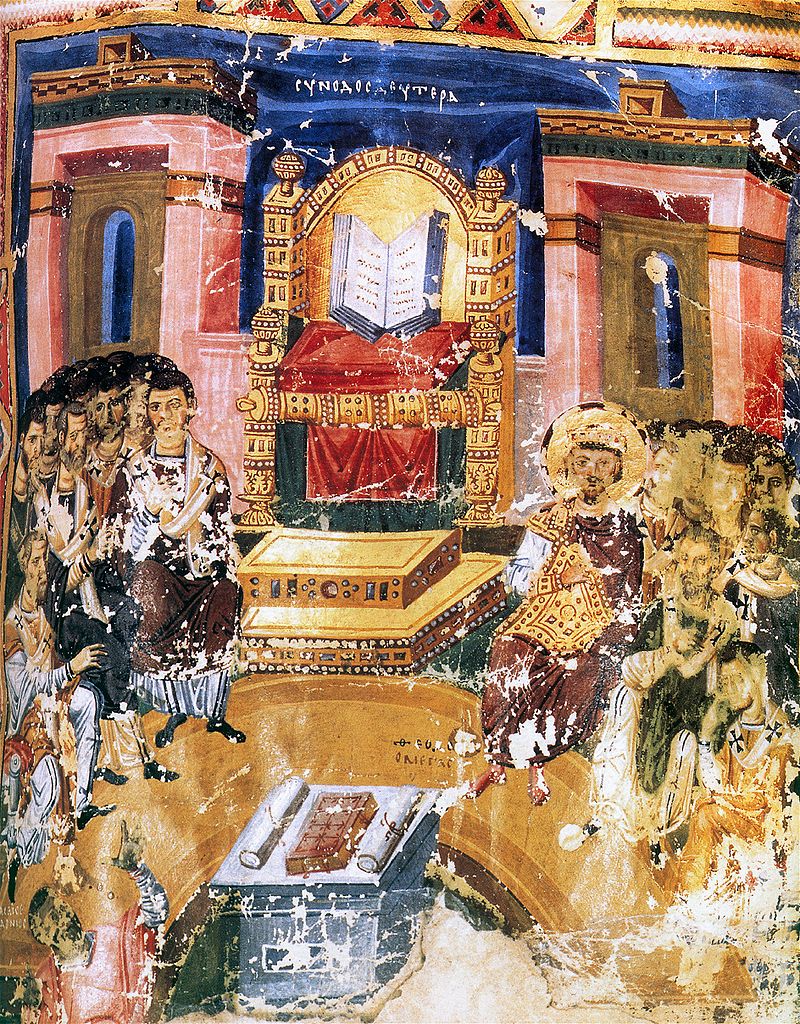
First Council of Constantinople
381 AD council of Christian bishops

Athanasian Creed
Christian statement of belief focused on Trinitarian doctrine and Christology

God the Son
in Christianity, the second person of the Trinity, begotten by God the Father, incarnated as Jesus Christ
hypostasis
shared existence of spiritual or corporal entities

shamrock
thumb|A wood sorrel, often called a shamrock, especially in the United States
Community of Christ
second-largest denomination in the Latter Day Saint movement

Homoousion
Homoousion ( ; , from , , "same" and , , "being" or "essence") is a Christian theological term, most notably used in the Nicene Creed for describing Jesus (God the Son) as "same in being" or "same in essence" with God the Father (). The same term is also applied to the Holy Spirit in order to designate him as being "same in essence" with the Father and the Son. Those notions became cornerstones of theology in Nicene Christianity, and also represent one of the most important theological concepts within the Trinitarian doctrinal understanding of God.
Chalcedonian Christianity
Christian demoninations that accept the Fourth Ecumenical Council

Philippine Independent Church
Christian denomination, 1902-
Johannine Comma
Interpolated phrase in verses 5:7–8 of 1 John

Anomoeanism
In 4th-century Christianity, the Anomoeans , also known as Heterousians , Aetians , or Eunomians , were a sect that held to an extreme form of Arianism, claiming that Jesus was neither of the same nature (homoousian) as God the Father nor even a similar nature to God the Father (homoiousian)—the latter being maintained by the semi-Arians.
Catholic theology
study of the doctrines of the Roman Catholic Church
God the Holy Spirit
in trinitarian Christianity, the third person of the Trinity, that proceeds from the Father (and the Son, depending on the branch of Christianity); often depicted as a dove in iconography
pre-existence of Christ
existence of Christ before his incarnation as Jesus
Ousia
Ousia (; ) is a philosophical and theological term, originally used in ancient Greek philosophy, then later in Christian theology. It was used by various ancient Greek philosophers, especially Aristotle, as a primary designation for philosophical concepts of essence or substance. It is analogous to concepts of being and the ontological in contemporary philosophy. In Christian theology, the concept of (divine essence) is one of the most important doctrinal concepts, central to the development of trinitarian doctrine.

Perichoresis
thumbnail|Gothic triskele window element
In Christian theology, perichoresis (from ) is the relationship of the three persons of the triune God (Father, Son, and Holy Spirit) to one another. The term was first used theologically by the Church Fathers. As a noun, the word first appears in the writings of Maximus Confessor (d. 662), but the related verb perichoreo is found earlier in the work of Gregory of Nazianzus (d. 389/90). Gregory used the word to describe the relationship between the divine and human natures of Christ, as did John of Damascus (d. 749), who also extended it to the "interpe
Nicene Christianity
set of Christian doctrinal traditions reflecting the Nicene Creed
On the Trinity
book written by Augustine of Hippo
Trinitarian formula
in Christianity, the phrase “in the name of the Father, and of the Son, and of the Holy Spirit”, from Mt 28:19, referring to the three persons of the Trinity
Shield of the Trinity
medieval triangular diagram of the Christian Trinity; summarizes the first half of the Athanasian Creed
Seventh Day Adventist Reform Movement
pacifist Christian denomination (1920-)
Holy, Holy, Holy
Christian hymn written by Reginald Heber, set to the tune NICAEA
Consubstantiality
Consubstantiality, a term derived from , denotes identity of substance or essence in spite of difference in aspect.
Athinganoi
The Athinganoi (, singular Athinganos, , Atsinganoi) were a Manichaean sect and practiced some of the Jewish customs (which can be regarded as a form of Judaizing) who lived in Phrygia and Lycaonia but were neither Hebrews nor gentiles. They kept the Sabbath but were not circumcised. They were shomer negiah.
Advent Christian Church
body of Adventist Christians
Prosopon
Prosopon is a theological term used in Christian theology as designation for the concept of a divine person. The term has a particular significance in Christian triadology (study of the Trinity), and also in Christology.
The Trinity in art
Christian artistic theme
Palamism
thumb|upright|Palamas
Palamism or the Palamite theology comprises the teachings of Saint Gregory Palamas (c. 1296 – 1359), whose writings defended the Eastern Orthodox practice of Hesychasm against the attack of Barlaam. Followers of Palamas are sometimes referred to as Palamites.
Godhead in Christianity
the substantial essence or nature of the Christian God
Homoiousian
Homoiousios ( from , hómoios, "similar" and , ousía, "essence, being") is a heretical Christian theological term, coined in the 4th century to identify a distinct group of Christian theologians who held the belief that God the Son was of a similar, but not identical, essence (or substance) with God the Father.
Hesychast controversy
14th-century theological dispute in the Byzantine Empire