Category
page 1Twin satellites
STEREO
STEREO (Solar TErrestrial RElations Observatory) is a solar observation mission. Two nearly identical spacecraft (STEREO-A, STEREO-B) were launched in 2006 into orbits around the Sun that cause them to respectively pull farther ahead of and fall gradually behind the Earth. This enabled stereoscopic imaging of the Sun and solar phenomena, such as coronal mass ejections.

Gravity Recovery and Interior Laboratory
thumb|right|MoonKAM shot
The Gravity Recovery and Interior Laboratory (GRAIL) was an American lunar science mission in NASA's Discovery Program which used high-quality gravitational field mapping of the Moon to determine its interior structure. The two small spacecraft, GRAIL A (Ebb) and GRAIL B (Flow), were launched on 10 September 2011 aboard a single launch vehicle: the most-powerful configuration of a Delta II, the 7920H-10. GRAIL A separated from the rocket about nine minutes after launch, GRAIL B followed about eight minutes later. They arrived at their orbits around the Moon 25 hours ap
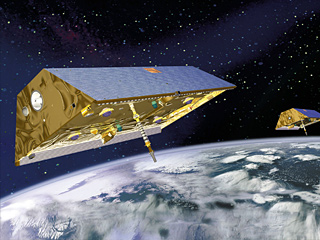
Gravity Recovery and Climate Experiment
joint mission of NASA and the German Aerospace Center

TerraSAR-X
TerraSAR-X is an imaging radar Earth observation satellite, a joint venture being carried out under a public-private-partnership between the German Aerospace Center (DLR) and EADS Astrium. The exclusive commercial exploitation rights are held by the geo-information service provider Astrium. TerraSAR-X was launched on 15 June 2007 and has been in operational service since January 2008. With its twin satellite TanDEM-X, launched 21 June 2010, TerraSAR-X acquires the data basis for the WorldDEM, the worldwide and homogeneous DEM available from 2014.

Sentinel-2
Sentinel-2 is an Earth observation mission from the Copernicus Programme that acquires optical imagery at high spatial resolution (10 m to 60 m) over land and coastal waters. The mission's Sentinel-2A and Sentinel-2B satellites were joined in orbit in 2024 by a third, Sentinel-2C, and in the future by Sentinel-2D, eventually replacing the A and B satellites, respectively. The mission supports services and applications such as agricultural monitoring, emergencies management, land cover classification, and water quality. Sentinel-2 has been developed and is being operated by the European Space A
Double Star mission
former joint Chinese-European satellite mission
Elektron
satellite
Pleiades
satellite constellation

TanDEM-X
TanDEM-X (TerraSAR-X add-on for Digital Elevation Measurement) is a German twin satellite mission using interferometric synthetic aperture radar (InSAR). It is developed in a public-private partnership between the German Aerospace centre (DLR) and EADS Astrium (now Airbus Defence and Space). It consists of the original TerraSAR-X satellite (TSX) and an identical spacecraft (TDX) in formation flying, with typical distances between 250 and 500 m. The two satellite constellation allowed the generation of the WorldDEM global digital elevation models starting in 2014.
SAOCOM
SAOCOM (Satélite Argentino de Observación COn Microondas, Spanish for Argentine Microwaves Observation Satellite) is an Earth observation satellite constellation of Argentina's space agency CONAE. Two satellites are already orbiting the Earth in a Sun-synchronous orbit. The second one was launched on 30 August 2020.
Dynamics Explorer
NASA geomagnetic satellite mission
GIOVE
), or Galileo In-Orbit Validation Element, is the name for two satellites built for the European Space Agency (ESA) to test technology in orbit for the Galileo positioning system.
SABIA-Mar
SABIA-Mar (Spanish: , Portuguese: ), originally called SAC-E by CONAE, is a dual satellite joint Earth observation mission. The mission objective is to study the oceanic biosphere, its changes over time, and how it is affected by and reacts to human activity. It will focus on the monitoring of ocean surfaces, especially studying the ocean ecosystem, the carbon cycle, and marine habitats, as well as ocean mapping.
Sentinel-2B
Sentinel-2B is a European optical imaging satellite that was launched on 7 March 2017. It is the second Sentinel-2 satellite launched as part of the European Space Agency's Copernicus Programme, and with its orbit phased 180° against its sister satellite, Sentinel-2A. The satellite carries a wide swath high-resolution multispectral imager with 13 spectral bands. It provides information for agriculture and forestry, among other services, allowing for prediction of crop yields.
Sentinel-2A
Sentinel-2A is a European optical imaging satellite launched in 2015. It is the first Sentinel-2 satellite launched by the European Space Agency's and this Sentinel is part of the European Commission's Copernicus Programme. The satellite carries a wide swath high-resolution multispectral imager with 13 spectral bands. Its observations support services such as forest monitoring, land cover change-detection, natural disaster management and water quality monitoring. On 7 March 2017 the Sentinel-2A was joined in orbit by its sister satellite, Sentinel-2B.