Category
page 1Types of archaeological artefact

arrow
300px|thumb|Traditional target arrow (top) and replica medieval arrow (bottom)
thumb|Modern arrow with plastic fletchings and nock

stele
thumb|260px|Stele N from Copán, [[Honduras, depicting King K'ac Yipyaj Chan K'awiil ("Smoke Shell"), as drawn by Frederick Catherwood in 1839]]
thumb|Stele to the French 8th Infantry Regiment. Commons:Category:Battle of Waterloo steles|One of more than half a dozen steles located on the Waterloo battlefield.
A stele ( ) or stela ( ) is a stone or wooden slab, generally taller than it is wide, erected in the ancient world as a monument. The surface of the stele often has text, ornamentation, or both. These may be inscribed, carved in relief, or painted.
.png)
adze
thumb|Adze

chariot
thumb|250px|Reconstructed Roman chariot drawn by horses.
thumb|250px|Approximate historical map of the spread of the spoke-wheeled chariot, 2000—500 BC

archaeological artefact
something made or modified by humans and of archaeological interest
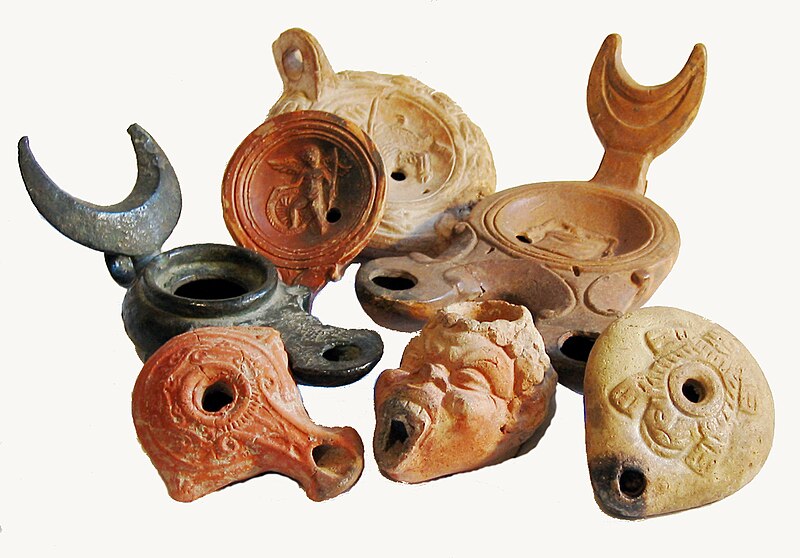
oil lamp
object used to produce light continuously for a period of time using an oil-based fuel source
quipu
thumb|259x259px|Quipu in the Cleveland Museum of Art in Cleveland, Ohio.
Quipu ( ), also spelled khipu (, ; , ), are record-keeping devices fashioned from knotted cords. They were historically used by various cultures in the central Andes of South America, most prominently by the Inca Empire.

Mjölnir
thumb|A silver-gilded Thor|Thor's hammer found in [[Scania, Sweden, that once belonged to the collection of Baron Claes Kurck.]]
fibula
ancient pin or brooch for securing clothing
Venus figurine
prehistoric statuettes depicting women
hand axe
stone tool
%2C%20Spain%20-%2048244034452.jpg)
rhyton
thumb|Silver rhyton with goat protome and death of Orpheus, –410 BC, housed in the [[Vassil Bojkov Collection, Sofia, Bulgaria.
The horn in a continuous and graceful curve makes a right-angled bend. Its lower two thirds are covered by flutes with arc-shaped upper tips. A figural scene below the flaring rim represents the murder of Orpheus. The musician is the central figure, fallen to his right knee, flanked by three attacking Thracian women. He holds a six-string lyre on his right hand and with his left one, wrapped in his mantle, a knobbed wooden stick, with which he tries vainly to protect
clay tablet
writing medium

ostracon
[[Image:AGMA Ostrakon Cimon.jpg|right|thumb|Ostrakon inscribed with "Kimon [son] of Miltiades", for Cimon, an Athenian statesman.]]
thumb|Ostrakon of Megacles, son of Hippocrates (inscription: ΜΕΓΑΚΛΕΣ ΗΙΠΠΟΚΡΑΤΟΣ), 487 BC. On display in the Ancient Agora Museum in Athens, housed in the [[Stoa of Attalus]]
right|thumb|Ancient Greek ostraca voting for the ostracism|ostracization of [[Themistocles in 472/471 BC.]]

torc
thumb|Bronze 4th-century BC buffer-type torc from France
thumb|The Dying Gaul, a Roman statue with a torc in the [[Capitoline Museums in Rome]]
A torc, also spelled torq or torque, is a large rigid or stiff neck ring in metal, made either as a single piece or from strands twisted together. The great majority are open at the front, although some have hook and ring closures and a few have mortice and tenon locking catches to close them. Many seem designed for near-permanent wear and would have been difficult to remove.

atlatl
thumb|A silver Peruvian atlatl from the 12th–15th century
thumb|Atlatl in use
cylinder seal
form of seal used in ancient times to roll an impression onto a two-dimensional surface

quern-stone
thumb|Disc quern made of basalt stone
thumb|Nepali women using quern-stones to grind grains
votive offering
type of religious offering, obejct displayed or deposted in a sacred place
stone tool
any tool, partially or entirely, made out of stone

tamga
thumb|Tamgha of the Bayundur, which represents a [[falcon according to Mahmud al-Kashgari]]
A tamga, or tamgha (from ), was an abstract seal or brand used by Eurasian nomads and cultures influenced by them, initially as a livestock branding. The tamga was used as a livestock branding for a particular tribe, clan or family. They were common among the Eurasian nomads throughout Classical Antiquity and the Middle Ages. As clan and family identifiers, the collection and systematic comparison of tamgas is regarded to provide insights into relations between families, individuals and ethnic groups in
grave good
objects placed intentionally in a grave

dogū
thumb|Dogū, Ebisuda site in Tajiri, Miyagi|Tajiri, [[Miyagi Prefecture, 1000–400 BC.]]
scraper
stone hand-tool
ard
simple light plough without a mouldboard
Roman dodecahedron
small hollow object made of bronze or stone, with a dodecahedral shape
lithic flake
portion of rock removed from an objective piece by percussion or pressure
drinking horn
horn of a bovid used as a drinking vessel
chopping tool
prehistoric stone tool

larnax
alt=|thumb|Late Minoan III larnax from Kavrochori, Archaeological Museum of Heraklion
lithic core
in archaeology, a stone artifact left over from toolmaking

situla
thumb|Etruscan situla, 600–550 BC, tomb 68 at Certosa di Bologna#The cemetery|the Certosa necropolis
bi
type of circular ancient Chinese jade artifact

bucchero
thumb|right|Oinochoe in bucchero
Bucchero () is a class of ceramics produced in central Italy by the region's pre-Roman Etruscan population. This Italian word is derived from the Latin poculum, a drinking-vessel, perhaps through the Spanish búcaro, or the Portuguese púcaro.

andiron
thumb|375px|A pair of simple wrought-iron andirons, 1780s, America
thumb|375px|A drawing of andirons in use
thumb|375px|French, late 18th century. Gilt-bronze fronts, with [[wrought iron behind]]
golden hat
Bronze Age artefact
lithic reduction
prehistoric process of reducing and cutting a stone by removing shards or flakes in order to make a pointed, sharp or blunt tool
burin
type of Stone Age tool
Roman brick
style of brick used in Ancient Roman architecture
chopper
type of crude stone tool
bone tool
In archaeology, tool made by bone
cong
ancient Chinese vessel
bulla
hollow amulet hung around the neck, worn by male children in Ancient Rome

Guatimac
thumb|250px|Guatimac in the Archaeological Museum of Puerto de la Cruz.
Guatimac or the Idol of Guatimac is an owl-shaped Guanche cult image, found in 1885, hidden in a cave between the municipalities of Fasnia and Güímar (Tenerife, Canary Islands, Spain) wrapped in goat hide.

eolith
thumb|"Hammerstone" eolith, recognized to be of natural origin by Boule in 1905
An eolith (from Ancient Greek ἠώς (ēṓs), meaning "dawn", and λίθος (líthos), meaning "stone") is a flint nodule that appears to have been crudely knapped. Eoliths were once thought to have been artifacts, the earliest stone tools, but are now believed to be geofacts (stone fragments produced by fully natural geological processes such as glaciation).
blade
type of stone tool; a long narrow flake produced by laminar debitage
projectile point
object that was hafted to weapon that was capable of being thrown or projected
.jpg)
racloir
thumb|Type of Mousterian Racloir
thumb|Racloir from Galería (TG11) of Archaeological Site of Atapuerca|Atapuerca
cleaver
biface stone tool
horned helmet
helmet with horns
clay nail
symbolic item buried under foundations to consecrate the building in Sumerian culture

bronze mirror
type of ancient mirrors
lunula
crescent-moon shaped late Neolithic and Early Bronze Age necklace or collar

bâton de commandement
type of prehistoric sceptre made of a bone perforated with a hole in its widest part

hammerstone
thumb|250px|various hammerstones
thumb|right|An example of a cobble used as a hammerstone
carved stone ball
petrosphere dating from the late Neolithic to the Iron Age, mainly found in and around Scotland
Temple ring
ornament that hangs from a headdress or in braids of hair in the front area
Bog butter
Ancient substance found in peat bogs
Clovis point
characteristically fluted projectile points associated with the Clovis culture

astragalomancy
right|upright=1.2|thumb|Replica Roman astragali
right|upright=.8|thumb|Astragali used for gaming in Mongolia