Category
page 1Types of countries
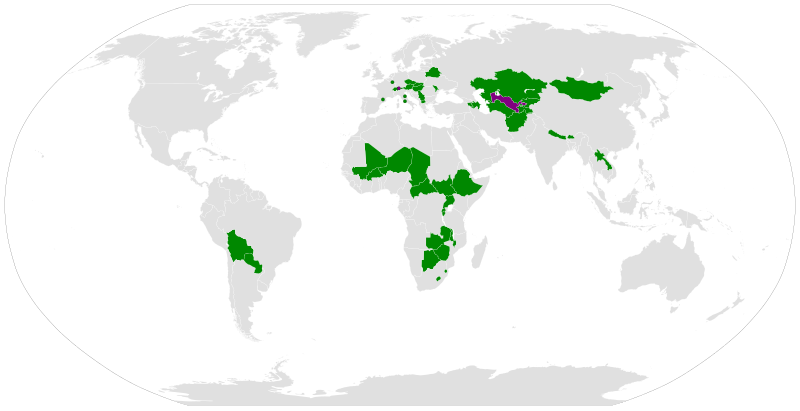
landlocked country
country fully enclosed by land areas, or whose only coastlines lie on closed seas or lakes

island country
state whose primary territory consists of one or more islands or parts of islands

city-state
thumb|Monaco is a city state located on the Mediterranean and the second smallest country in the world

superpower
Superpower describes a sovereign state or supranational union that holds a dominant position characterized by the ability to exert influence and project power on a global scale. This is done through the combined means of economic, military, technological, political, and cultural strength as well as diplomatic and soft power influence. Traditionally, superpowers are preeminent among the great powers. While a great power state is capable of exerting its influence globally, superpowers are states so influential that no significant action can be taken by the global community without first consider

great power
nation that has great political, military and economic influence

banana republic
political science term for a politically unstable country

socialist state
sovereign state constitutionally dedicated to the establishment of socialism

microstate
upright=1.4|thumb|The world's five smallest sovereign states by area, from largest to smallest: San Marino, [[Tuvalu, Nauru, Monaco, and Vatican City shown in the same scale for size comparison]]
thumb|Map of the smallest states in the world by population or land area

failed state
a state which is no longer able, or seen to be able, to carry out its basic functions
buffer state
country located between two other mutually hostile countries
rogue state
late-20th-century political term
client state
state that is economically, politically, or militarily subordinate to another
multinational state
state comprising multiple nations
regional power
state wielding power within a geographic region
rump state
remnant of a once-larger state, left with a reduced territory
middle power
type of state
.jpg)
quasi-state
A quasi-state (sometimes referred to as a state-like entity or formatively a proto-state) is a political entity, that does not represent a fully autonomous sovereign state, with its own institutions.
free state
form of government

hyperpower
thumb|upright=1.3|Countries with military bases and facilities of the United States
The term hyperpower has been used by political scientists and historians to describe an uncontested superpower, although the use of the concept is inconsistent. French foreign minister Hubert Védrine coined the term in 1999 to describe what he saw as the historically-unparalleled influence and might that were held by the United States at the turn of the century.
Mafia state
state system where the government is tied with organized crime
pariah state
Nation considered an outcast by the international community
energy superpower
country exporting lots of energy

narco-state
thumb|upright|Panamanian leader [[Manuel Noriega, following his arrest by U.S. authorities]]
small power
a state which generally prefers multilateralism as both a path to influence and a means to restrain larger states
limitrophe state
territory situated on a border or frontier
state collapse
the catastrophic failure and downfall of a government
revisionist state
international relations term
fragile state
unstable state on the verge of failure
maritime power
military power over the oceans