Category
page 1Unpitched percussion instruments

cymbal
thumb|Characteristic rock hi-hat pattern.
The cymbals (/ˈsɪm.bəl/ ) are common percussion instruments. Often used in pairs, cymbals consist of thin, normally round plates of various copper alloys. The majority of cymbals are of indefinite pitch, although small disc-shaped cymbals based on ancient designs (such as crotales) sound a definite note. Cymbals are used in many ensembles ranging from the orchestra and percussion ensembles to jazz bands, rock bands, and marching bands. Drum kits usually incorporate at least a crash, a ride, or a crash/ride cymbal and a pair of hi-hat cymbals. A player

castanets
thumb|200px| Castanets seller in Granada, [[Spain]]
thumb|198px|Pierre-Auguste Renoir's 1909 painting Dancing girl with castanets
Castanets, also known as clackers or palillos, are a percussion instrument (idiophonic), used in Spanish, Calé, Moorish, Ottoman, Greek, Italian, Mexican, Sephardic, Portuguese, Filipino, Brazilian, and Swiss music. In ancient Greece and ancient Rome there was a similar instrument called the crotalum.
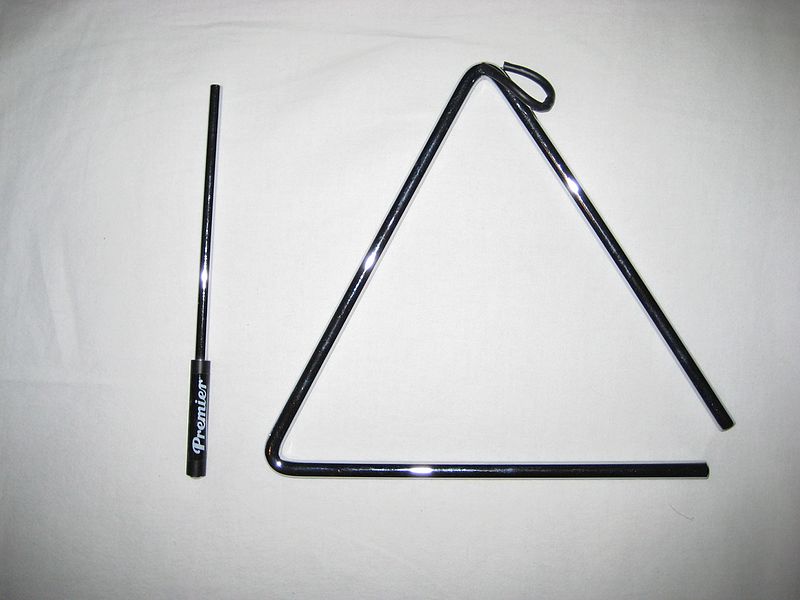
triangle
idiophone type of musical instrument in the percussion family

snare drum
type of percussion instrument
maraca
A maraca ( , , ), sometimes called shaker or chac-chac, is a rattle which appears in many genres of Caribbean and Latin music. It is shaken by a handle and usually played as part of a pair. A maraca player in the Spanish language is called a .

bass drum
percussion instrument
bongo
type of drum from Cuba

djembe
A djembe or jembe ( ; from Malinke jembe , N'Ko: ) is a rope-tuned, skin-covered goblet drum played with bare hands from the Sabar family, originally from Senegal that is widely used in West Africa.
According to the Bambara people in Mali, the name "djembe" comes from the saying "Anke djé, anke bé," which translates to "everyone gather together in peace" and defines the drum's purpose. In the Bambara language, "djé" is the verb for "gather" and "bé" translates as "peace."

bodhrán
The bodhrán (, ; plural bodhráin) is a frame drum used in Irish music ranging from in diameter, with most drums measuring . The sides of the drum are deep. A goatskin head is tacked to one side (synthetic heads or other animal skins are sometimes used). The other side is open-ended for one hand to be placed against the inside of the drum head to control the pitch and timbre.
taiko
thumb|right|This performance at the Tsukiji Hongan-ji Festival involves several performers switching between . Performers lean toward and away from the drum by adjusting the degree of bend in their left knee.|alt=Video of
cajón
thumb|Sounds of a cajón in use
ratchet
percussion instrument

claves
Claves (; ) are a percussion instrument consisting of a pair of short, wooden sticks about 20–25 centimeters (8–10 inches) long and about 2.5 centimeters (1 inch) in diameter. Although traditionally made of wood (typically rosewood, ebony or grenadilla) many modern manufacturers offer claves made of fiberglass or plastic.
cowbell
musical instrument
güiro
The güiro () is a percussion instrument consisting of an open-ended, hollow gourd with parallel notches cut in one side. It is played by rubbing a stick or tines (see photo) along the notches to produce a zipper-like ratchet sound.

davul
The Tabl, dhol, tapan, atabal or davul is a large double-headed drum that is played with mallets. It has many names depending on the country and region. These drums are commonly used in the music of West Asia and the Balkans. These drums have both a deep bass sound and a thin treble sound due to their construction and playing style, where different heads and sticks are used to produce different sounds on the same drum.The drum traditionally known as ṭabl is closely associated with dabke, a pre-Arab Levantine folk dance, indicating the instrument’s deep roots in the cultural traditions of the L
shekere
The shekere (from Yoruba Ṣẹ̀kẹ̀rẹ̀) is a percussion instrument consisting of a dried gourd with beads or cowries woven into a net covering the gourd. There are multiple ways to produce sounds with the instrument. It can be shaken or hit against the hand. The instrument can also rest in the palm of one hand while other hand holds the handle of the gourd. A twisting wrist motion is used so that the gourd moves while beads remain in place causing friction and sound different than when the instrument is simply shaken or struck. The shekere originated in Yorubaland in West Africa, which comprises t
agogô
An agogô () is idiophone bell percussion instrument. With origins in West African music, it is now commonly used in traditional and popular Brazilian music. Agogôs are typically made from two cone-shaped pieces of metal with different pitches.

rainstick
thumb|300x300px|Traditional cactus rainsticks
timbales
thumb|right|Sound of timbales
Timbales () are shallow single-headed drums with metal casing. They are shallower than single-headed tom-toms and usually tuned much higher, especially for their size.
cabasa
The cabasa, similar to the shekere, is a percussion instrument that is constructed with loops of steel ball chain wrapped around a wooden cylinder. The cylinder is fixed to a long, wooden or plastic handle.

txalaparta
The txalaparta ( or ) is a specialized Basque music device of wood or stone. In some regions of the Basque Country, (with ) means "racket", while in others (in Navarre) has been attested as meaning the trot of the horse, a sense closely related to the sound of the instrument.
wood block
musical instrument
rattle
class of musical instruments
bones
musical instrument

dunun
Dunun (; plural dunun) (also spelled dundun or doundoun) is the generic name for a family of West African drums that have developed alongside the djembe in the Mande drum ensemble.
tenor drum
type of drum
mark tree
A percussion instrument consisting of many small chimes – typically cylinders of solid metal approximately 6 mm (one-quarter inch) in diameter – of varying lengths mounted hanging from a bar.
clash cymbals
cymbals played in matched pairs
thunder sheet
percussion instrument
clapper
musical instrument
octoban
right|thumb|A cluster of four homemade octobans.
noise in music
unpitched, indeterminate, uncontrolled, loud, unmusical, or unwanted sound in music
afoxé
The afoxé (also known as the cabaça or cabaca) is an Afro-Brazilian unpitched percussion instrument in the idiophone family. It is composed of a hollowed vessel wrapped in a net through which beads or seeds are threaded.