Category
page 1Upper Paleolithic sites in Europe
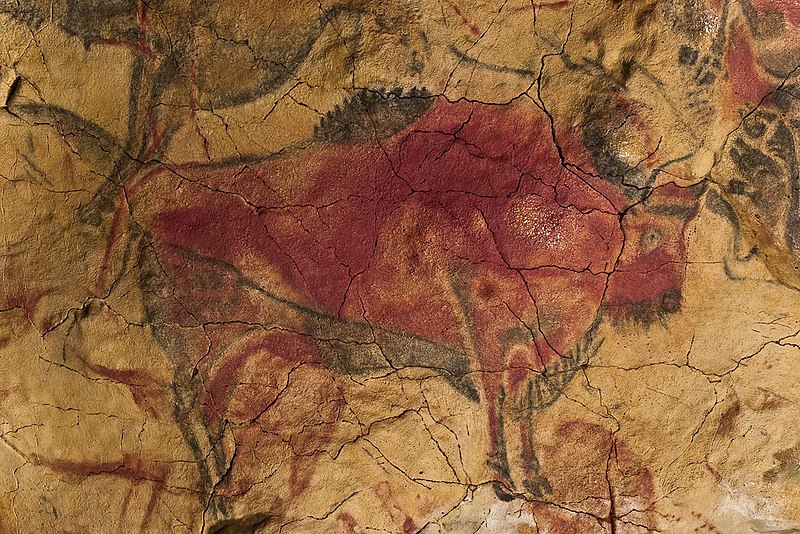
Cave of Altacosa
cave with prehistoric paintings in Spain

Lascaux
Lascaux ( , ; , "Lascaux Cave") is a network of caves near the village of Montignac, in the department of Dordogne in southwestern France. Over 600 parietal wall paintings cover the interior walls and ceilings of the cave. The paintings represent primarily large animals, typical local contemporary fauna that correspond with the fossil record of the Upper Paleolithic in the area. They are the combined effort of many generations. With continued debate, the age of the paintings is now usually estimated at 17,000 to 22,000 years (early Magdalenian). Because of the outstanding prehistoric art in th
Bacho Kiro cave
cave in Bulgaria
Cueva de Nerja
cave in southern Spain
Dolní Věstonice
Archaeological site in the Czech Republic
Kamyana Mohyla
blockfield and rock engravings site in Zaporizhia Oblast, Ukraine
Vogelherd cave
cave in Niederstotzingen, Germany

Balzi Rossi
Groups of caves, Ventimiglia, Italy

Kostyonki–Borshchyovo archaeological complex
The Kostyonki–Borshchyovo archaeological complex is an area where numerous Upper Paleolithic archaeological sites have been found, located around the villages of Kostyonki (also Kostenki) and Borshchyovo (also Borshchevo). The area is found on the western (right) bank of the Don River in Khokholsky District, Voronezh Oblast, Russia, some 25 km south of the city of Voronezh.
The 26 Paleolithic sites of the area are numbered Kostenki 1–21 and Borshchevo 1–5.

Hohlenstein-Stadel
Hohlenstein-Stadel is a cave located in the Hohlenstein cliff (not to be confused with the Hohle Fels) at the southern rim of the Lonetal (valley of the Lone) in the Swabian Jura in Germany. While first excavations were started after the second half of the 19th century, the significance of some of the findings was not realized until 1969. The most significant finding was a small ivory statue called the Löwenmensch, which is one of the oldest pieces of figurative art ever found.
Grotte de Bédeilhac
cave in France
Předmostí u Přerova
archeological site
Sakajia Cave Natural Monument
cave in Georgia
Mezine
Mezine or Mezyn () is an archaeological site in Ukraine, located alongside the Desna River in Novhorod-Siverskyi Raion of Chernihiv Oblast, near the village of . It has the country's greatest number of finds originating from the Paleolithic period. The site is known for an archaeological find of a set of engraved bracelets, with marks possibly representing calendar lunar-cycles.
Bonn–Oberkassel dog
late Paleolithic dog specimen
Grotte des Fées
cave in France
Abrigo do Lagar Velho
cultural heritage monument in Leiria, Portugal
cave of Aurignac
prehistoric habitat from the upper paleolithic at Aurignac, Haute-Garonne, France
La Marche
cave in France
Romuald’s Cave
archaeological site in Croatia
Rivière souterraine de Labouiche
subterranean river in France with evidence of Paleolithic culture
Brillenhöhle
The Brillenhöhle (, literally spectacles cave) is a cave ruin, located west of Ulm on the Swabian Alb in south-western Germany, where archaeological excavations have documented human habitation since as early as 30,000 years ago. Excavated by Gustav Riek from 1955 to 1963, the cave's Upper Paleolithic layers contain a sequence of Aurignacian, Gravettian and Magdalenian artifacts. In 1956 the first human fossils were discovered within a fireplace in the center of the cave, a discovery which made important contributions to the foundational understanding of the Magdalenian culture of central Euro