Category
page 1Uquian

Macrauchenia
Macrauchenia ("long llama", based on the now-invalid llama genus, Auchenia, from Greek "big neck") is an extinct genus of large ungulate native to South America from the Pliocene or Middle Pleistocene to the end of the Late Pleistocene. It was one of the last surviving members of the extinct order Litopterna, a group of South American native ungulates distinct from the two orders which contain all living ungulates which had been present in South America since the early Cenozoic, over 60 million years ago, prior to the arrival of living ungulates in South America around 2.5 million years ago as
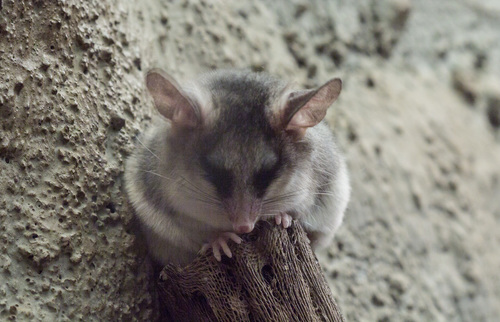
Thylamys
Thylamys is a genus of opossums in the family Didelphidae. The premaxillae are rounded rather than pointed. The females lack a pouch. The females' nipples are arranged in two symmetrical rows on the abdomen. All species but T. macrurus store fat in their tails, although this is not necessarily true for all species in the genus. Fossils belonging to the genus date back to the Miocene, with the oldest specimens being found in the Cerro Azul Formation of Argentina and the Honda Group of Colombia. Genetic studies indicate that the genus may have originated around 14 million years ago.

Toxodon
Toxodon (from Ancient Greek τόξον (tóxon), meaning "bow", and ὀδούς (odoús), meaning "tooth", in reference to the curvature of the teeth) is an extinct genus of large ungulate native to South America from the Pliocene to the end of the Late Pleistocene. Toxodon is a member of Notoungulata, an order of extinct South American native ungulates distinct from the two living ungulate orders that had been indigenous to the continent for over 60 million years since the early Cenozoic, prior to the arrival of living ungulates into South America around 2.5 million years ago during the Great American Int
.jpg)
Arctotherium
Arctotherium ("bear beast") is an extinct genus of short-faced bears endemic to Central and South America from the Late Pliocene to the end of the Late Pleistocene. Arctotherium migrated from North America to South America during the Great American Interchange, following the formation of the Isthmus of Panama during the late Pliocene.

Eremotherium
Eremotherium (from Greek for "steppe" or "desert" "beast": ἔρημος "steppe or desert" and θηρίον "beast") is an extinct genus of giant ground sloth in the family Megatheriidae. Eremotherium lived in southern North America, Central America, and northern South America. It was one of the largest sloths, with a body size comparable to elephants, weighing around and measuring about long, slightly larger than its close relative Megatherium.

Mylodon
Mylodon is an extinct genus of ground sloth belonging to the family Mylodontidae, known from southern South America. With a total length of 3 to 4 m and a body mass of 1-2 tonnes, it is one of the largest mylodontids (though it was considerably exceeded in size by the mylodontid Lestodon).

Thalassocnus
Thalassocnus is an extinct genus of semiaquatic ground sloths from the Miocene and Pliocene of the Pacific South American coast. It is monotypic within the subfamily Thalassocninae. The five species—T. antiquus, T. natans, T. littoralis, T. carolomartini, and T. yuacensis—represent a chronospecies, a population gradually adapting to marine life in one direct lineage. They are the only known aquatic sloths, but they may have also been adapted to a terrestrial lifestyle. They have been found in the Pisco Formation of Peru, the Tafna Formation of Argentina, and the Bahía Inglesa, Coquimbo, and Ho

Cuvieronius
Cuvieronius is an extinct New World genus of gomphothere which ranged from southern North America to northwestern South America during the Pleistocene epoch. Reaching a shoulder height of and a body mass of , it was comparable in size to an Asian elephant. Cuvieronius inhabited subtropical and tropical latitudes in environments ranging from grasslands to tropical rainforest. Among the last gomphotheres along with the South American Notiomastodon, it became extinct as part of the end Pleistocene-extinction event, approximately 12-11,000 years ago, along with most other large mammals in the Amer

Doedicurus
Doedicurus, from Ancient Greek δοῖδυξ (doîdux), meaning "pestle" and oυρά (ourá), meaning "tail", is an extinct genus of glyptodont from South America containing one species, D. clavicaudatus. Glyptodonts are a member of the family Chlamyphoridae, which also includes some modern armadillo species, and they are classified in the superorder Xenarthra alongside sloths and anteaters. Being a glyptodont, it was a rotund animal with heavy armor and a carapace. Averaging at an approximate , it was one of the largest glyptodonts to have ever lived. Though glyptodonts were quadrupeds, large ones like D

Hippidion
Hippidion (meaning "little horse" in Ancient Greek) is an extinct genus of equine that lived in South America from the Late Pliocene to the end of the Late Pleistocene (Lujanian), between 2.5 million and 11,000 years ago. Hippidion arrived in South America along with many other animals of North American origin as part of the Great American Interchange. They were one of two lineages of equines native to South America during the Pleistocene epoch, alongside Equus (Amerhippus) neogeus. Hippidion ranged widely over South America, extending to the far south of Patagonia. Hippidion differs from livi

Chapalmalania
Chapalmalania is an extinct genus of procyonid from the Late Miocene or Early Pliocene to Early Pleistocene (Montehermosan to Uquian) of Argentina (Andalhualá Formation), Venezuela (San Gregorio Formation, Venezuela), and Colombia (Ware Formation, Cocinetas Basin, La Guajira).

Platygonus
Platygonus ("flat head" in reference to the straight shape of the forehead) is an extinct genus of herbivorous peccaries of the family Tayassuidae, endemic to North and South America from the Miocene through Pleistocene epochs (10.3 million to 11,000 years ago), existing for about . P. compressus stood tall.

Holmesina
Holmesina is an extinct genus of pampathere, a group of armadillo-like xenarthrans that were distantly related to extant armadillos. Like armadillos, and unlike the other extinct branch of megafaunal cingulates the glyptodonts, the shell was made up of flexible plates which allowed the animal to move more easily.
thumb|left|Holmesina occidentalis
thumb|left|Life reconstruction of Holmesina floridanus and size comparation
Holmesina individuals were much larger than any modern armadillo: They could reach a length of , and a weight of , while the modern giant armadillo does not attain more than
Desmodus draculae
species of mammal

Glossotherium
Glossotherium is an extinct genus of large mylodontid ground sloths of the subfamily Mylodontinae. It represents one of the best-known members of the family, along with Mylodon and Paramylodon. Reconstructed animals were between long and possibly weighed up to 1,002.6–1,500 kg. The majority of finds of Glossotherium date from the Middle and Upper Pleistocene, around 300,000 to 10,000 years ago, with a few dating older, as far back Pliocene, about 3.3-3 million years ago. The range included large parts of South America, east of the Andes roughly from latitude 20 to 40 degrees south, leavin

Mixotoxodon
Mixotoxodon ("mixture Toxodon") is an extinct genus of notoungulate of the family Toxodontidae inhabiting South America, Central America and parts of southern North America during the Pleistocene epoch, from 1,800,000–12,000 years ago.
Hemiauchenia
Hemiauchenia is an extinct genus of lamine camelids that evolved in North America in the Miocene epoch about 10 million years ago. This genus diversified and entered South America in the Late Pliocene about three to two million years ago, as part of the Great American Biotic Interchange. The genus became extinct at the end of the Pleistocene. The monophyly of the genus has been considered questionable, with phylogenetic analyses finding the genus to paraphyletic or polyphyletic, with some species suggested to be more closely related to living lamines (llamas and relatives) than to other Hemiau
Panochthus
Panochthus is an extinct genus of glyptodont, which lived in the Gran Chaco-Pampean region of Argentina (Lujan, Yupoí and Agua Blanca Formations), Brazil (Jandaíra Formation), Bolivia (Tarija and Ñuapua Formations), Paraguay and Uruguay (Sopas and Dolores Formations) during the Pleistocene epoch. The first specimen of Panochthus consisted of two carapace (shell) fragments, now lost, recovered from Buenos Aires. In 1845, the fragments were referred by Sir Richard Owen to the genus Glyptodon. In 1864, working from more complete remains, Karl Hermann Konrad Burmeister erected Panochthus as a subg
Antifer
Antifer is an extinct genus of large herbivorous deer belonging to the tribe Odocoileini native to South America during the Pleistocene, becoming extinct around 12,000 years ago. It was one of the largest South American deer genera, with an estimated body mass of up to , comparable to red deer, considerably exceeding the marsh deer, the largest living South American deer species in size. The genus has large antlers that could reach a length of over .
Catonyx
Catonyx is an extinct genus of ground sloth of the family Scelidotheriidae, endemic to South America during the Pliocene and Pleistocene epochs. It lived from 2.5 Ma to about 10,000 years ago, existing for approximately . The most recent date obtained is about 9600 B.P.
Dusicyon cultridens
species of mammal
Thylophorops
Thylophorops is an extinct genus of didelphine opossums from the Pliocene of South America. Compared to their close didelphine cousins like the living Philander and Didelphis (and like the still living Lutreolina) opossums, Thylophorops displays specialization towards carnivory, and one species, T. lorenzinii, is the largest known opossum of all time, which could imply a macropredatory role.
Neolicaphrium
Neolicaphrium is an extinct genus of ungulate mammal belonging to the extinct order Litopterna. This animal lived from the Late Pliocene (Chapadmalalan) to the Late Pleistocene (Lujanian) in southern South America, being the last survivor of the family Proterotheriidae.
Nothrotherium
Nothrotherium is an extinct genus of medium-sized ground sloth from South America (Bolivia, Brazil and the Ware Formation, La Guajira, Colombia). It differs from Nothrotheriops in smaller size and differences in skull and hind leg bones.
Caiman venezuelensis
species of reptile (fossil)
Plaxhaplous
Plaxhaplous was a dubious genus of glyptodont, an extinct relative of the modern armadillo. It lived in the Pleistocene epoch. The type species is Plaxhaplous canaliculatus. Plaxhaplous canaliculatus fossils were found in Argentina, near Luján in Buenos Aires Province. Plaxhaplous fossils have also been found in Uruguay. and in the Charana Formation of Bolivia.
Promacrauchenia
Promacrauchenia is an extinct genus of macraucheniids that lived during the Late Miocene to Late Pliocene epochs of what is now Argentina and Bolivia. It belongs to the subfamily Macraucheniinae, which also includes Huayqueriana, Macrauchenia, and Xenorhinotherium. Fossils of this genus have been found in the Ituzaingó, Andalhuala, and Cerro Azul Formations of Argentina.